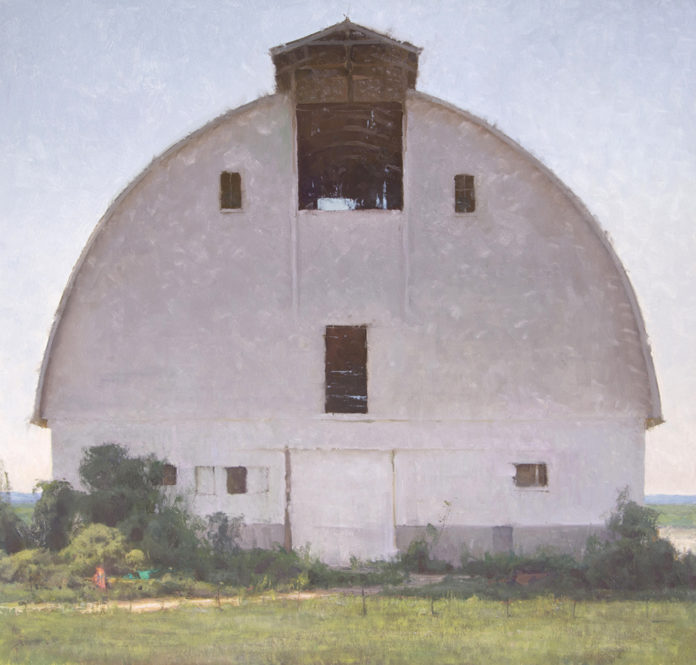
The Old Grey
48 x 48 in.
oil
$16,200
Available through Astoria Fine Art in Jackson, Wyoming
Born in 1982, Joshua grew up drawing and was rarely without a pencil and paper, but it wasn’t until he began studying art at BYU-Idaho that he began painting. That first oil painting class included a trip to the galleries in Jackson Hole (his first visit to an art gallery or museum) and completely changed the course of his life. Since graduating with a BFA in illustration from BYU-Idaho in 2007 Josh has been supporting himself and his family with art — and he thanks God every day for that remarkable blessing. He figures that if he can paint all day, every day, for the next 20 years, eventually he’ll paint something pretty decent.
Josh has earned numerous awards along the way including artists choice at the 2012 Laguna Plein Air Invitational and 2nd place in the Raymar 6th Annual Painting Competition. Early in 2014 Josh was featured for three consecutive months in several of the nation’s finest art magazines: Western Art and Architecture, Southwest Art, and Art of the West. He lives with his drop-dead gorgeous wife and four ridiculously cute children in Cache Valley, UT.
Harvey Dunn, a golden age illustrator, taught his students that they should thank God every day for “the privilege of seeing the sun cast shadows.” Josh does just that.
“The Old Grey is a portrait of a barn located here in Cache Valley, UT where I live,” says Josh. “These old barns have a spirit about them that I love; I consider many of them sacred spaces. Painting them is my way of capturing a bit of the hard work and the beauty of those who have gone before us — to whom we owe so much.”
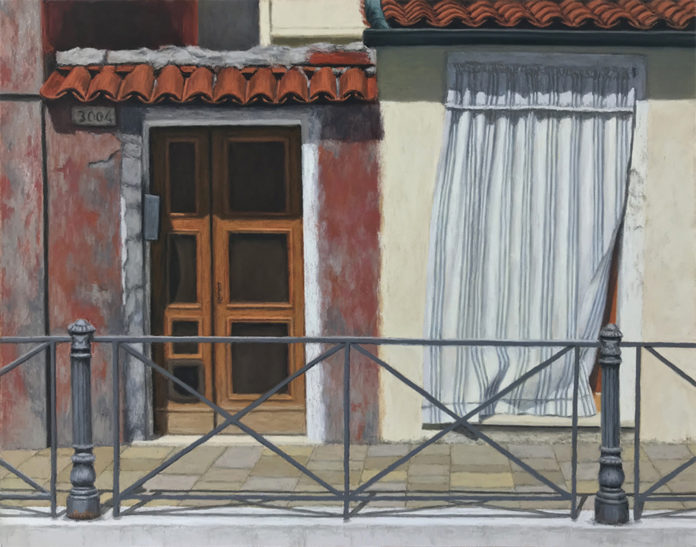
“This facade caught my eye, reflecting what appears to be a quiet existence in a very old neighborhood in Venice, Italy. These two separate dwellings are closely connected, yet reveal very different characteristics of hard and soft elements, light and dark colors, and warm and cool tones, while coexisting next to each other…diverse yet connected.”
LISA CUNNINGHAM – CREATING A SENSE OF PLACE
A classically trained, representational artist with degrees in fine art and education, Lisa Cunningham finds inspiration through travel and the simple things that exist in everyday life. “Much of my current work focuses on buildings in the landscape; places we see and experience every day. Although sometimes taken for granted, architecture in our environment, throughout our cities and rural landscapes, incorporates history, culture, and purpose for each of us.
“Through an intimate and up-close perspective, my paintings allow the viewer an opportunity to identify with or reflect upon a moment in time; of places familiar, or that no longer exist.”
Using soft pastels and layering techniques, Lisa’s compositions are representational yet painterly, allowing the dramatic play of light and shadow to reveal the character behind the subject matter. “Vibrant, sometimes exaggerated color is also common in my work, which lends credibility to the magic of the pastel medium, as I see it.”
Lisa is a signature member of the Pastel Society of America. Her award-winning painting, Diversity, was juried into the Pastel Society of America’s 47th Annual Exhibition, and was then selected for an exhibition at the Butler Institute of American Art in Youngstown, Ohio.
She is also a Signature Member of the Pastel Society of New Jersey, a member of American Women Artists, the Salmagundi Club, the Catherine Lorillard Wolfe Art Club, and the American Artists Professional League.
Gallery Representation
Cooper & Smith Gallery, Essex, CT
Patricia Hutton Galleries, Doylestown, PA
See more of Lisa’s work on her website.
Stay connected with Lisa and subscribe to her newsletter.
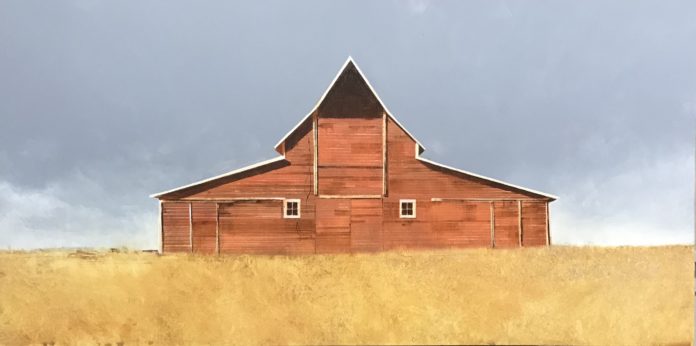
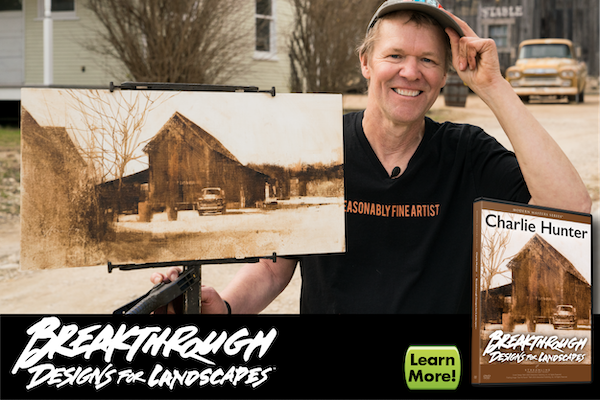
Charlie Hunter, "Montana Song II," October 2020, oil on canvas, 24 x 48 in.
“My goal is to paint beautifully that which is not traditionally considered beautiful.” ~ Charlie Hunter (hunter-studio.com)
In this spotlight, Hunter shares three of his recent works, taking us behind the scenes.
3 New Paintings by Charlie Hunter
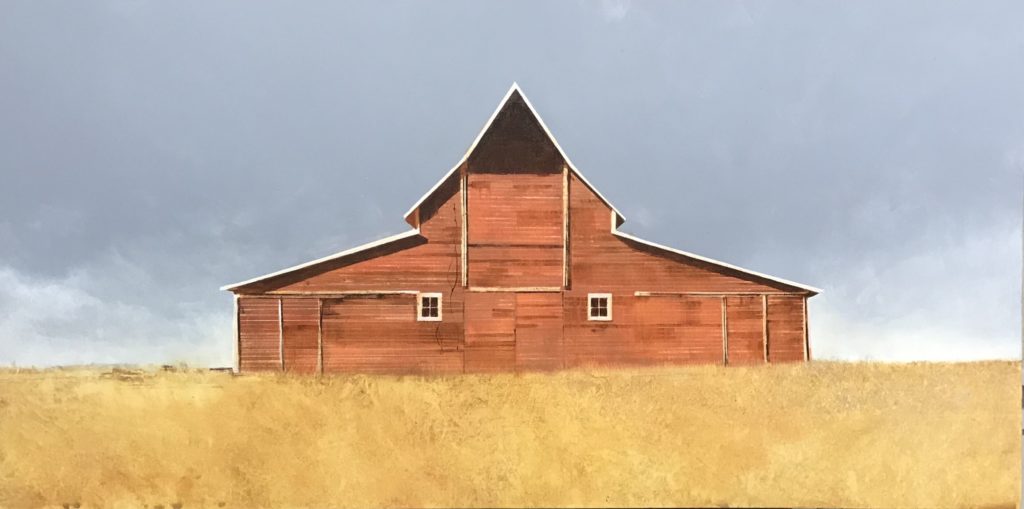
Charlie Hunter, “Montana Song II,” October 2020, oil on canvas, 24 x 48 in., Courtesy of Old Main Gallery, Bozeman, Montana
1. “Montana Song II”
I am enamored of vernacular architecture, and when I was offered the chance to do some paintings of Western barns, I leapt at the chance. “Montana Song II” was based on a photograph by Liselle Moburg (Abandoned Montana – Until They All Fall Down), who was kind enough to let me work from it.
I like to approach paintings like this as portraits – no tricky angles or razzle-dazzle; just a dead-on staring match between viewer and subject.
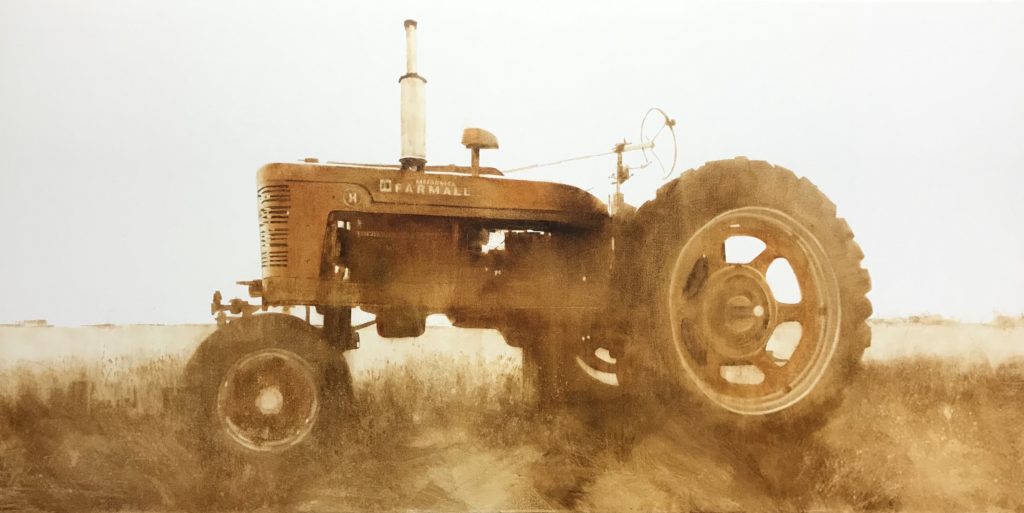
Charlie Hunter, “October Farmall,” October 2020, oil on canvas, 24 x 48 in., Courtesy of Old Main Gallery, Bozeman, Montana
2. “October Farmall”
I know, I know. The John Deere is the tractor with the biggest fan base. So sue me; I’m a Farmall guy. What can I say? For one, my uncle was an International Harvester salesman. For another, Farmall tin has the slightest hint of streamline moderne – the styling of legendary industrial designer Raymond Loewy – to break up the resolutely practical purposes to which they were built. And thirdly, there are STILL a bunch of gritty, greasy, gorgeous Farmalls, some nearly eighty years old, toiling away out there.
As someone from New England, where fields can be pretty hilly, I’m not a real fan of a row-crop front end as a practical matter; but aesthetically, I love ’em.
In terms of painting “October Farmall,” what I was trying to do was to leave out as much detail as I could whilst making it look like I was putting in oodles of the stuff.
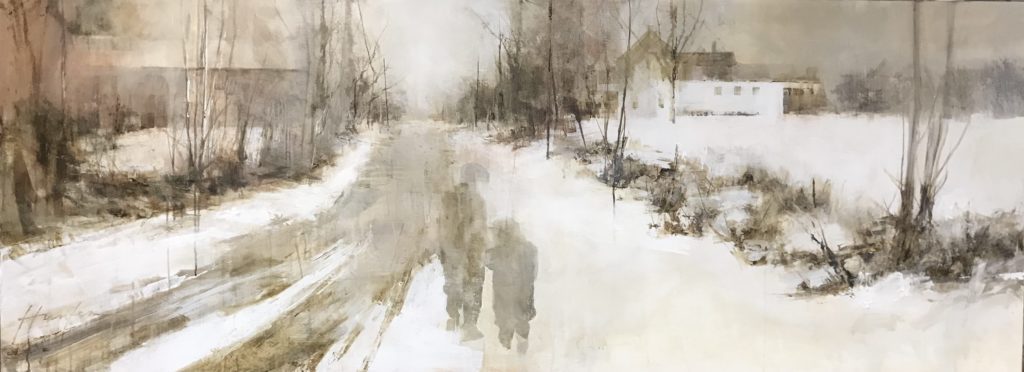
Charlie Hunter, “Emerson Road,” November 2020, oil on muslin, 28 x 80 in.
3. “Emerson Road”
The source material for “Emerson Road” is a photo from a book my mom wrote, called “The William and Charles Museum.” The plot is basically that my brother collected lots of stuff, and called it a museum (today we would call that “hoarding”) and I, as an infant, went along with it.
This is a picture of my brother and his little friend Catherine, down by the skating pond, with our barns (on the left) and our farmhouse (on the right). It was a great place to be a kid, until the State of New Hampshire put a highway bypass in that demolished the barns and we moved back to the family homestead in Vermont, where my Great Aunt Mary put the kibosh on any unproductive fooling around. Ah well – tempus fugit.
In terms of the painting itself, this is on muslin, mounted on a hollow core door, an idea given to me by the great Utah painter Doug Fryer. I love painting on muslin for my plein air work, where generally the largest size I’ll do is 12 x 24 inches, and the grain of the muslin is perfect for my reductive-tonalist technique (if you can call it that). When working this big, the tooth of the muslin is maybe a bit fine for the more painterly passages; I’m in the middle of prepping another hollow-core door now – this time I’m using a medium-weave canvas.
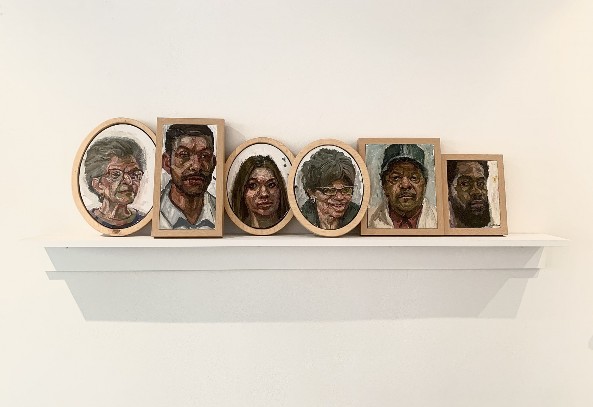
Sedrick Huckaby, "Study of the Huckabys," 2020, oil on canvas, 14h x 48w in
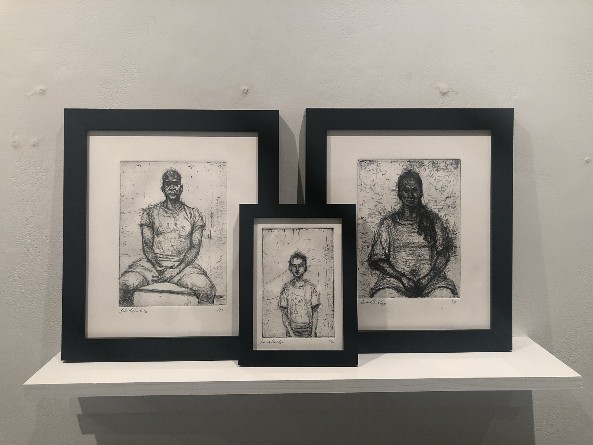
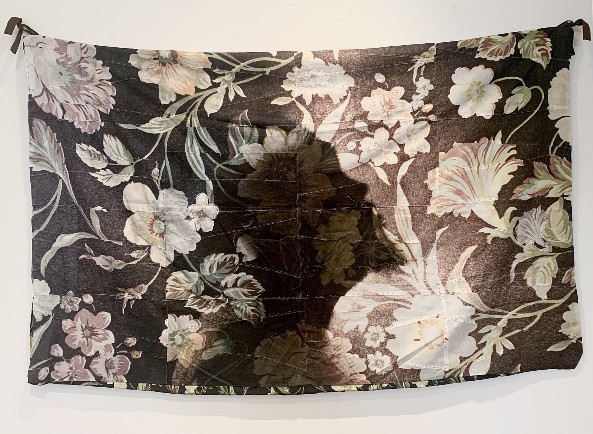
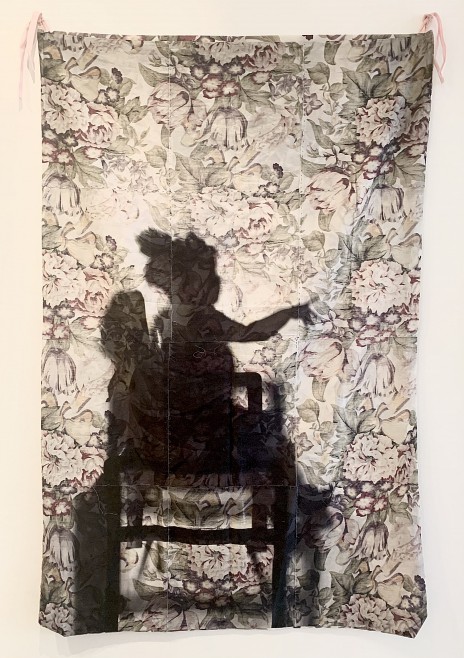
Steven Harvey Fine Art Projects (New York) is presenting “Faith Family Legacy,” a two-person exhibition of Letitia and Sedrick Huckaby. Letitia shows photographic images printed on fabric and Sedrick shows painted portraits installed together in groups along with etchings. Letitia and Sedrick are married and both embrace a social dimension in their work. This is Sedrick’s second exhibition at the gallery, the first being ”99%” in 2017.
Holland Cotter wrote in the NY Times about Sedrick’s 2017 exhibition at SHFAP:
His small oil-on-canvas head-shot paintings of family members are as texturally dense and detail-specific as ancient Egyptian Fayum portraits. In his dozens of lithographic likenesses of hometown friends — he likened the series to a patchwork quilt — the sitters, accompanied by conversational quotations, look casually but distinctly regal. Symbolism enters the work in a paint-caked sculptural tableau about the plague of black incarceration, but politics is really there throughout the exhibition, which feels like a completely realized act of civic and familial devotion.
Sedrick Huckaby, “The Bridges,” 2020, oil pastel on paper, 14 1/2h x 24w in
For Sedrick Huckaby, the African American family and its heritage has been the content of his work for several years. “In large scale portraits of family and friends I try to aggrandize ordinary people by painting them on a monumental scale.”
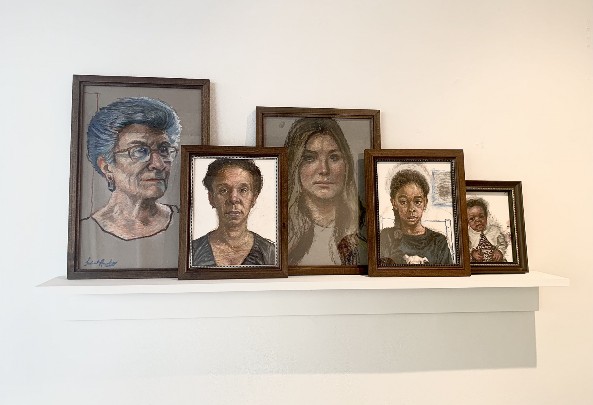
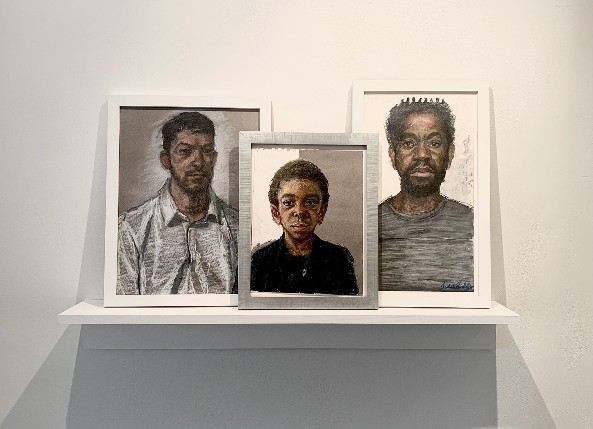
In the current exhibition he shows small-scale figure groups installed on shelves. Two of the groups involve a juxtaposition of two families who share the name Huckaby, one of Scottish origin along with Sedrick and Leticia’s African American family.
This intermingled juxtaposition of black and white was a core element of the couple’s monumental community mural “End Racism Now” painted on the streets of Fort Worth in summer of 2020.
Sedrick Huckaby, “The Huckaby Ladies,” 2019, oil pastel on paper, 20h x 45w in.
Sedrick Huckaby was born in 1975 in Fort Worth, Texas. His formal education in art started at Texas Wesleyan University in Fort Worth, where he studied with two excellent painters: Ron Tomlinson and Jack Barnett. He then transferred to Boston University and received his BFA in1997. At Boston, he received extensive academic training in studio art. For graduate studies, Sedrick went to Yale University in New Haven, Connecticut, graduating with an MFA in 1999. There he immersed himself in the notion that “art is about ideas.” He expanded his conceptual horizons in art and art history. After graduating with his MFA, Huckaby used a traveling grant he received from Yale to explore France, Italy, and Spain for two years. It was during this time in Europe that Sedrick said he came to “appreciate the Old Masters,” understanding the difference in the social conditions of art production between the present and the past. After his European residency, Huckaby settled back in his home town of Fort Worth, Texas where he has continued to make art until the present day.
Sedrick Huckaby, “Huckaby Gentlemen,” 2019, oil pastel on paper, 19 1/2h x 31w in
Sedrick Huckaby has been the recipient of numerous prestigious awards including a Guggenheim award, Joan Mitchell Foundation Grant, and a Lewis Comfort Tiffany Award. Most recently he was named the Texas State Artist for 2018. His works are in the collections of American Embassy in Namibia, San Francisco Museum of Modern Art, Amon Carter Museum of American Art, Fort Worth, Texas, African American Museum, Dallas, Texas; McNay Art Museum, San Antonio, Texas; Minneapolis Institute of Arts, Minneapolis, Minnesota; Museum of Fine Arts, Boston, Massachusetts; Nasher Museum of Art at Duke University, Durham, North Carolina; Whitney Museum of American Art, New York, New York; and the Tyler Museum of Art, Tyler, Texas. Sedrick is married to artist Letitia Huckaby and is the father of three children, Rising Sun Huckaby, Halle Lujah Huckaby, and Rhema Rain Huckaby.
Letitia Huckaby describes her work as a time capsule of the African American experience. “I am always looking at how the past relates to the present and whether or not things have changed or remain the same. There is always a history built into the pieces, whether through process or actual materials … I am a photographer at heart, each piece starts with an image and progresses from there. The images are printed on cotton fabrics, hand stitched together into traditional African American quilting patterns and finished as quilts, dresses, sacks, or framed quilt tops. I love pushing the boundaries of photography by using a traditional practice in an untraditional way and hopefully creating a new visual language.”
Letitia Huckaby, “Frederick,” 2012, pigment prints on fabric, 60h x 38 1/2w in
Letitia relates her history:
“After studying and earning degrees in both journalism and photography some of my first works were naturally photojournalistic. A voyeur documenting the lives of others, but with the loss of my father, I became interested in doing more personal work. For the first time I turned the camera on myself and my family. The results have been an exploration of my own family history and my African American heritage. Also the change in perspective has caused me to shift from the life of a photojournalist to a more impassioned contemporary artist interested in personal expression, history and culture.
“The basic premise behind my work is faith, family, and legacy. It is a time capsule for the African American experience. I often use heirloom fabrics, and I think that is why so many people can relate to my work.”
Letitia Huckaby obtained her Master’s degree from the University of North Texas in 2010. She exhibited as an emerging artist at the Dallas Contemporary, the Galveston Arts Center, Renaissance Fine Art in Harlem curated by Deborah Willis, PhD, the McKenna Museum in New Orleans, the Camden Palace Hotel in Cork City, Ireland, the Texas Biennial at Blue Star Contemporary Art Museum and the Anzenberger Gallery in Vienna, Austria. Her work is included in several prestigious collections; the Library of Congress, the Art Museum of Southeast Texas, the Brandywine Workshop in Philadelphia, and the Samella Lewis Contemporary Art Collection at Scripps College in Claremont, California. Letitia has participated in the Brandywine residency and a residency in Gee’s Bend Alabama with the Gee’s Bend quilters. Letitia Huckaby resides in Benbrook, TX with her husband, Sedrick Huckaby, and their three children.
Letitia Huckaby, “A’Riyah,” 2012, pigment prints on fabric, 32 1/2h x 52w in
The exhibition continues through December 12, 2020. For more details about “Faith Family Legacy,” please visit shfap.com.
Artists Sunday is a promotional effort on the part of artists, galleries, and art organizations around the country to encourage consumers to shop for the gift of art this holiday season. In our endeavor to help keep arts thriving during the pandemic, we’re proud to bring you this “Virtual Gallery Walk.”
Browse the paintings below and click any image to learn more about the painting, including how to contact the gallery.
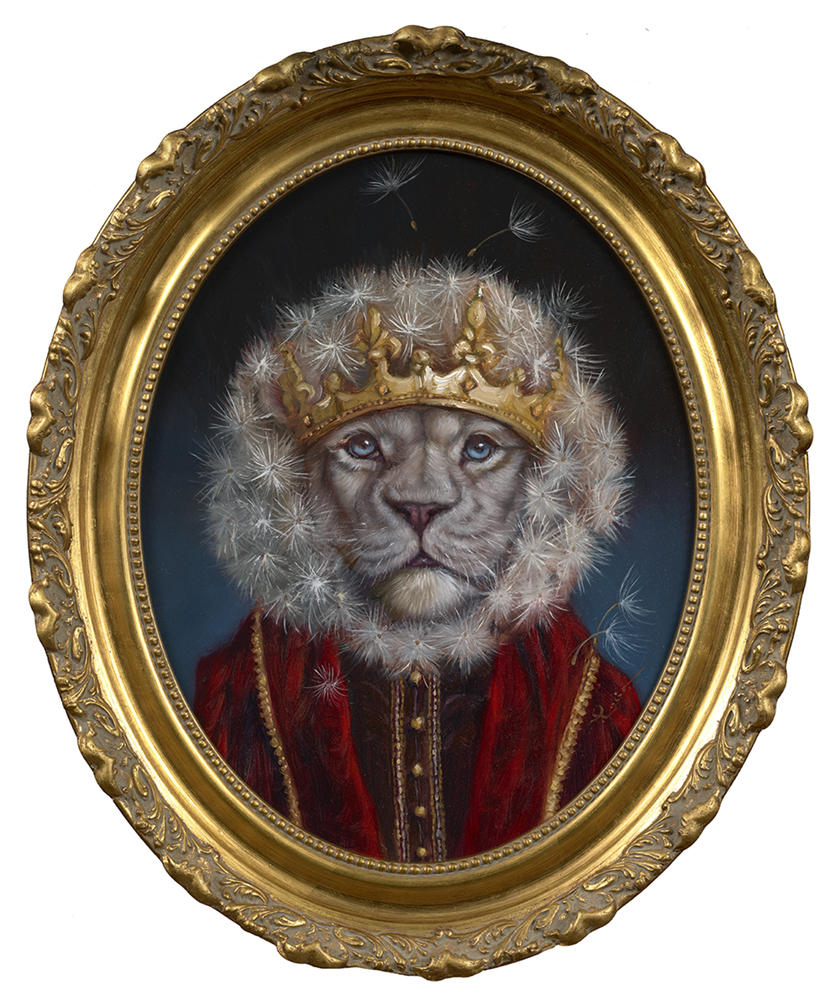
Dandelion King by Lucia Heffernan (Born 1966), Oil on panel, 14 x 11 in., signed; Rehs Contemporary
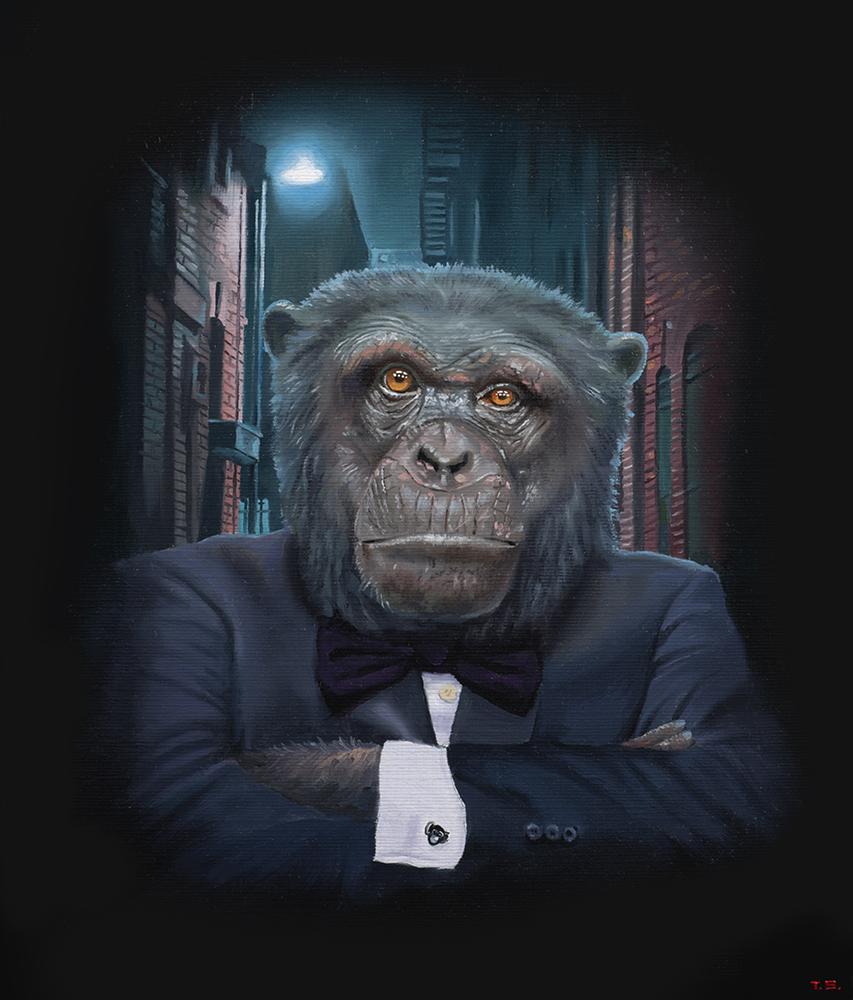
If Your Names Not Down by Tony South (Born 1964), Oil on board, 9 x 7.75 in., signed; Rehs Contemporary
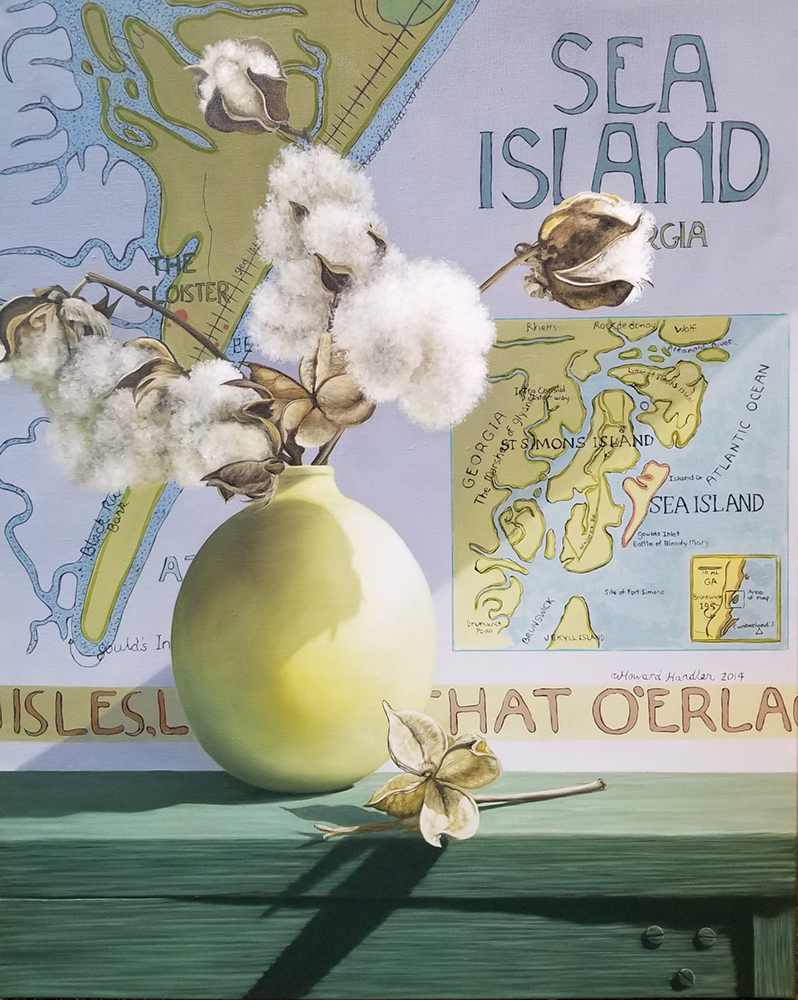
Sea Island Cotton by Loren DiBenedetto, oil, 30 x 24 in.; Anderson Fine Art Gallery
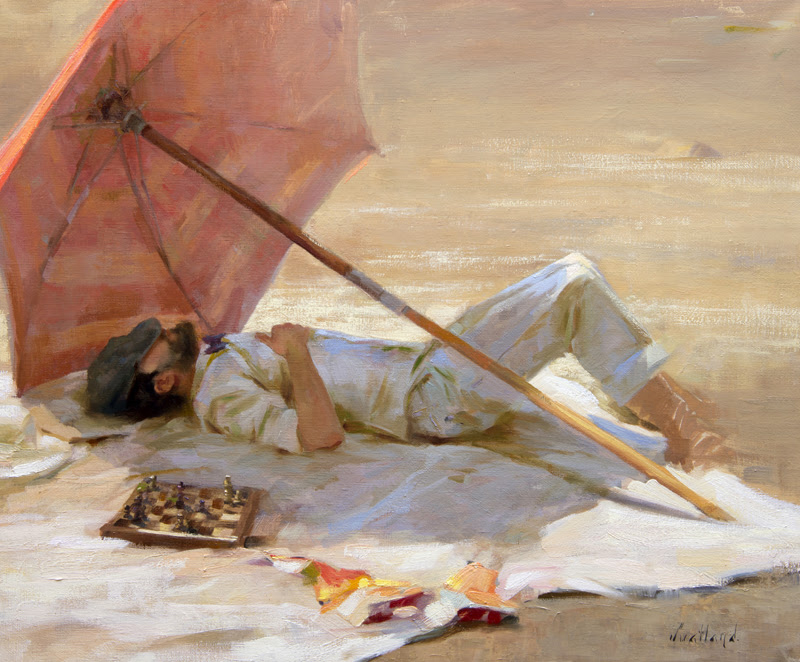
Summer by Katie Swatland, Archival Giclée, 14 x 18 in.; Ceres Gallery
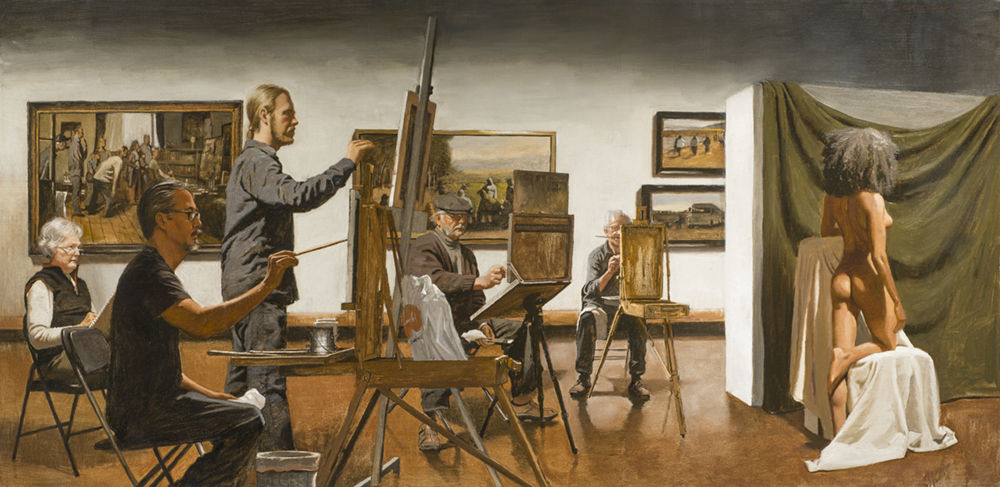
Gill Gallery by Warren Chang (b. 1957), oil on canvas, 28 x 57 in., 2015; Art Ventures Gallery
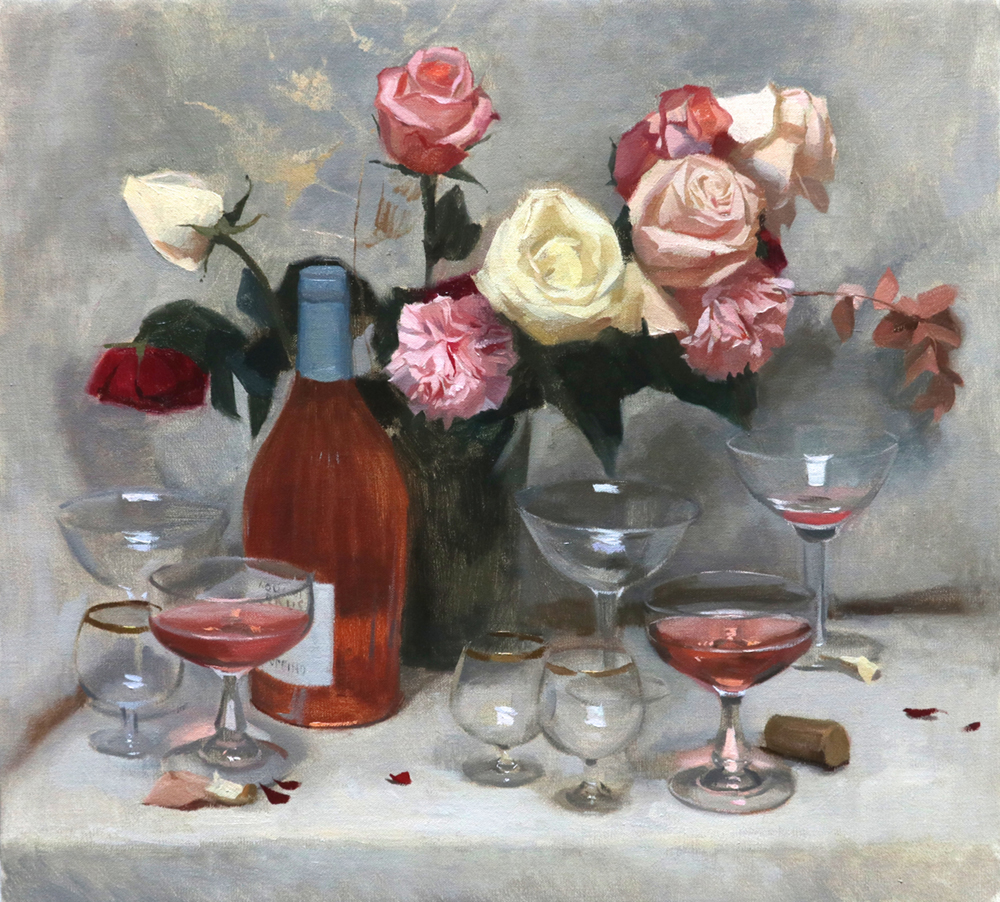
Rosé and Roses by Tanvi Pathare, Original oil on linen, 19.70 x 21.70 in.; Hagan Fine Art
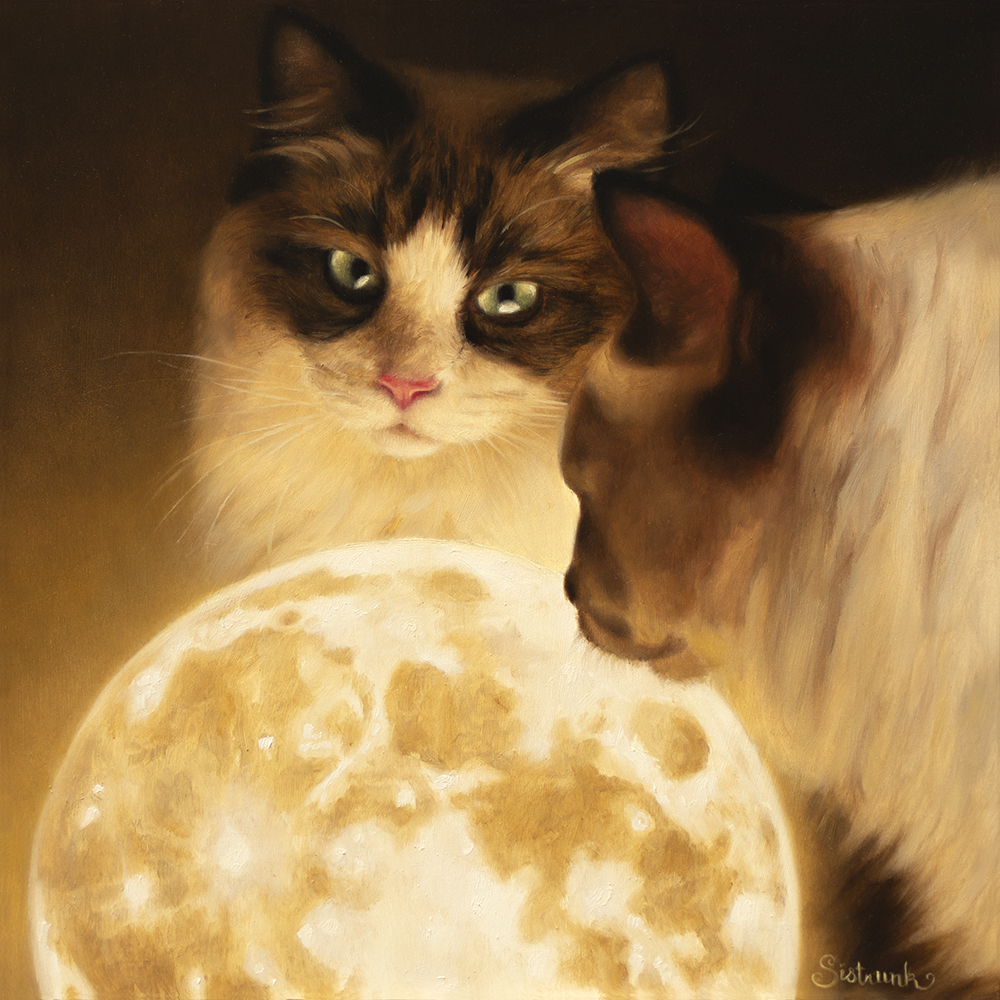
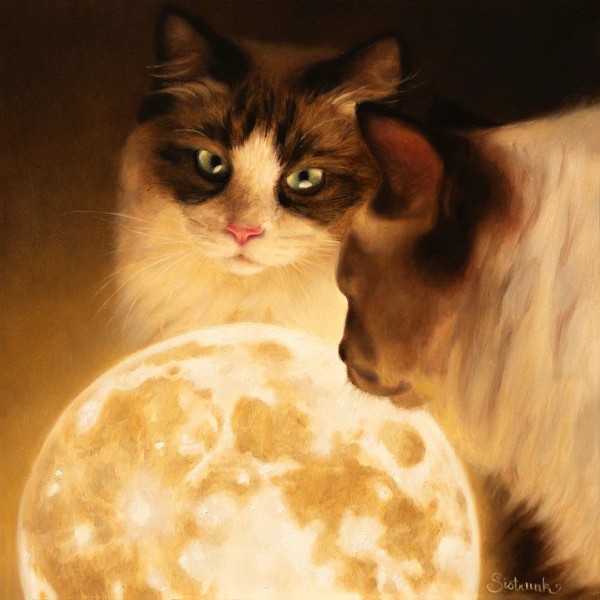
Conjuring by Beth Sistrunk (Born 1978), Oil on panel, 8 x 8 in., signed; Rehs Contemporary
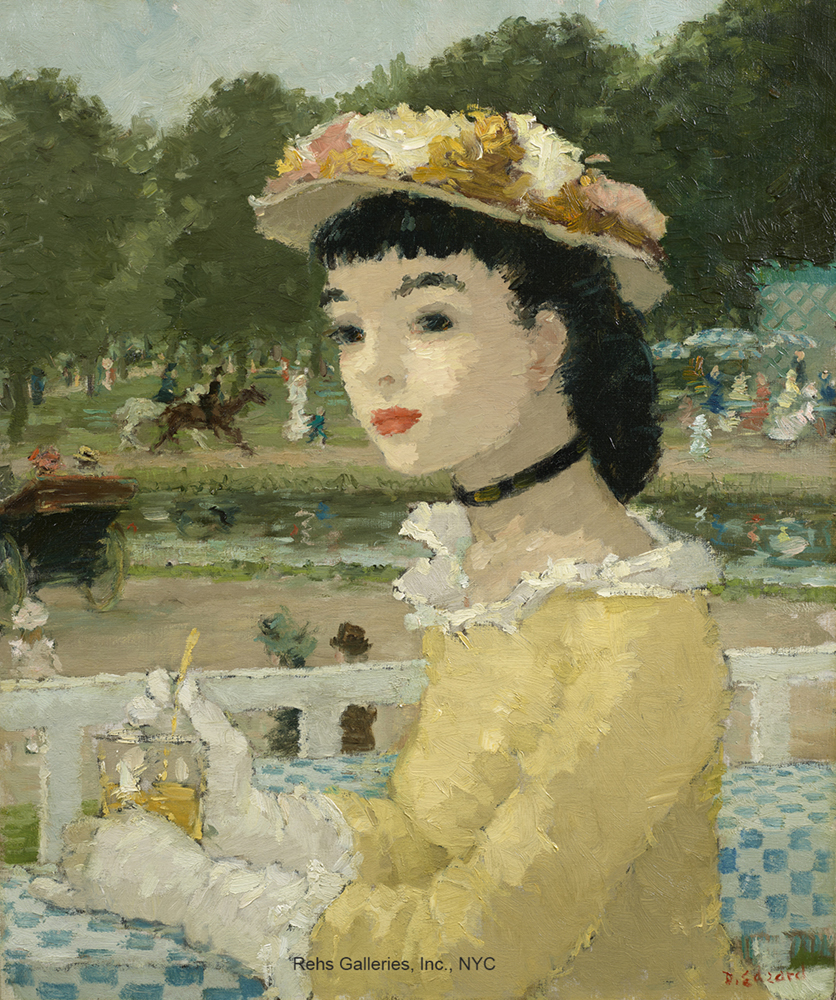
Femme sur une Terrasse by Dietz Edzard (1893 – 1963), Oil on canvas, 21.5 x 18.125 in., signed; Rehs Galleries, Inc.
Want to see your gallery featured in an upcoming Virtual Gallery Walk? Contact us at [email protected] to advertise today – don’t delay, as spaces are first-come first-serve and availability is limited.
The Northwest Watercolor Society (NWWS) 80th Annual International Open Exhibition is live now through February 1, 2021 at www.nwws.org.
Internationally known juror Ron Stocke awarded first place of $2,000 cash to Dongfeng Li for his painting, “A Breath of Fresh Air.”
“He paints with a brush in one hand and a foam roller in the other,” Stocke said of Li, “and he builds up these lovely formed paintings. Just master class.” Li was born and raised in China but moved to the U.S. in 1992 and is an associate professor of art at Morehead State University in Kentucky.
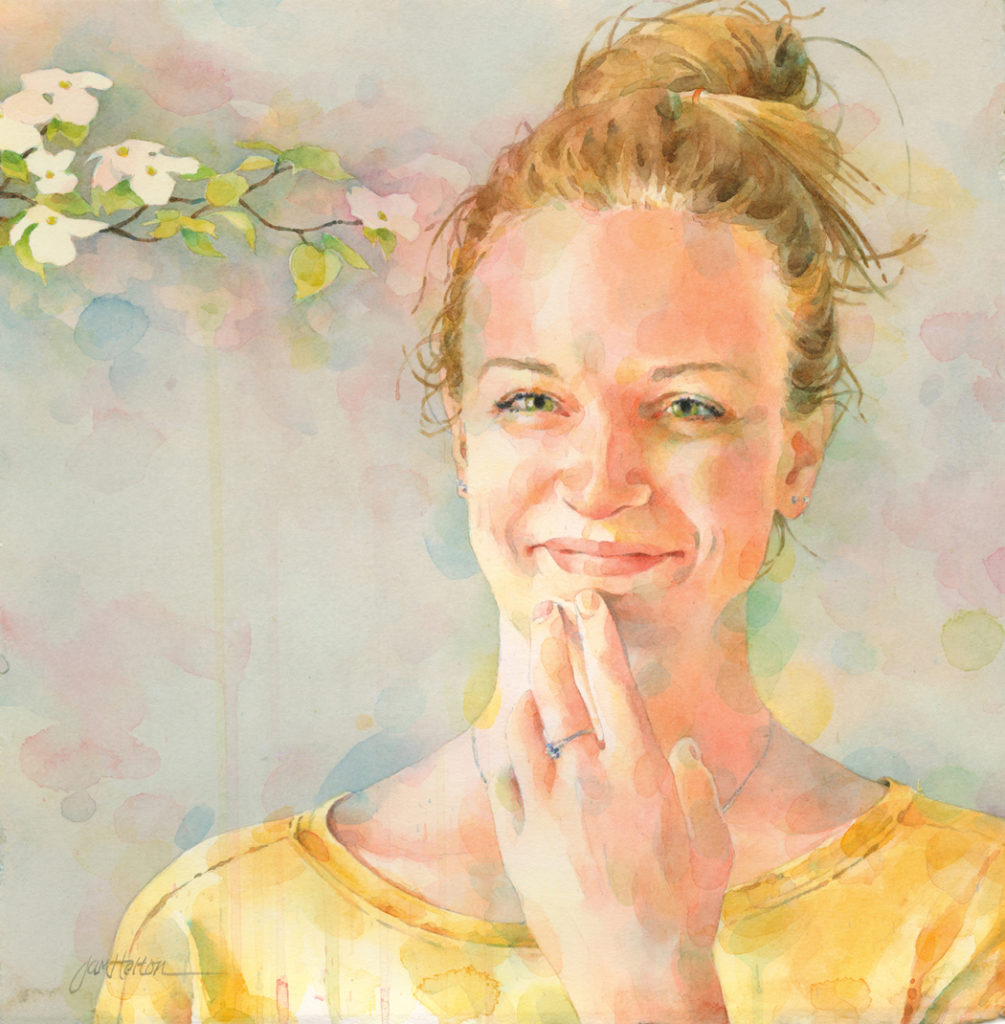
Second place of $1,300 went to Janine Helton of St. Charles, Missouri for her painting, “Bubbly.” At the virtual awards reception October 30th, Stocke said, “There’s one thing about portraits I particularly look at – does the painting capture the personality and soul of that person.” Stocke went on to say he didn’t know the person in “Bubbly” but felt like he does now “simply by looking at Janine’s painting.”
Janine Helton, “Bubbly,” watercolor
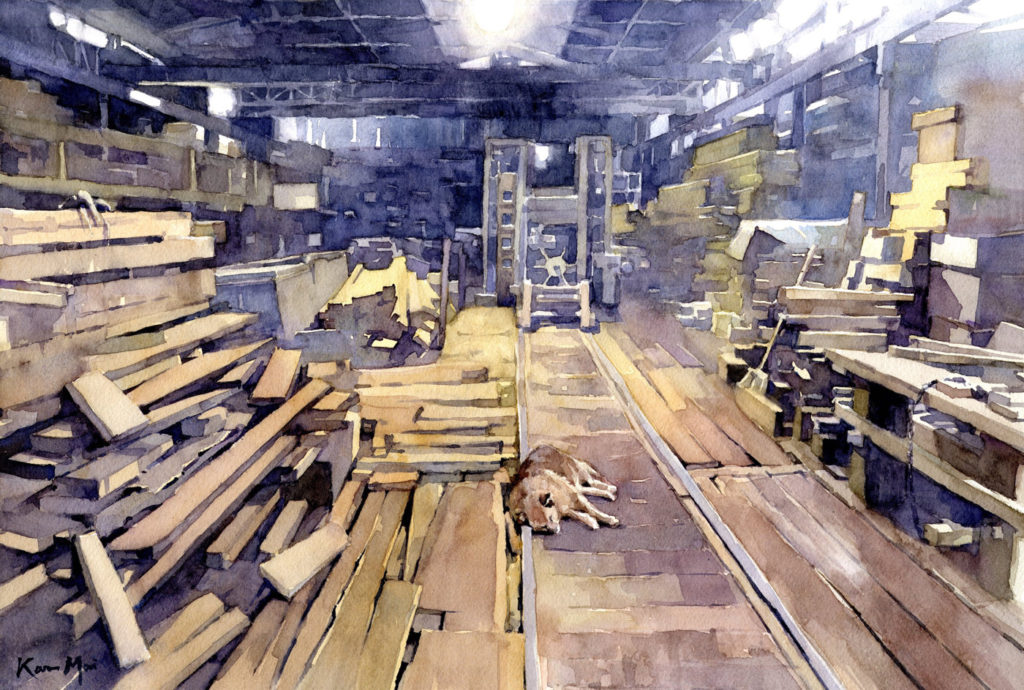
Karen Mai, based in Hong Kong, received $800 for her 3rd place award of “Nap at the Sawmill.”
“This is what watercolor is all about,” Stocke said. “The values, the shapes, the lines, the perspective, the composition – everything about this painting is working.”
Karen Mai, “Nap at the Sawmill,” watercolor
NWWS congratulates these top three winners along with 12 other winners in the exhibition. Ron Stocke had his work cut out for him to narrow 674 entries from 38 states and 12 countries, down to 75 paintings.
To hear Ron Stocke’s own words on why he chose each watermedia painting and to see the exhibition please go to www.nwws.org.
Beth Sistrunk, "Conjuring," oil on panel, 8 x 8 in.
This holiday season, New York based gallery Rehs Contemporary will present a selection of more than 50 small works as part of their exhibition, “Not A Creature Was Stirring,” highlighting furry friends and critters.
From the gallery:
The five participating artists include Stuart Dunkel, Tony South, Beth Sistrunk, Lucia Heffernan, and Kelly Houghton. While each artist has their own unique flair, all of these whimsical works are sure to brighten your day and bring some joy to your holiday celebration.
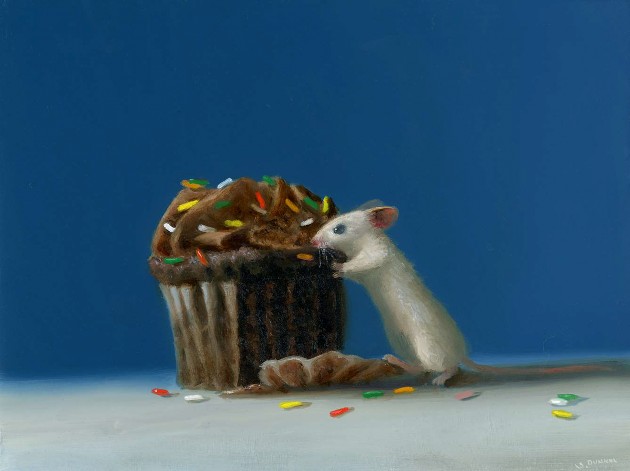
Stuart Dunkel, who is said to have completed more than 3,000 paintings in his career, will have a fresh set of works featuring his well-known muse, Chuckie the mouse. Among the bunch will be some of the classic subjects, like “Big Reach,” where Chuckie is stealing Oreos… or “Cupcake Caper,” which is rather self-explanatory.
Dunkel also got festive with a few pieces such as “The Gambler,” with Chuckie spinning a dreidel, and “Self Portrait,” where the little mouse catches his reflection in a shiny Christmas tree ornament. While the works are rather simple and straightforward, Dunkel has this unique ability to connect with his viewers, oftentimes making someone feel as if the work was made just for them.
Stuart Dunkel, “Cupcake Caper,” oil on panel, 6 x 8 in.
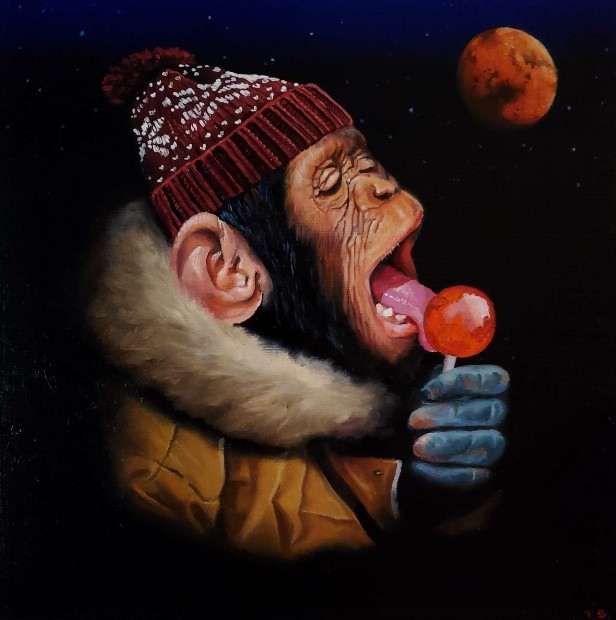
Tony South’s contribution is a new series of “head studies,” but they are not human heads. If you are familiar with South’s work, you would know he paints a preponderance of primates. With these small works, South notes he is able to explore and develop a multitude of characters.
In his 7 x 7 inch “Planets Aligned,” a young chimp is bundled up in his winter coat and hat, tongue out licking a spherical Lolli-pop with Mars in the distance, capturing a scene where these “celestial bodies” crossed paths for a brief moment.
Tony South, “Planets Aligned,” oil on paper, 7.5 x 7.5 in.
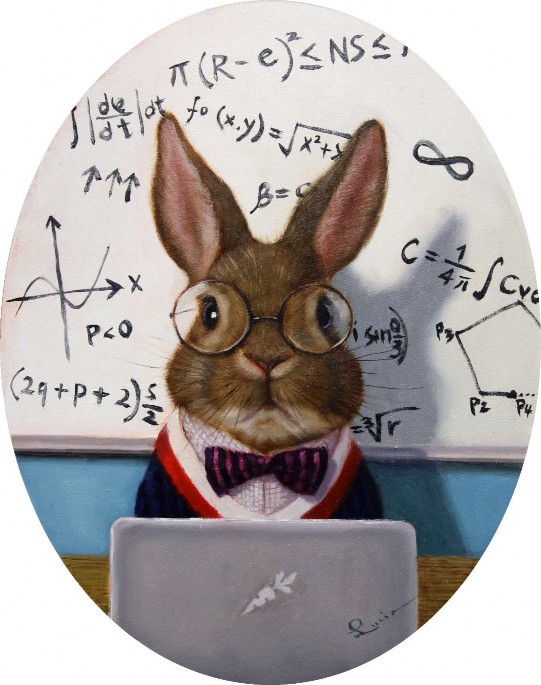
Kelly Houghton and Lucia Heffernan each paint an array of animals; Houghton’s cleverly titled 12×12’s instantly bring a smile to your face; her piece “So I Build,” with a determined beaver holding a new found stick, set before a community of homes in the distance; or “Shape Shifter” showing a fox mid-sprint as the background becomes a blur. Heffernan more so develops characters and narratives for her subjects, such as “Day Off,” where a chick is pampering herself, or “Distance Learning,” portraying a very studious young rabbit.
By bringing a voice to these creatures, the works become far more relatable as we see elements of ourselves, family or friends reflected in the works.
Lucia Heffernan, “Distance Learning,” oil on panel, 14 x 11 in.
Beth Sistrunk completes the quintet with a few felines: works like “Cool Cat,” with a ragdoll peering over the top of her heart-shaped sunglasses, and “Conjuring,” depicting two cats hunched over a glowing orb, truly capture the lively and mischievous essence of these kitties in a humorous and playful way.
The extensive and diverse exhibition is an animal lover’s delight. For more details, please visit https://www.rehscgi.com.
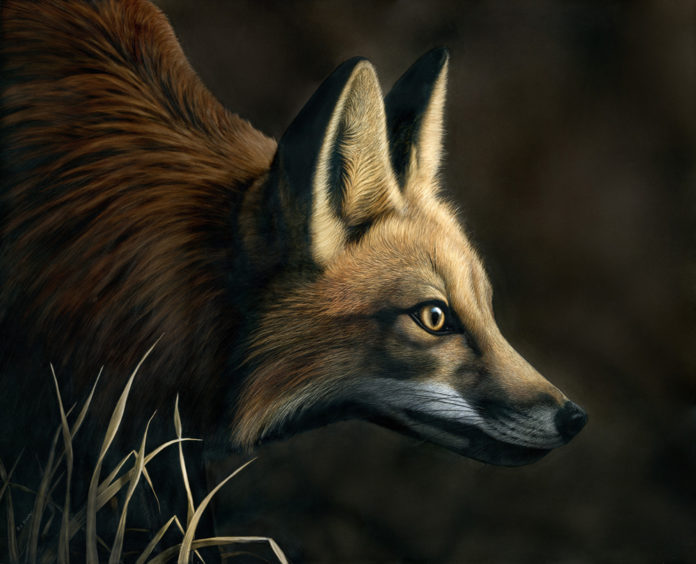
Sly by Cathy Sheeter
16 x 20 in.
Scratchboard
$4,000
Cathy Sheeter is one of a handful of Master Scratchboard Artists worldwide, as recognized by the International Society of Scratchboard Artists. She is an award-winning artist and signature member of the Society of Animal Artists. Her works can be found in private, corporate and museum collections worldwide.
“With each artwork I hope to bring the viewer into the lives of the animals I create and share the sense of wonder that they excite within me. I choose scratchboard as my medium for the amazing details and life-like realism I can create, and the unique drama as the animal emerges and comes to life before my eyes!”
You can find Cathy and her work, along with 100 other artists, at the Celebration of Fine Art in Scottsdale, Arizona, January 16–March 28, 2021. Contact us at 480-443-7695 or [email protected].
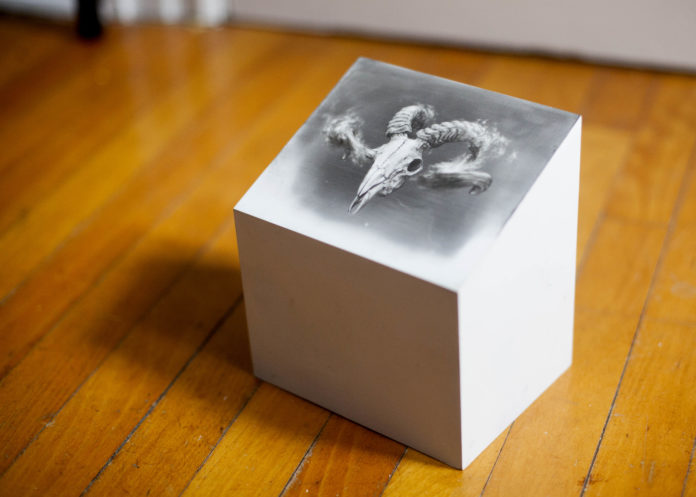
David Bonagurio, “Solid as Bone,” 2017, powdered graphite on inclined pedestal, 5 x 6 inches
Fine Art Today caught up with ascending artist David Bonagurio for a chat about his drawings, inspirations, vision, and so much more.
Fine Art Today: We’ll start generically: Tell us a little about your creative process. What inspires you, and once it hits, how do you approach the page? Do you always start a piece the same way, even if the sources of inspiration are different? How do you know when a piece is completed — is it that sense of fulfillment or that a particular experience/idea is re-achieved?
David Bonagurio: Generically, it begins with curiosity. I’ll come across something interesting, and if it sticks with me long enough, it will pull me down several different rabbit holes of “hows” and “whys.” I’ve never been a person able to let something drop after the first explanation. I have to build a conceptual understanding that I can find personally satisfying or I’ll lose sleep. My work helps me to do that.
And, yes, that is typically how it happens regardless of the source of inspiration. My imagery comes from a kind of edited stream-of-consciousness consideration of the concept. I take mental note of all the imagery that surfaces in my mind while reading or thinking about a particular subject. Later on, I try to piece them together into a legible, interesting metaphor.
I do a series of thumbnails to decide on scale, proportion, cropping, and to just see if what I’ve thought up will still make sense once I see it in front of me, outside of mind. Often, it does not. If it does, I build a panel for the specific piece and dive in.
Pinpointing the time to stop is something I am objectively bad at. I’ll declare a piece finished, on average, maybe seven times before I really set it aside. You get a flash of that sense of fulfillment only to have that same work, the next day, turn your stomach with all the glaring mistakes and poor decisions you just couldn’t notice the day before. Something is out of place or handled wrongly, to the point where it throws the experience too far from where you want it to be.
It used to really bother me to go back to something I had thought was finished, but now I’ve come to enjoy it. It’s an opportunity to nail down that legitimate feeling of fulfillment. You know a piece is finished when you can walk by it again and again, and you don’t lose that feeling of fulfillment.
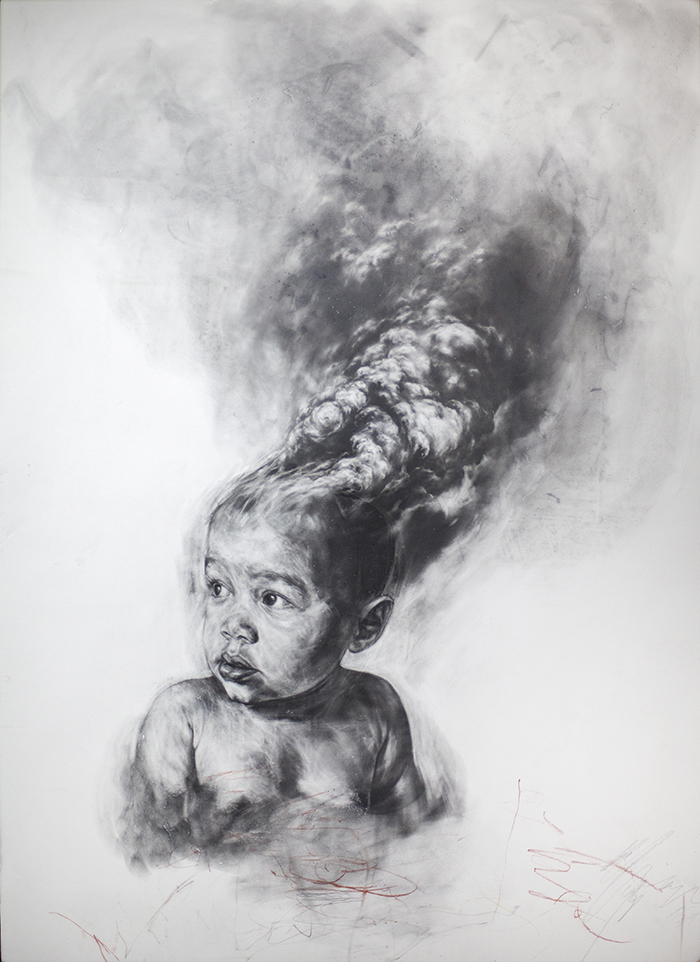
David Bonagurio, “Youth,” 2017, powdered graphite, conté crayon on panel, 32 x 24 inches
Fine Art Today: Could you dive into the process of a specific work that will be featured in the article? Perhaps you could recall when/where/how you were moved to create it and the process involved in its realization?
David Bonagurio: I have a daughter, Lily. I have always been very interested in all the questions of consciousness, so a child has felt like an intimate concert of a mind switching on. In early childhood, children experience mental progressions that are so profound that they almost see and experience things for the first time, several times. I’ve watched Lily revisit objects and situations with increasing clarity, punctuated by sudden bursts of understanding.
I wanted to make something that reflected that eruption of consciousness. That’s what this piece was originally supposed to represent. It still does, but when I let my guard down and Lily ran by with a stray piece of conté crayon and made one big scribble across the bottom, it shattered the voyeurism of a concert. It was just funny. She made the piece more accurate. She had been shaping the way I had been working since before she was born. I had gone back to a smaller scale so I could move around the house more easily and help my pregnant wife, then to help look after a newborn. I put the oils aside to lessen the risk of poisoning anyone.
So when she finally scribbled across the bottom of that drawing she had just made the final jump to actually making marks on my work. Her first target was a piece about her, no less. It was just too perfect, so I let her keep doing it.
Fine Art Today: Do you ever create ulterior narratives in your paintings? By this I mean, are they ever revealed metaphorically or symbolically through, say, your use of light, surface technique, etc.?
David Bonagurio: Yes, definitely. One of the reasons that I really enjoy graphite is the way that it interacts with light. Depending upon how finely I sand a panel, I can get different levels of reflection. When a panel is sanded very smooth and burnished with graphite, it can be like looking in a mirror in a dark room. You see a ghost image of yourself intermingling with the image that I’ve made. I believe it reinforces the feeling that these pieces are about you in some way.
Fine Art Today: What are your primary goals in painting, and what do you hope your audiences take from your works?
David Bonagurio: That everything has layers. That there are more intricacies in everything, including ourselves, than we acknowledge. Nothing in our experience should be considered mundane. It’s possible to look at everything in life the way that we look at a mountain or the moon. Everyday experience is awe-inspiring, romantic, and mysterious.
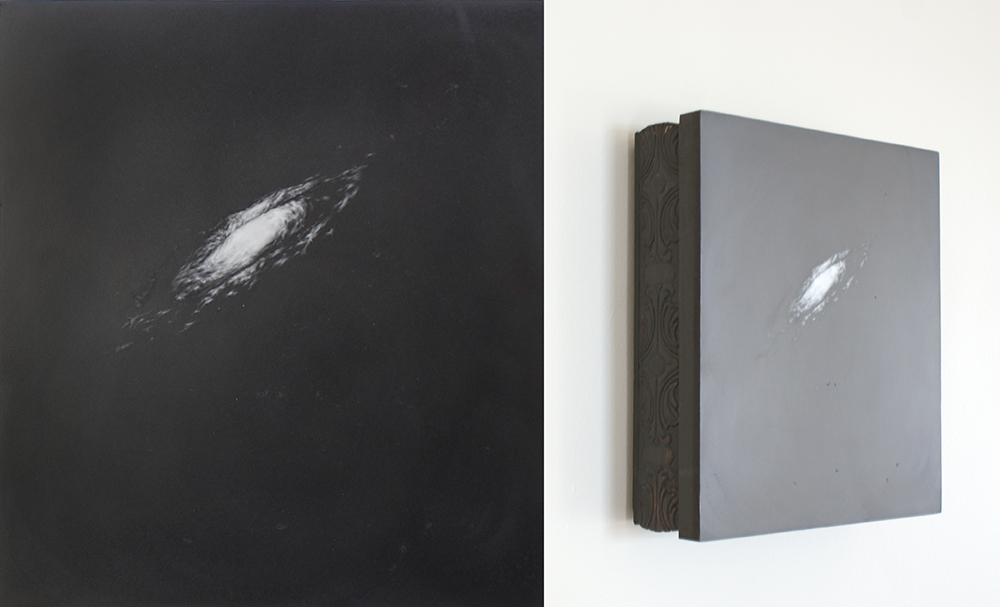
David Bonagurio, “Galaxy,” 2016, powdered graphite on panel, 11 x 10 inches
Fine Art Today: Many of your works feature the figure; talk to me a little about your attraction to it. There are, obviously, infinite ways in which the body can express different concepts, ideas, traditions, and connections, but is there something specific that draws you to the human form?
David Bonagurio: As you’ve stated, it is an extremely expressive and flexible symbol. It is the most immediately recognizable and relatable form for anyone because we all have a body and we all project something of ourselves into what is familiar. The human form might be the most direct way to convince a viewer that this conversation I’m having concerns them.
It’s almost a cheap trick, in that sense. I’ve tried to get away from it but I keep coming back. So, as a tool, it is just so wonderfully functional. For me, as the one making the work, it does the same thing. It works as a conceptual anchor, reminding me to keep myself in the piece. Anytime I work with the figure, it feels like I’m working on myself.
Fine Art Today: What artists have influenced you and your work the most? Is it purely conceptual, or aesthetic? Both?
David Bonagurio: There have been so many. When you enjoy art and also make art, you can’t help but be influenced by work that you admire. There’s no point in trying to be 100 percent original. It’s kind of the way the human mind works; if you’re not standing on the shoulders of giants, you’re blind.
That being said, let me tell you about comic strips. Other than watching my mother paint, what first brought an interest in art was probably the Sunday funny pages. More specifically, it was Calvin and Hobbes by Bill Watterson. His style was beautiful and his writing had a great influence on the way I thought as a child. I think it’s good for kids to read things that are just above their heads. You understand most of it but know there’s something else barely out of reach. It makes you want to think more deeply about everything, because it’s been proven to you that the effort is worth it.
The first contemporary painter who had a great influence on my work (and whose influence is still easily seen) is Sophie Jodoin. She’s a French Canadian painter who, I believe, lives in Montreal. In her work, I saw what the technique of reductive drawing could do for me. Phil Hale is an exceptionally talented painter whose figures are about as expressive as it gets. His brushwork is every bit as efficient as John Singer Sargent, and his use of color hurts my heart. I’ve long strived to gain even a bit of that beautiful sense of expression in my work. Michaël Borremans has definitely been a conceptual influence. There seems to be intent lending to the central concept behind every decision in his imagery. I began to use a good deal of segmentation in my work after seeing his.
I could really go on and on.
David Bonagurio, “Life and Death,” 2014, powdered graphite on panel, 48 x 42 inches
Fine Art Today: What has your journey to becoming a professional artist been like? Were you always interested in art?
David Bonagurio: I have always been interested in art but never took it very seriously until my late teens. My mother is a painter, so it has always been around, but she is also a nurse. My father is an engineer. Neither of my siblings had more than a passing interest. But I discovered what a useful outlet it is and began to see how important it was to society, historically and contemporarily. When decided to actually sit down and focus, I discovered that I had a decent hand. I went to school, getting my bachelor’s in drawing from the Minneapolis College of Art and Design.
During my final year, I interned for a local artist, Edward Lentsch. After I graduated, Ed hired me on full-time as his everything assistant. I cleaned his studio, watched his kids, built his stretchers, and drove his work all over the country in a Sprinter Van. Ed made large-scale gestural abstraction pieces. Think Antonio Tápies crossed with Anselm Kiefer. From Ed, I learned that a drawing or painting didn’t have to be limited in the way it was made. You don’t need to adhere to tradition. You should find your own way of using materials that suits your needs best. From Ed, I also learned how much goddamned hustle it takes to sell your work. That side of things, I’m still working on. I’m not much of a natural salesman.
I lived in Baltimore, Maryland, for a year and did a post-bachelor’s at MICA before moving to Syracuse, New York, for graduate school. Graduate school allowed me the time to find my focus and figure out what I should be making. Now I live in Utica, New York, which is about an hour east of Syracuse. I’ve been teaching on and off when I get the opportunity and have been working at the Wellin Museum of Art, in preparations. My studio has been picking up steam again since our daughter has been getting older. My recent work has been getting some attention, which is nice. If I can keep that going, I can continue being a “professional artist.”
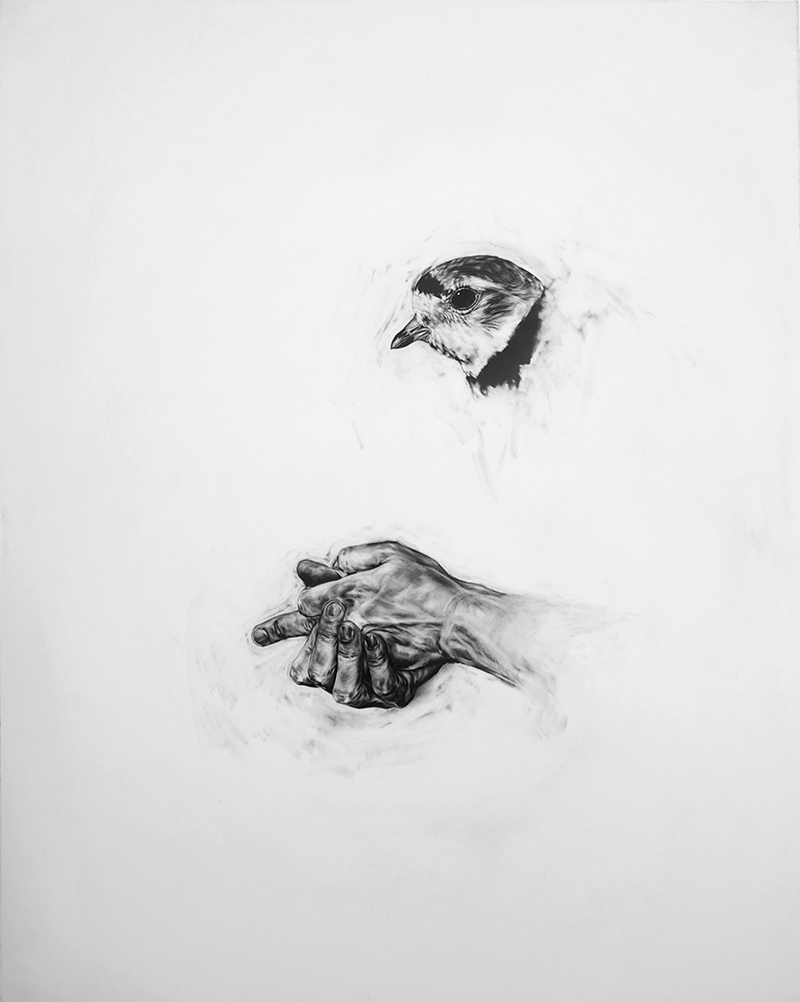
David Bonagurio, “Piping Plover,” powdered graphite on panel, 20 x 16 inches
Fine Art Today: Finally, where are David and his art in five years? How do you see your career and artwork evolving in the future, and what are some things you seek to achieve?
David Bonagurio: This is tough. Career-wise, I hope I’m still in a position where I don’t have to second-guess what I’m making. That’s really all I ask for. Now, if I come up with an idea that I know will take maybe a month to complete one piece or I’m not sure if it is something that will work out the way I would like, I can still do it without too much hesitation.
That might be a not-so-veiled way of saying that I hope my work is still selling in five years so I can keep making ambitious things and taking the types of chances that really do move the work forward. I really don’t know the type of work I’ll be making in the future. All I know is, right now, I have a focus that will keep me busy for some time. Lastly, I would like to get my work seen by as many people as I can. Not because I think I’m so important, or my message is so unique, but I need to contribute to the direction of discourse I believe is needed. Be the change, right?
This article was written by Andrew Webster and originally featured in 2017 in Fine Art Today, a weekly e-newsletter from Fine Art Connoisseur magazine. To start receiving Fine Art Today for free, click here.
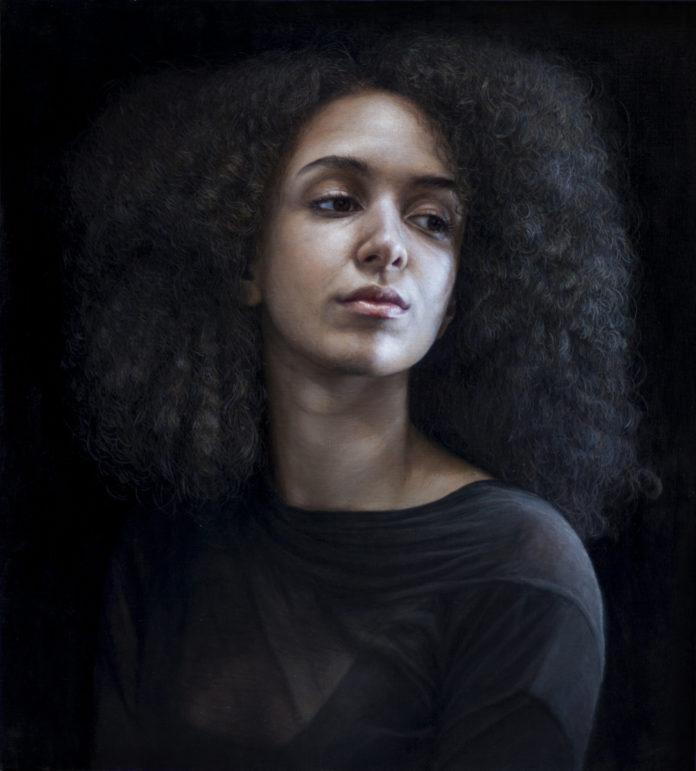
Nick Gebhart, "Portrait of a Model," 2019, oil on linen, 30 x 27 in.
There is a lot of superb contemporary realism being made these days; this article by Allison Malafronte shines light on a gifted individual.
At first glance, the portraits of Nick Gebhart (b. 1988) advertise the merits of strict adherence to tradition and a skill-based technique. Despite his highly detailed finish and faithful representation, however, the 31-year-old artist does not just replicate what is in front of him.
Through his slow and meticulous process, he works to capture the nuances of reality while presenting viewers with unusual or uncanny observations that are open to interpretation.
Gebhart’s interest in art became apparent at an early age and was fostered by his mother, an artist herself.
In 2009, while he was pursuing a degree in art education at Rhode Island College, he took his first painting class and fell in love with oils. Four years later he earned his B.F.A. with a concentration in painting. He then pursued further studies in traditional figurative painting by earning an M.F.A. at the New York Academy of Art. There Gebhart discovered a great passion for painting portraits and exploring the endless possibilities of human expressions.
The artist developed an affinity for the Baroque period of art history and for painters who have used dramatic light and shadow to direct a viewer’s visual journey. “Light is the driving force behind most representational art, and it plays a principal role in my paintings,” Gebhart explains. “This key element of design was a focus of paintings during the 16th and 17th centuries, when artists such as Caravaggio, Rembrandt, and Vermeer used light to seduce the viewer and evoke an emotional response. Baroque art is characterized by contrast and rich shadows, and this has greatly influenced my own work.”
Whether Gebhart’s subjects are entirely in the dark with a streaming rake of light illuminating a particular section, or in full light with subtle shadows, he clearly enjoys observing and translating the close contrasts between these two worlds.
In his painting, “Portrait of a Model” (above), a young woman sits in a classical set-up, with the dark background and her dark hair becoming a unified back-drop highlighting the subdued softness of her expression and skin.
“’In Portrait of a Model,’ I used light to evoke feelings of mystery and curiosity,” Gebhart notes. “Through the light, viewers can step into the world I’ve created, where I’ve asked them to accept my perception of reality as their own. Here I’m presenting the subject in a more subtle cast of light, compared to my earlier pieces, which creates an even greater feeling of intrigue.”
Fill your mind with useful art stories, the latest trends, upcoming art shows, top artists, and more. Subscribe to Fine Art Today, from the publishers of Fine Art Connoisseur magazine.