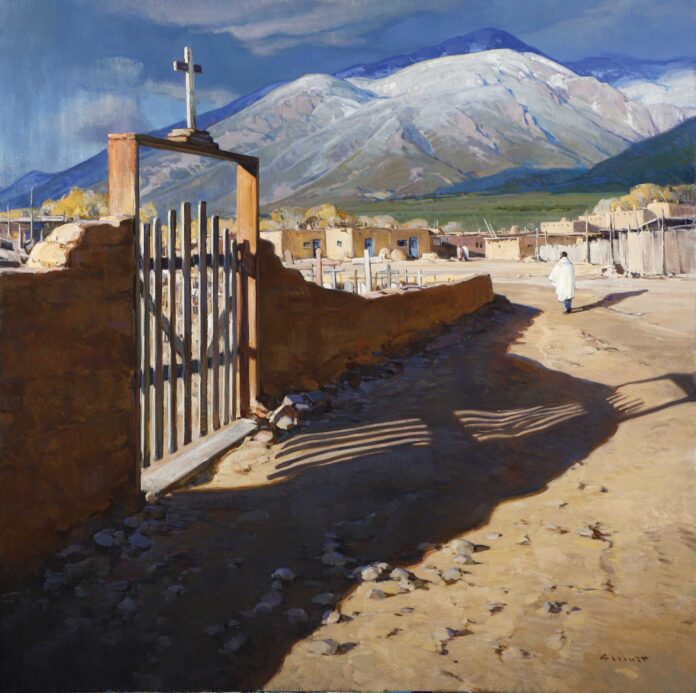
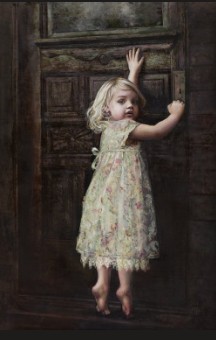
Dave Santillanes (b. 1972), "Autumn Pastures Study," 2025, oil on panel, 15 x 30 in.
PLEIN AIR PAINTINGS EXHIBITION: “Colorado Grandeur”
Plein Air Painters of America
Shaun Horne Gallery at the Crested Butte Center for the Arts
Crested Butte, Colorado pleinairpaintersofamerica.com and shaunhornegallery.com
Through August 30, 2025
This year the nonprofit organization Plein Air Painters of America (PAPA) is mounting its national plein air paintings exhibition in partnership with Shaun Horne Gallery at the Crested Butte Center for the Arts. Appropriately, its title is “Colorado Grandeur,” as many of its more than 150 paintings depict the Rocky Mountain State, especially Crested Butte (population 1,700). PAPA’s members are seasoned outdoor painters and considered some of the best teachers active in the genre today.
This year’s exhibitors include 29 “Signature” members of PAPA, nine emeritus members, and a single honorary one (Len Chmiel).
Founded in 1986 by artist Denise Burns on Catalina Island, California, PAPA began as a small group dedicated to painting from life. For their first two decades, they held annual paint-outs followed by an exhibition in Avalon on Catalina.
This format, unique at the time, has given birth to countless similar groups and events across the country. In 2007, PAPA expanded its format to include exhibitions in museums and art centers to emphasize the importance of field studies in the process of making studio paintings.
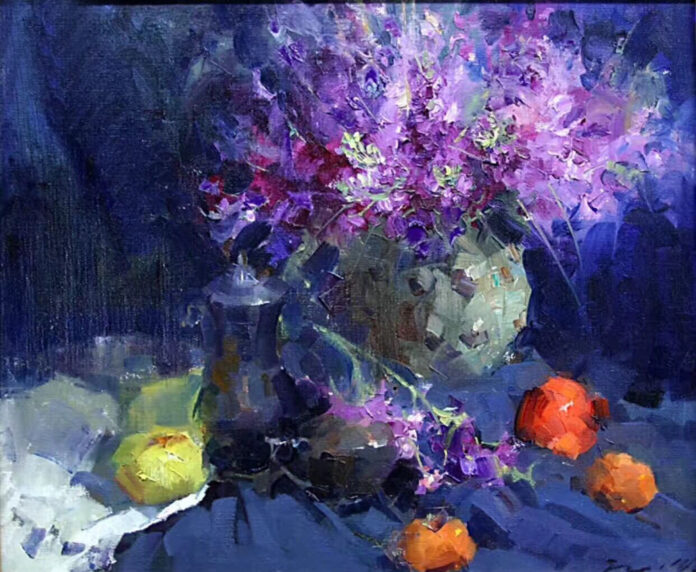
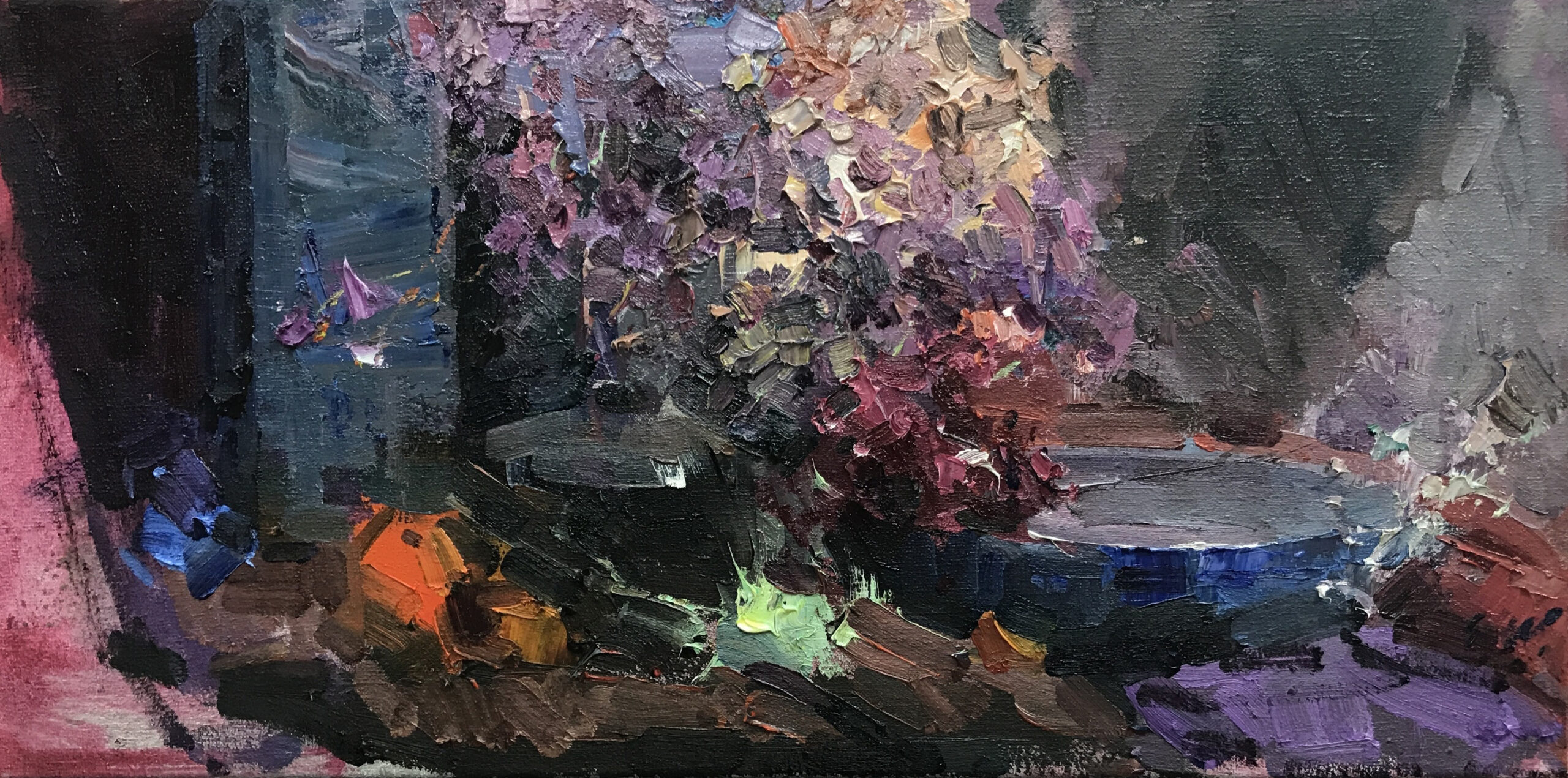
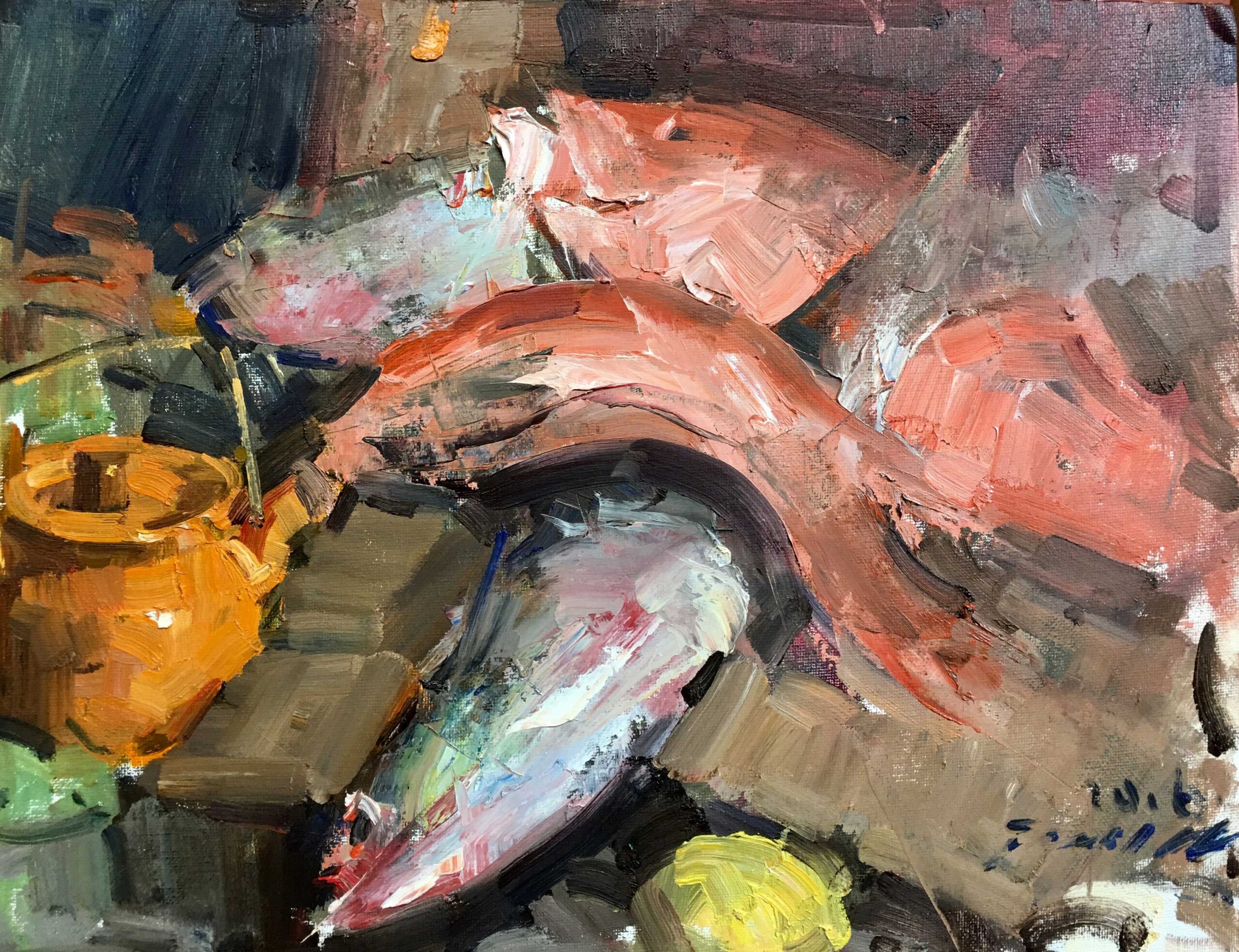
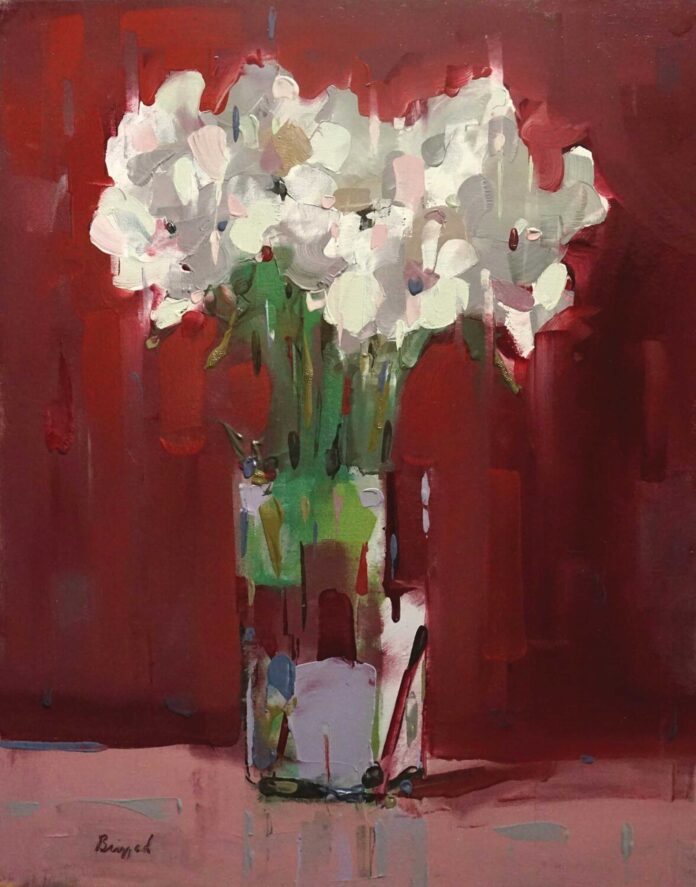
Still life paintings by Jove Wang (shown here, and below)
A Spotlight on Artist Jove Wang
Jove Wang was born in China in 1962. At the age of seven, he apprenticed with the master painter Gang Gu, subsequently studying at Jilin School of Art for three years and graduating in 1982. He was accepted into the Zhejiang Academy of Fine Arts (now known as the China Academy of Art), and graduated as an honor student in 1988. He also received professional training from the Tokyo Academy of Fine Arts.
In 1990 he immigrated to the United States, where he soon met with success. Immersing himself in the study and exploration of the Old Masters, he has established a career that has garnered him national recognition.
Jove Wang’s many honors include Grand Prize at Plein Air Tucson, 2000; Best of Show and Artists’ Choice, Carmel Art Festival, 2001; Best of Show and Artists’ Choice, American Impressionist Society 22nd National Juried Exhibition, 2021; and Best of Show, American Impressionist Society Annual All-Member Online Exhibition, 2021. He became a Signature Member of the Laguna Plein Air Painters Association in 2022.
The artist says, “I have made it my goal: Each work I paint has to be endowed with its own life and soul from within, be it a drama, an opera, a poem, or even a fantasy. I consider my work to be realism yet with modern expressionism.”
This article features a leading artist who is teaching others how to paint through online workshops at PaintTube.tv.
Discover a Master Artist’s Approach to Creating Dramatic and Soulful Still Life Paintings
Master artist Jove Wang invites you into the studio to reveal the secrets behind his captivating still life paintings in Timeless Still Life.
With over 45 years of professional experience and numerous prestigious awards including Best of Show at the American Impressionist Society’s competition, Master Jove shares his unique approach to creating still life paintings filled with soul, drama, and emotional resonance.
Follow along as Master Jove demonstrates his “Whole to Part to Whole” process through his painting demonstration, “Rhapsody in Violet.”
NATIONAL SCULPTURE SOCIETY 92ND ANNUAL AWARDS EXHIBITION
Brookgreen Gardens
Pawleys Island, South Carolina nationalsculpture.org brookgreen.org
Through October 26, 2025
Heidi Wastweet (b. 1969), “Portrait of Nanette Dyer,” 2024, bronze relief, 15 1/2 x 15 1/2 in.
The National Sculpture Society (NSS) has launched the annual exhibition of recent work by its talented members. Once again this show graces Brookgreen Gardens, which became America’s first public sculpture park in 1931, when it was founded by the sculptor Anna Hyatt Huntington and her philanthropist husband, Archer M. Huntington.
Dan Burgette, “Lunch Line”
On view are works in diverse styles created by the Society’s Fellows, Elected Members, and Associates. The jury of selection chose just 41 works out of the 326 submitted; that hard-working panel included Paul Michael of Connecticut’s Lyme Art Association and sculptor Benjamin Phillips.
Blair Buswell, “Risky Business”
The 41 participating artists are Douglas Aja, Thomas Ashbourne, Béla Bácsi, Debra Balchen, Dan Burgette, Richard Burke, Blair Buswell, LeaAnn Cogswell, John Robert Drlik-Mead, Erik Ebeling, Daniel Glanz, Jim Green, Thomas Hill, Warren King, Brendan Johnston, Jim Licaretz, Madeleine Lord, Roger Martin, Adam Matano, Walter Matia, Janice Mauro, Deanne McKeown, Michael Messing, Angela Mia, Roderick Morgan, Evan Morse, Scott Myers, James Nelson, Joseph Noorigian, Peter Ombasa, Chuong Pham, Moana Ponder, Vasil Rakaj, Paul Reiber, Sherry Rossini, Stephen Saxenian, Gary Staab, David Tumblety, Bart Walter, Dorie Wardie, and Heidi Wastweet.
Debra Balchen, “Portrait of a Young Artist”
All of these exhibitors are eligible for more than $18,000 in cash awards, which will be announced in August when the People’s Choice Award is revealed.
After the presentation at Brookgreen, the work of 16 prize winners will appear at the NSS Gallery in New York City (November 17, 2025–January 23, 2026). That selection will then move to the Lyme Art Association for a showing there (February 27–April 10, 2026).
Brendan Johnston, “Eidolon X”
The NSS promotes excellence in sculpture that is inspired by the natural world. In 1893, such founding members as Daniel Chester French, Augustus Saint-Gaudens, and Stanford White established the society to “spread the knowledge of good sculpture.” For 131 years, its members have created, exhibited, collected and supported the evolving tradition in American sculpture. Today, its offerings include not only the annual exhibition, but also Sculpture Quarterly magazine, the SculptureNews e-bulletin, an annual Sculpture Celebration conference, scholarships, grants, and competitions.
As part of our effort to continue to help artists and art galleries thrive, we’re proud to bring you this week’s “Virtual Gallery Walk.” Browse the artwork below and click the image itself to learn more about it, including how to contact the gallery.
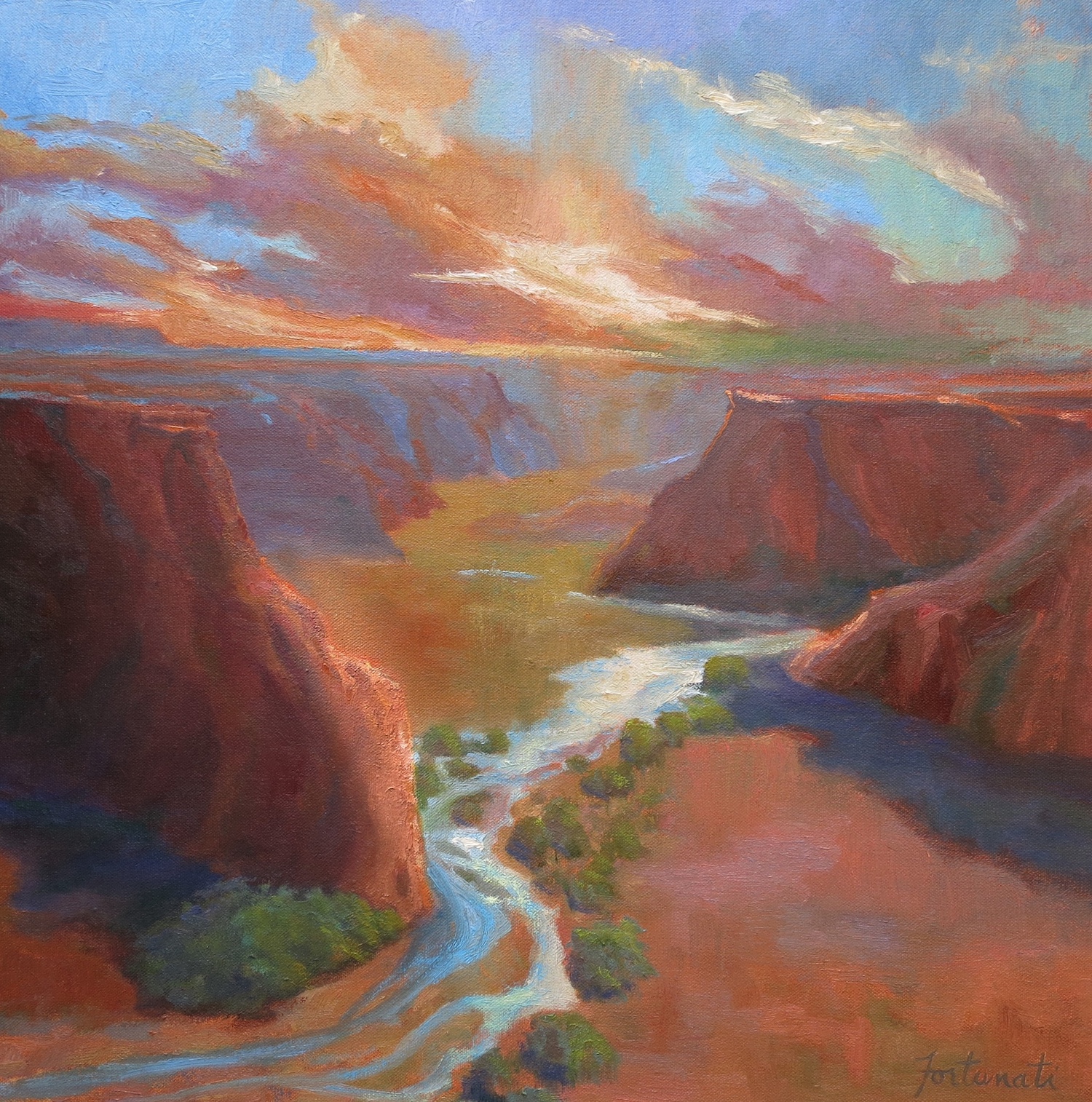
First Light, Marian Fortunati, oil on canvas 20 x 20; Marian Fortunati
***
Michael Gault, Shadows and Light on the Garden of the Gods, Michael Gault, oil on Linen Panel, 24 x 30; Peak Art Adventure-All About Pikes Peak Show with Reserve Our Gallery.
Want to see your gallery featured in an upcoming Virtual Gallery Walk? Contact us at [email protected] to advertise today. Don’t delay, as spaces are first come, first served, and availability is limited.
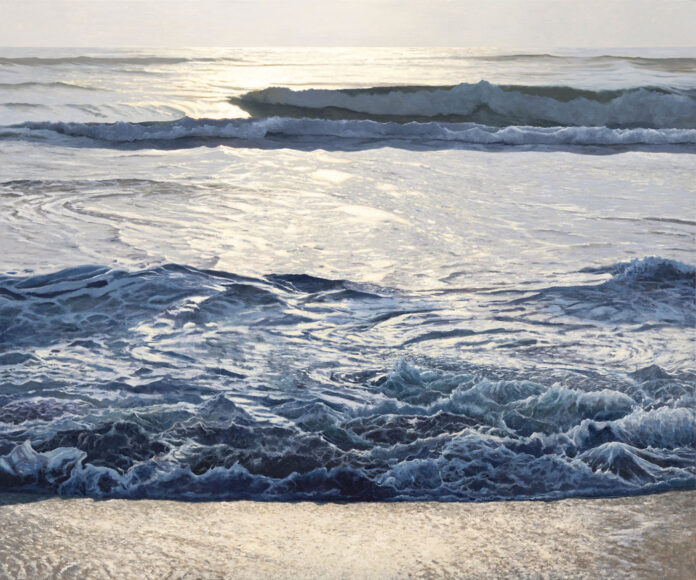
Light Dance VI, Matthew J Cutter, oil on linen, 60 x 72 in; available through Cutter & Cutter Fine Art
Matthew J Cutter: Light Dance VI is a continuation of a theme I’m working on where the light dances across moving water. The values in this painting are critical in conveying the effect of light, as is the variation of warm vs. cool colors.
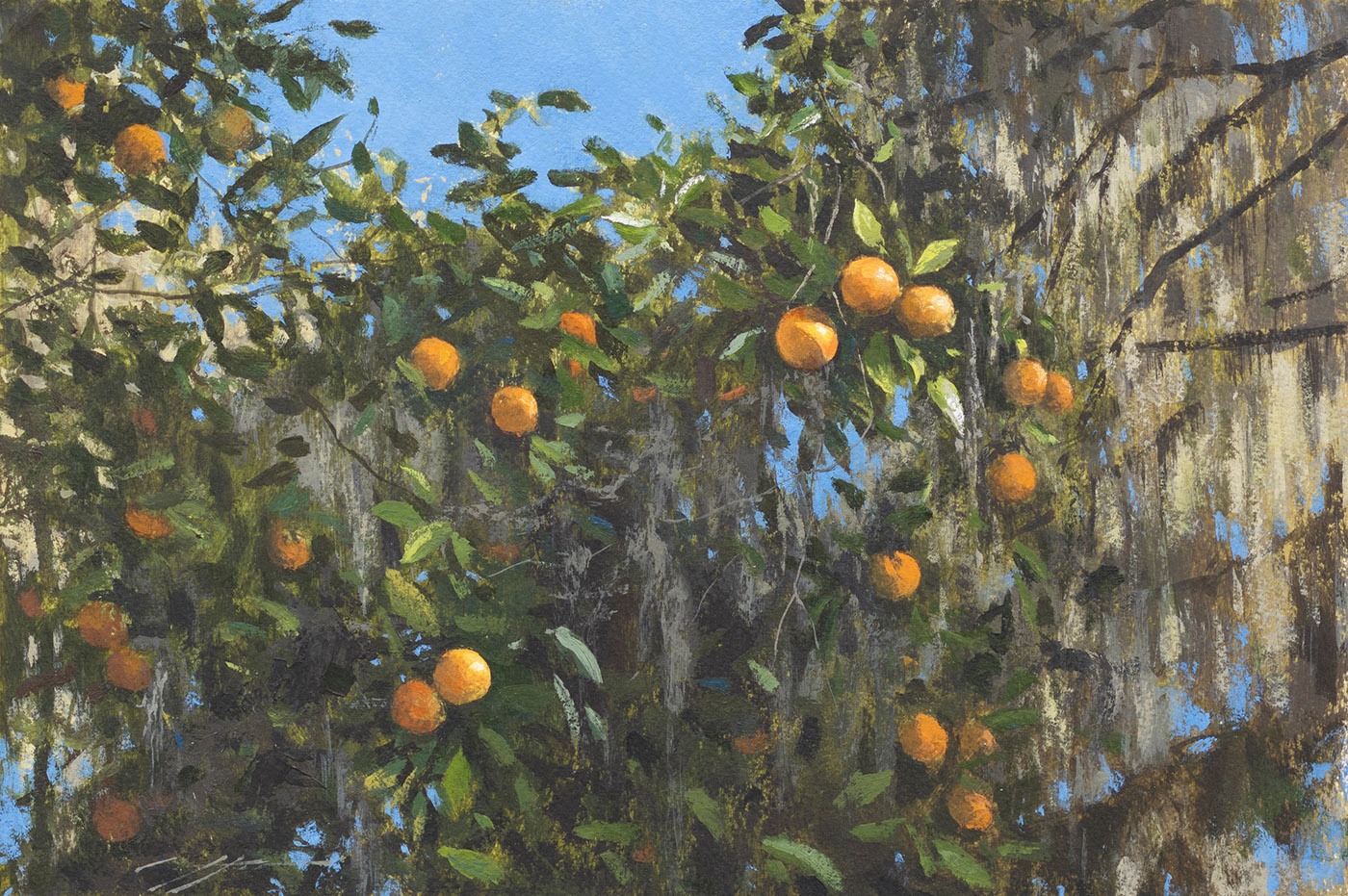
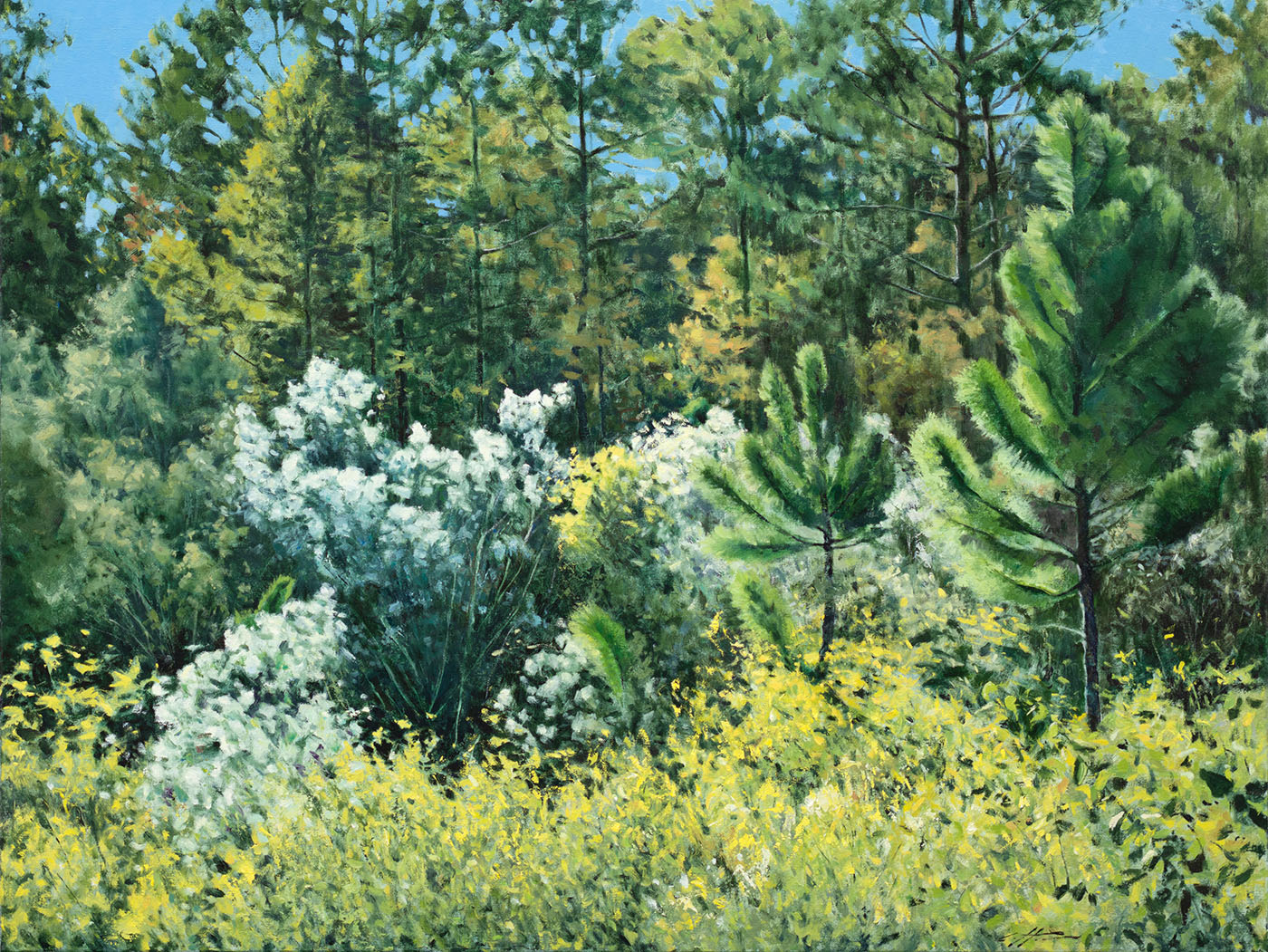
Study for Wild Florida Oranges,Matthew J Cutter, acrylic on paper, 10 x 15 in; available through Cutter & Cutter Fine ArtAbundance, Matthew J Cutter, oil on canvas, 30 x 40 in; available through Cutter & Cutter Fine Art
Josh Elliott (b. 1973), "Intersections," 2025, oil on canvas, 30 x 30 in.
Through its archives, collections, and programming, the Couse-Sharp Historic Site preserves and interprets Taos’s crossroads of cultures, promoting and facilitating research, education, and new perspectives on the Taos Society of Artists, early artists of Taos, and their ongoing legacy.
On view now is an intriguing exhibition that brings that legacy right up to date, “Sun Brothers: Dean, Elliott, Hagege in the Land of Enchantment.” The paintings in it demonstrate New Mexico’s enduring capacity to enchant artists. All of the works on view are for sale, and a portion of the proceeds will support the site as well as the Taos Pueblo Day School Art Fund.
The site’s executive director and curator, Davison Koenig, notes that Glenn Dean, Josh Elliott, and Logan Maxwell Hagege “represent a new generation of artists who are drinking from the same well of inspiration as the painters of the Taos Society of Artists well over a hundred years ago. All have visited our historic site and archive over the past several years, just as they’ve been growing as artists and gaining greater success in the art world. We came up with the idea for them to produce work directly related to Taos people, cultures, and landscapes, and we could not be more excited about the amazing artworks they’ve produced.”
Hagege notes, “The unique light, architecture, and people of Taos Valley attracted the Taos Society artists to the region. These artists from the past feel like long-lost brothers and sisters. Although Glenn, Josh, and I don’t live in the Taos Valley, we are connected to the Taos Society by an invisible artistic lineage that links like-minded artists no matter how much time or space exists between them.”
Dean adds, “I believe there is a brotherhood between artists that is woven throughout time, connecting artist to artist. I believe representational artists across any point in history have dealt with relatively the same (or similar) things in terms of pursuits, struggles, and victories in the development of their work, regardless of the obvious varying outcomes.” He continues, “Josh and Logan are my brothers in art. We have traveled and painted together under the sun for many years, not only in New Mexico but in various locations throughout the West. I believe we share an affinity in our pursuit of art, although our expressions are individual.”
Elliott concludes, “To see where [Eanger Irving] Couse and [Joseph Henry] Sharp created, the environment where they worked, to artists, is almost a sacred experience. I liken it to seeing the light in Paris that inspired the impressionists. It is a tangible connection to the great artists of the past. The work being done at the site will make certain the Taos Society’s legacy remains, and it will deepen the understanding of their relationship to the unique blending of cultures that is Taos.”
The American Impressionist Society (AIS) will soon open its 26th Annual National Juried Exhibition at Cassens Fine Art in the Bitterroot Valley of western Montana. On view will be 166 paintings, as well as 15 more created by AIS “Masters,” board members, and officers. Most have been executed in oil, casein, pastel, oil stick, watercolor, acrylic, or gouache. A five-member jury reviewed 1,750 entries, and a printed catalogue illustrating all of the works they selected will be available for purchase, as will the artworks themselves.
AIS Master Ned Mueller will serve as awards judge, and on July 31 he will distribute more than $100,000 in cash and merchandise, including $12,000 for Best of Show. Among the other opening-week activities (July 29–August 2) will be a Wet Wall exhibition, opportunities to paint outdoors (including on a 10,000-acre ranch), demos, critiques, a workshop, and a panel discussion.
Serving artists since 1998, AIS was founded to promote the appreciation of Impressionism through exhibitions, workshops and events. AIS offers our members engaging opportunities to enrich their fine art practice.
Jeff Yeomans (b. 1954), "Warm Reflections," 2010, oil on canvas, 16 x 20 in., collection of Paula Holtzclaw
A Spotlight on the Fine Art Collections of Contemporary Artists
By Rose Fredrick
Wondering what to collect next? Here’s a tip: ask an artist.
This does sound counterintuitive — “Don’t artists make enough work to fill their own homes?” — but artists are, in fact, some of the most knowledgeable, insightful, and avid (bordering on obsessive) collectors you’ll ever meet.
“As artists, we already love and appreciate art, and we are most likely surrounded by it in our daily lives,” oil painter Paula Holtzclaw replies when asked about her decades-long collecting journey. Sculptor Kevin Box explains it this way: “I look at my own artwork for eight to 10 hours a day at the studio. I don’t want to go home and look at my work.” The painter of surreal figures Steven DaLuz adds, “Artists like to surround themselves with beauty, mystery, and humankind’s interpretation of our fleeting existence.”
See what I mean? Artists know artists and what drives them, and they understand that there’s something more powerful going on beneath the surface of great works. When you factor in the nonconformist attitude artists tend to embrace, suddenly the “why” of someone buying art moves into a deeper realm. For example, artists often acquire work that pushes them to keep striving for something more in their own work, something more profound within themselves.
I decided to approach eight talented artists to learn about, and from, their collecting habits, which rival those of many connoisseurs with far greater means.
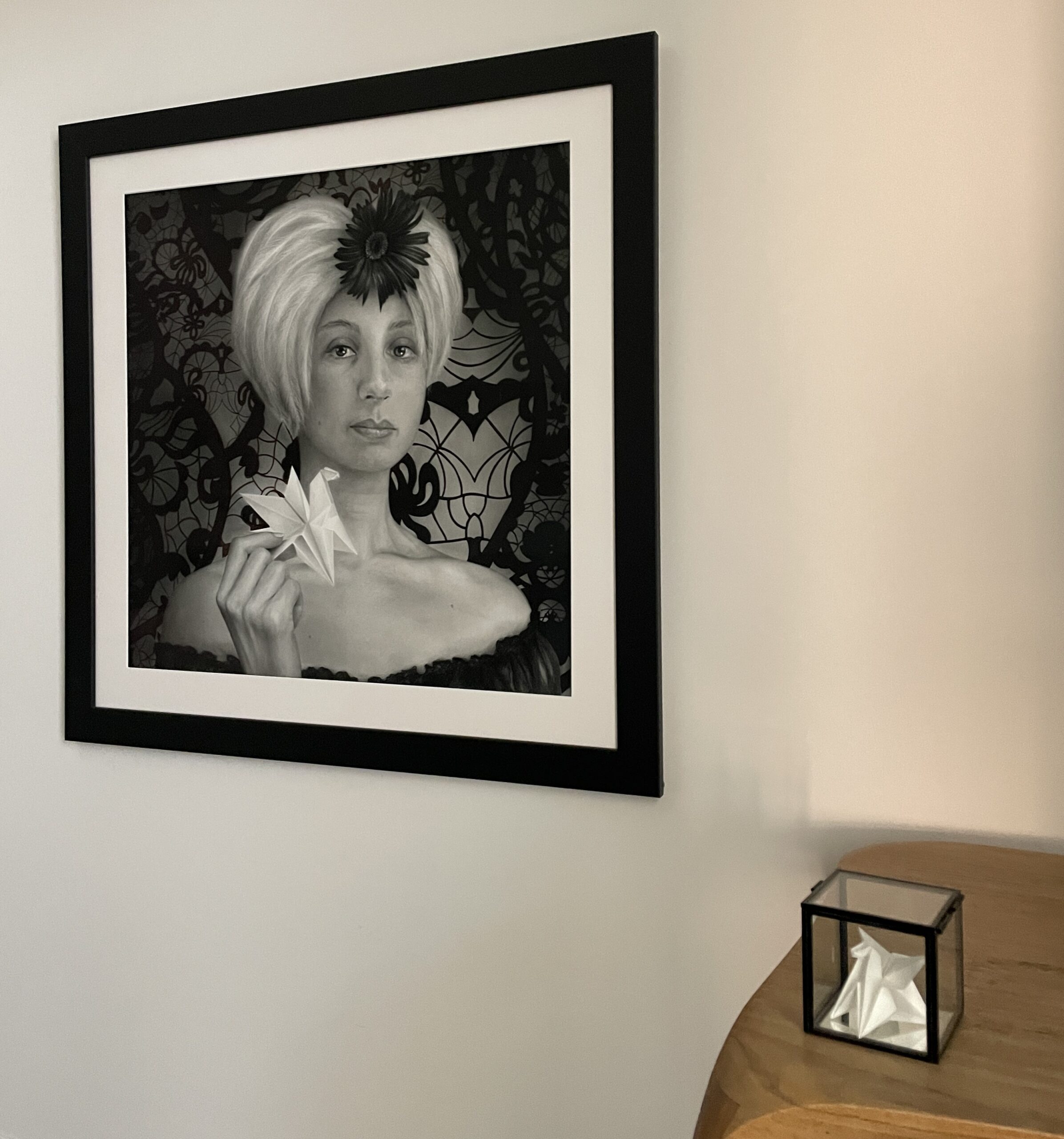
Marco Tidu (b. 1964), “Vanitas: Allegoria dell’effimero,” charcoal and pencil on paper, 28 x 28 in., collection of Kevin Box. Note Box’s own sculpture at bottom right, which coincidentally resembles one the model is holding in Tidu’s drawing.
Nature Vs. Nurture
If it’s true that collectors possess some special DNA passed down from their hunter-gatherer ancestors, this might explain why many artists heed the desire to acquire more objects than their spaces can accommodate. For them, collecting may well be a modern-day hunt that satisfies like no other.
“My grandfather was an avid collector; he frequented auctions and yard sales looking for antiques and paintings,” recalls landscape painter and art dealer Todd Montanaro. To this day he thinks about a painting he saw as a child, a Parisian scene his grandfather had purchased. “I inherited the collecting gene from him,” Montanaro says with a laugh, “but not the painting!”
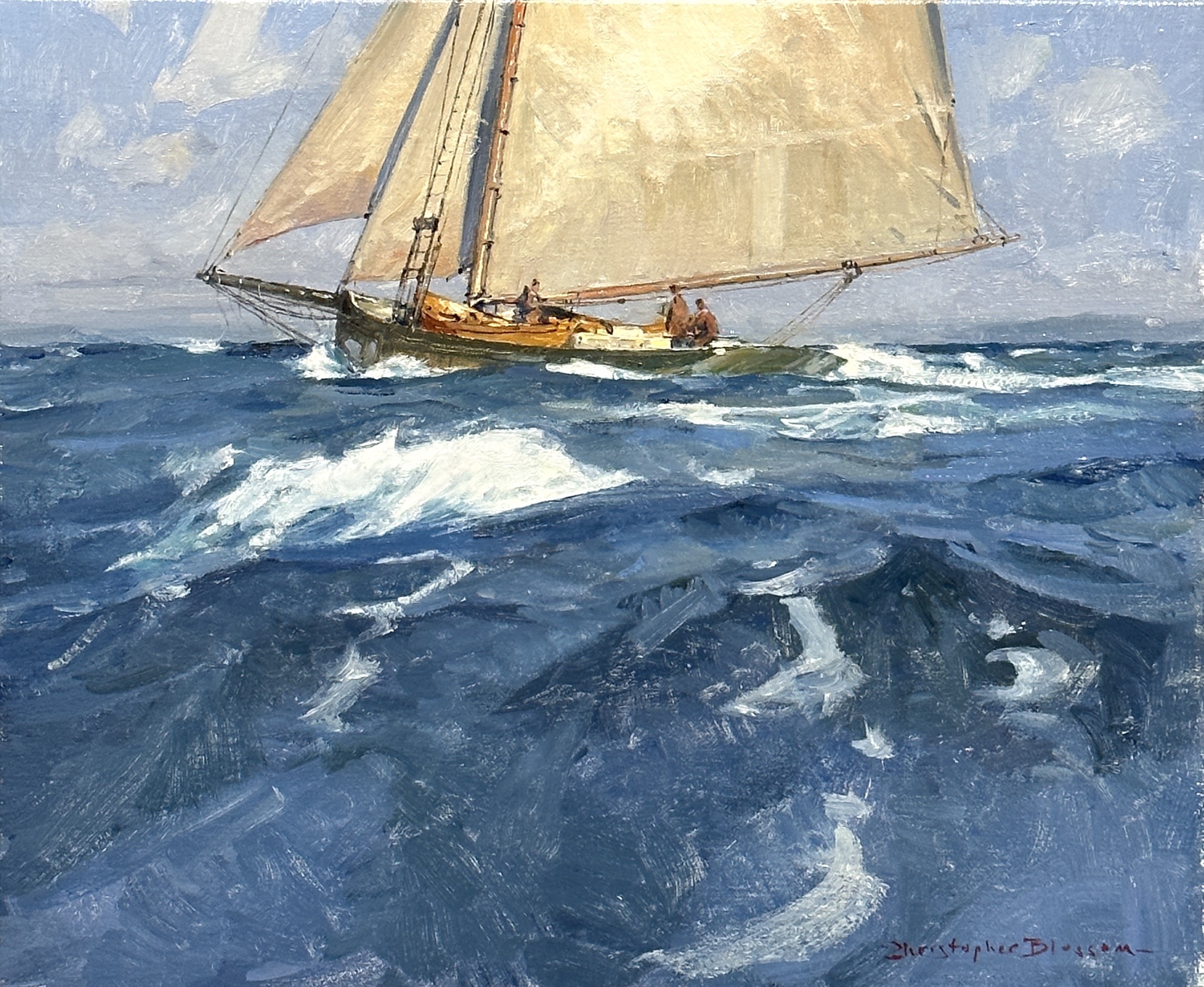
Christopher Blossom (b. 1956), “Gloucester Fishing Sloop Approaching Home,” oil on linen, 10 x 12 in., collection of Todd Montanaro
“My collection is built on the rare compulsion that comes over me when I see a piece that I must own,” says landscapist Stephanie Marzella, who buys when she absolutely connects with another artist’s personal expression.
According to colorist painter Manon Sander, being introduced to art at an early age probably has something to do with it. “When I was a child, I would catch my dad standing in front of the paintings in our home, studying them for a long time. Back then I thought it looked boring, just to stand and stare. Funny, now I do the same thing. My dad had so much appreciation for art; I guess I inherited that from him.”
Attention Art Collectors! May 20-22, 2025: Visit the Plein Air Convention & Expo’s robust pop-up art gallery at the Nugget Casino Resort in Reno, Nevada, where hundreds of artists, including our master faculty, will have studio and plein air works on display and ready to purchase. Register for the full event at PleinAirConvention.com now.
Elena Burykina (b. 1977), "Portrait of Jake," 2021, oil on panel, 12 x 12 in.
The Wausau Museum of Contemporary Art (WMOCA) is set to host another edition of its widely admired International Biennial Portrait Competition. Juried in by the institution’s executive director, David A. Hummer, the works on view reflect the unique relationships between artists and sitters, and have been created in a wide variety of media.
JuliAnne Jonker, “Goldie”
Launched in 2017 at the historic Wausau Club (built 1901), WMOCA is a venue where residents of north central Wisconsin experience recent works created by internationally important artists, both living and deceased. It presents exhibitions, performances, and educational programs and regularly displays highlights from its growing permanent collection.
Judy Takas, “(Trans)cendental (Trans)mutation: Portrait of the Poet”
At a Glance:
INTERNATIONAL BIENNIAL PORTRAIT COMPETITION
Wausau Museum of Contemporary Art
Wausau, Wisconsin wmoca.org
Through September 27, 2025
Rosetta (b. 1945), "Lynx" (artist’s proof), 1993, bronze (edition of 18), 16 x 21 x 15 in.
EXHIBITION: “Rosetta: Animal Artistry”
Loveland Museum
Loveland, Colorado thelovelandmuseum.org
through September 20, 2025
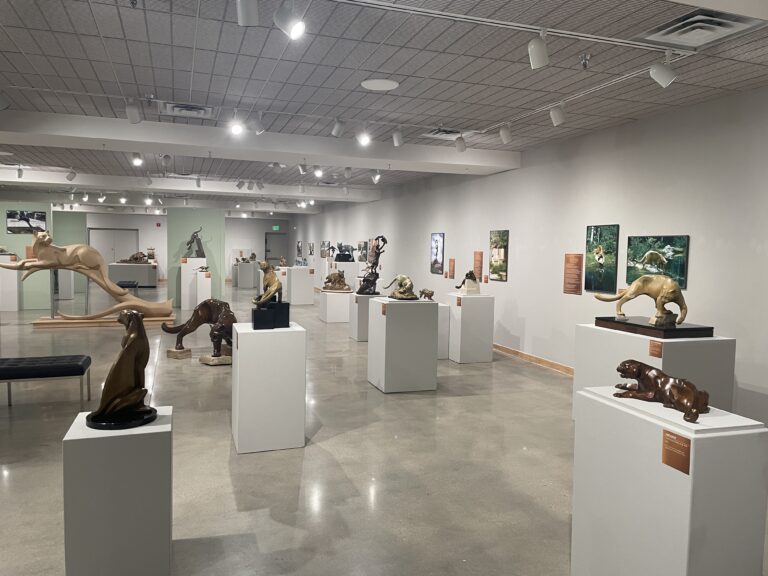
The Loveland Museum has organized “Rosetta: Animal Artistry, A 40-Year Journey,” a retrospective devoted to a leading sculptor who deftly captures the grace, power, and spirit of wildlife.
This venue is especially appropriate because the artist and her photographer husband, Mel Schockner, moved to Loveland in the 1990s, drawn by its renowned bronze foundries and skilled artisans.
Inspired by her lifelong love of animals, Rosetta blends hard edges with fluidity, melding abstraction with representation in order to convey her deep respect for the animals she portrays. The artist herself will lead tours of the exhibition on August 30.
Image credit: Loveland Museum
About the Museum: Author, collector, curator, and mountain guide, Harold Dunning, founded the Museum in 1937. The City of Loveland took over operations of Dunning’s pioneer museum in 1945. Renovations and expansions throughout the years have yielded an art and history museum that presents rotating and permanent art and history exhibits, family events, adult and youth classes, lectures, poetry readings, and other programming opportunities. The Museum has a 37,000-object history collection, provides educational spaces and community gathering spaces in both the main Museum building and the newly acquired Beet Education Center located adjacent to the Museum, and is accredited by the American Alliance of Museums.
Loveland Museum is an integral part of the cultural landscape in Northern Colorado. The Museum feels a strong responsibility to its regular patrons and our collaborative partners to move forward with accessible programs that contribute to the high quality of life residents have come to expect in the city.
Fill your mind with useful art stories, the latest trends, upcoming art shows, top artists, and more. Subscribe to Fine Art Today, from the publishers of Fine Art Connoisseur magazine.