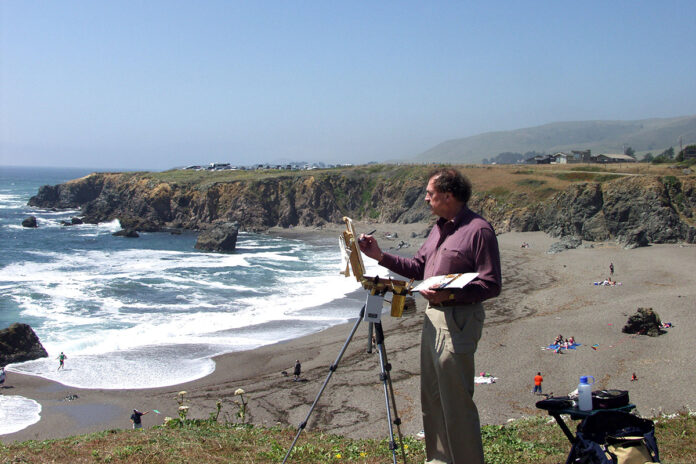
How did you develop your unique style? Larry Cannon: I did not start painting until my mid-50s. By that time, I was fully integrated into the beauty of California and influenced by what I saw and felt from the rich visual environment around me. From the moment that I arrived in San Francisco I had a visceral reaction to the forces of Nature flowing around me. Major influences were the coastal trees sculpted by the ocean winds, the continual wearing away of the land by the relentless ocean, and by several years of sailing on San Francisco Bay where the shifting winds and tidal currents provided a direct tactile connection between those forces and my hand on the sailboat tiller.
The sailing experience especially prepared me for the need to continually adjust to changing conditions – good training for painting in watercolor. Those feelings and observations have led me to paint in watercolors with more flowing broad-brush strokes in unison with the movements of the wind and water working on the coastal land and sea. It also led me to glazing with layers of transparent golden colors to add the glorious California Golden State sunshine that brings unity to the riot of color presented to us by Nature around us.
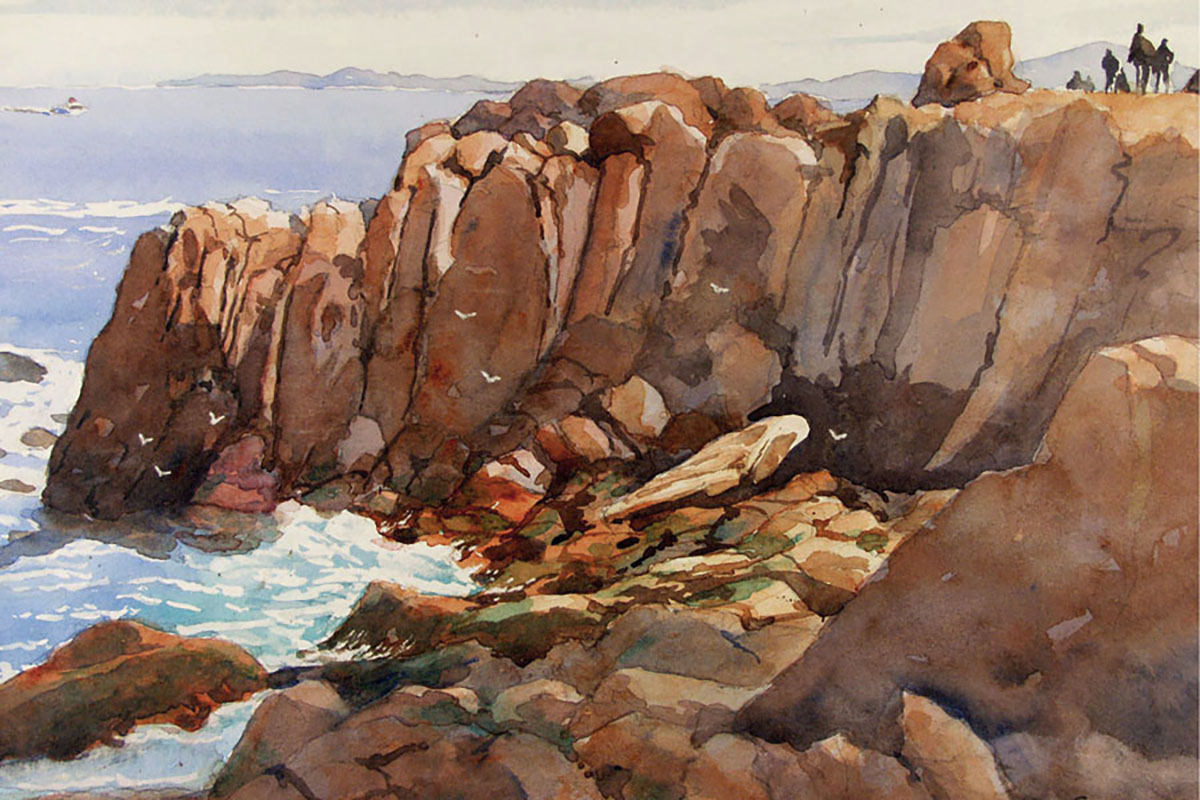
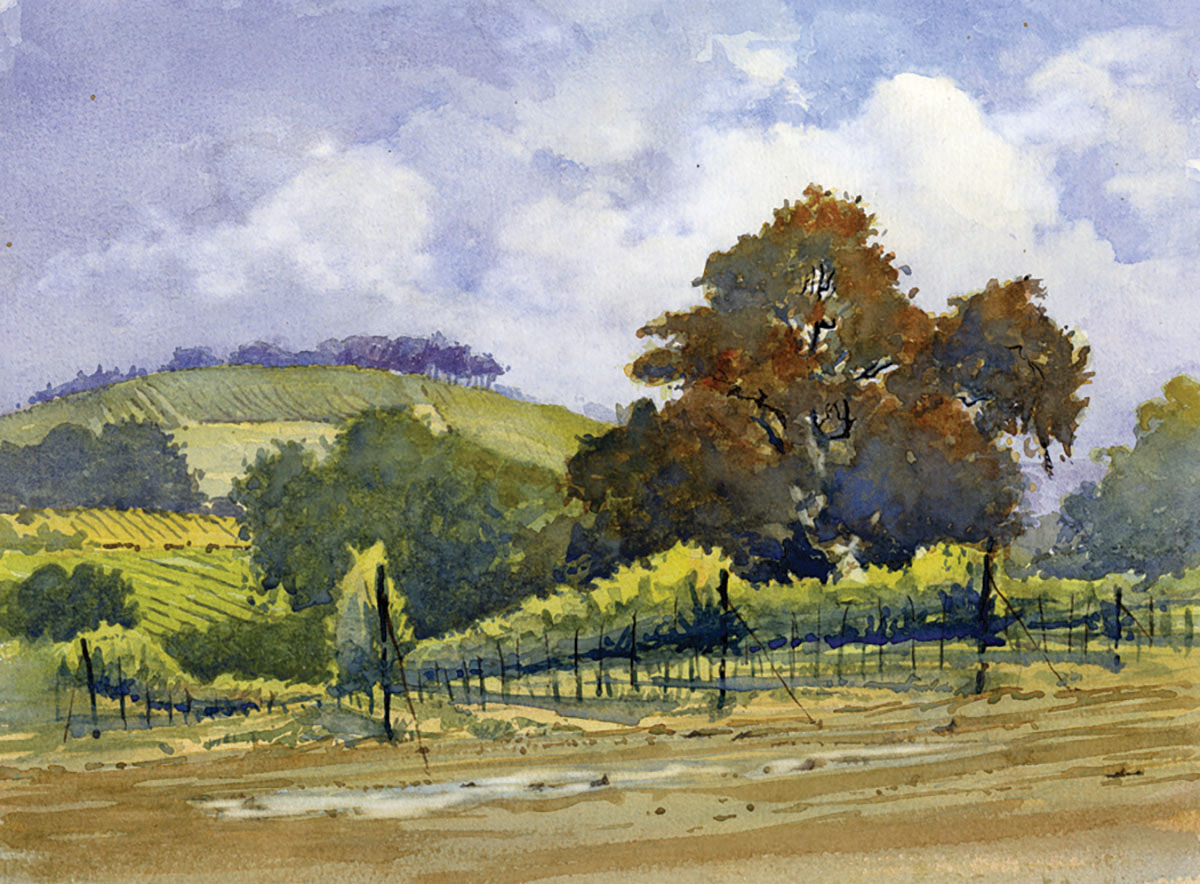
Larry Cannon, 2 Discovery, watercolor, 10 x 14 in; The wonder of arriving at the Pacific Ocean’s rugged Land’s End: Historically and TodayLarry Cannon, 3 Vineyard Showers, watercolor, 10 x 14 in; Rolling vineyards and oaks in the heart of the Sonoma Valley Wine Country
Joel Daniel Phillips, "Josephine: Rest Haven Motel," 2017, charcoal and graphite on paper. Collection of the Fort Wayne Museum of Art.
Truthful Illusions: Realism in the Age of Abstraction
Through July 6, 2025
Fort Wayne Museum of Art (FWMoA), Indiana fwmoa.org
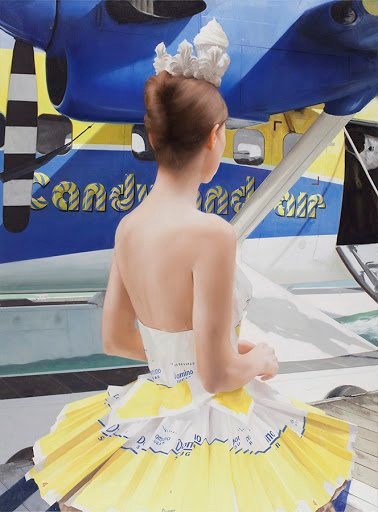
Will Cotton, “Arrival,” 2017, oil on linen. Collection of the Grandon Family.
From the Museum:
Throughout the 20th century, artists absorbed new ideas in philosophy, politics, and aesthetics, spurred in part by European-American cultural exchange and giving rise to what we call “modern art.” The surrealist Salvador Dali illustrated the vivid inner world of dreams and the subconscious as theorized by neurologist Sigmund Freud, while other artists, influenced by Marxist philosophy, saw traditional forms of art and their standards as oppressive.
The years leading up to the two World Wars engulfed Europe in various forms of totalitarianism. American Abstract Expressionists like Jackson Pollock (1912-1952) and Mark Rothko (1903-1970), disillusioned by these repressive regimes, saw art as the embodiment of freedom and sought to throw off all its constraints. For Pollock, even awareness of painting was a constraint, writing in 1947, “When I am in my painting, I am not aware of what I’m doing,” and for Rothko, the painting had a life of its own: “I think of my pictures as dramas; the shapes are the performers…Neither the action nor the actors can be anticipated or described in advance.”
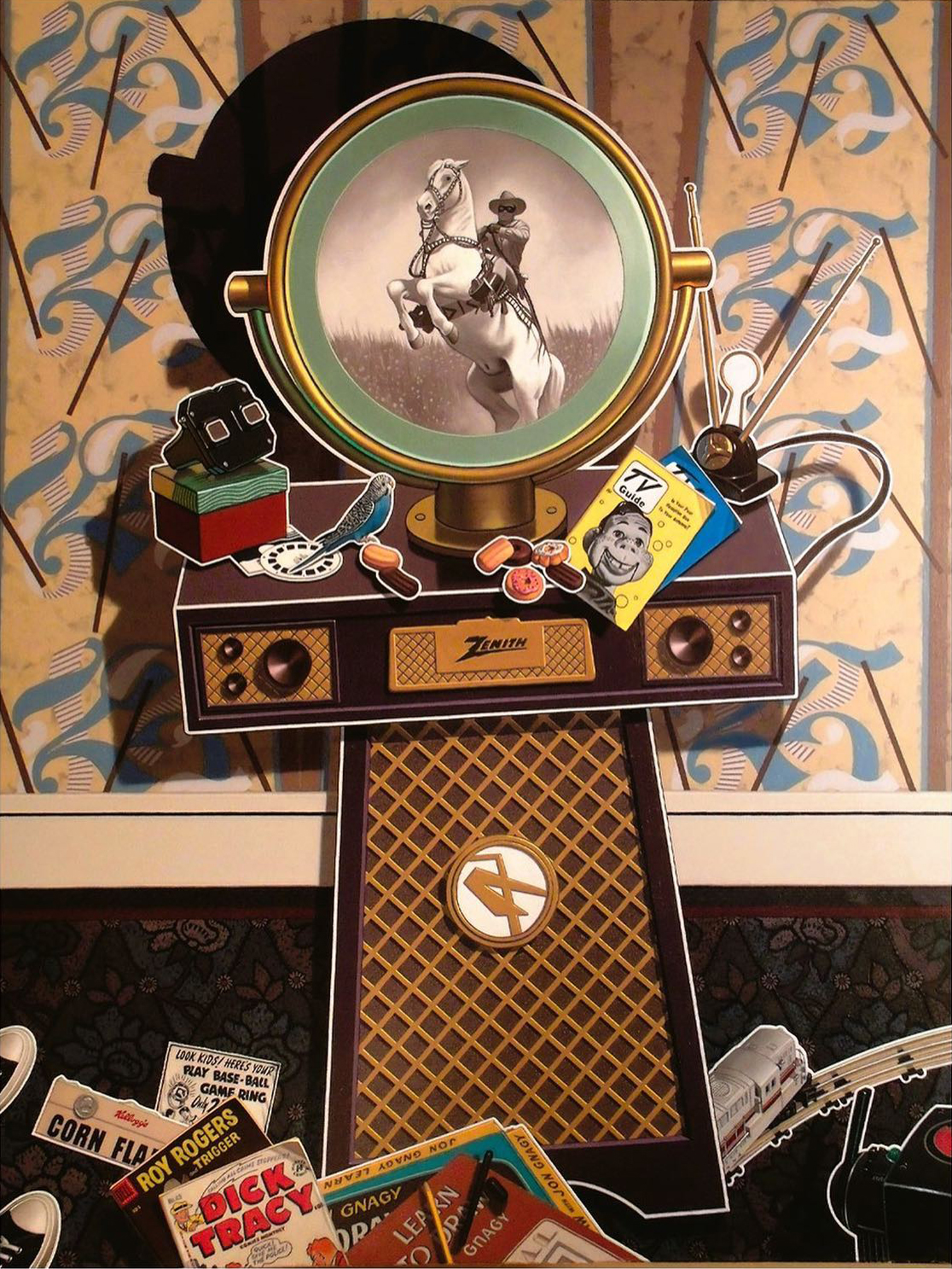
Gary Erbe, “Sunny Day: Today,” 2021-2022, oil on canvas. Collection of the Fort Wayne Museum of Art.
This quest for pure art, unconstrained by standards of skill or even consciousness, was a century-long attempt at answering these questions: What is art, and how does it represent reality? This exhibition of what is called “realism” provides another answer with work by artists whose obvious technical skill supports and does not constrain their artistic intent. They create by the forms, patterns, and embodied nature of the world, savoring what can be seen and showing us its truth.
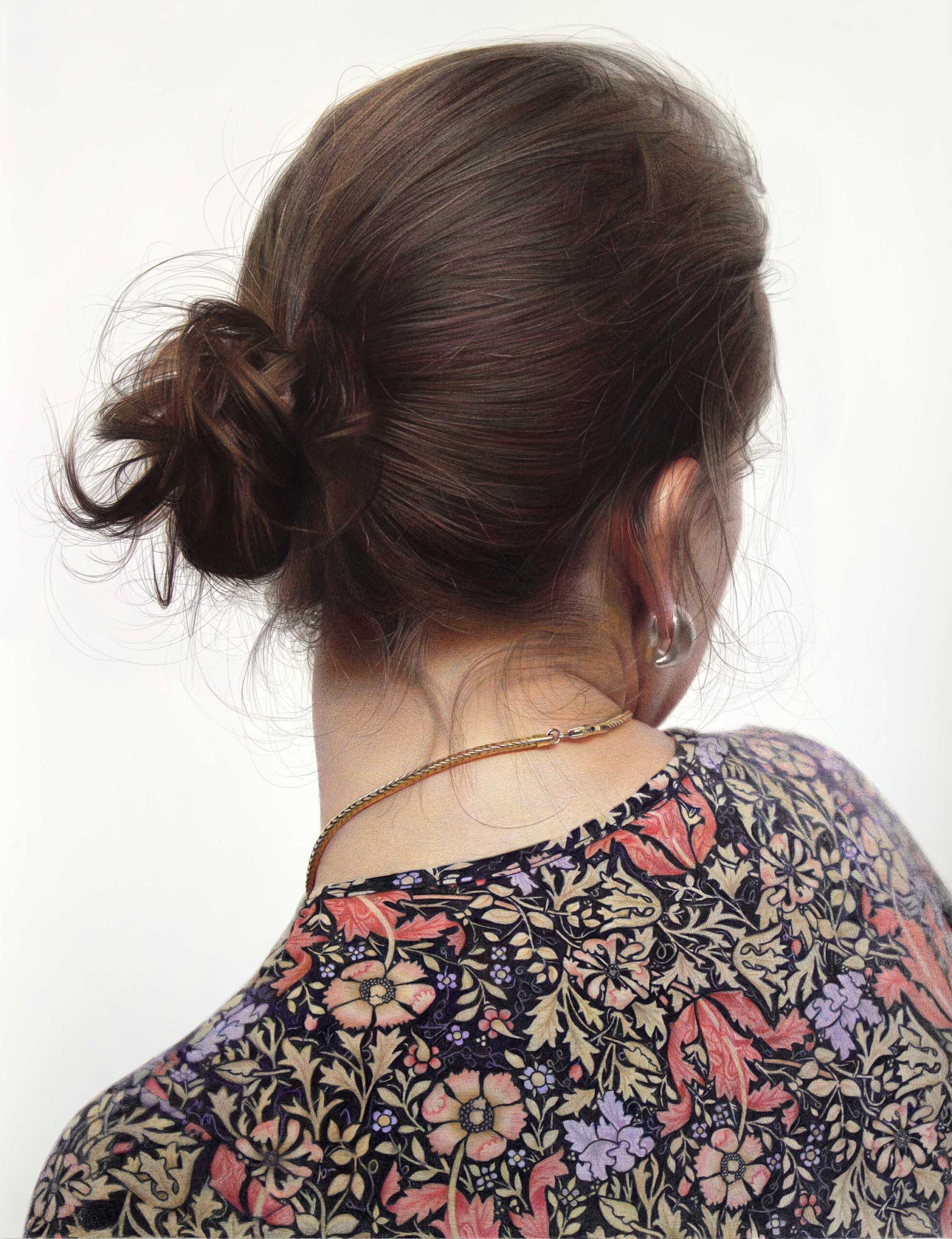
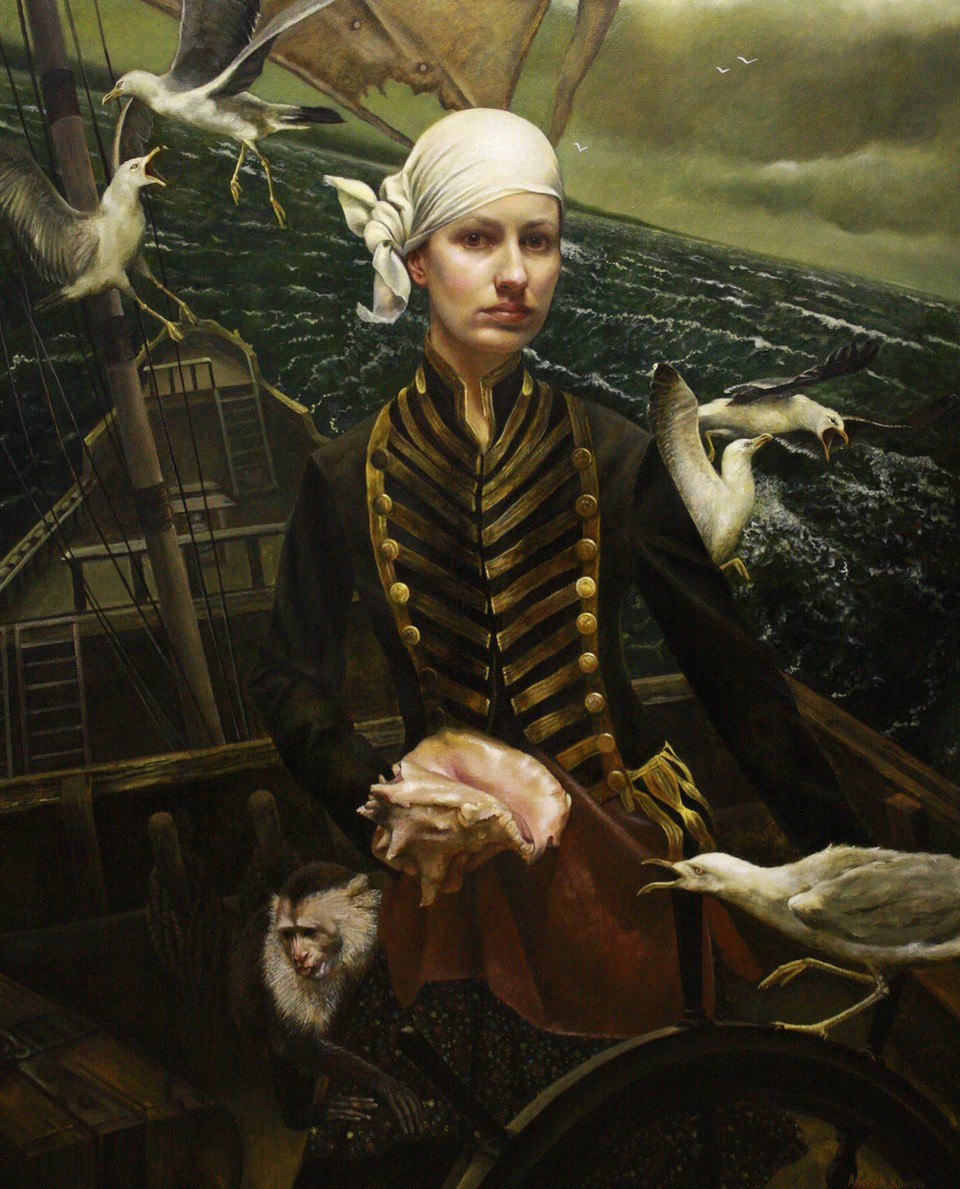
Clio Newton, “All That’s Borrowed,” 2023, colored pencil on paper. Collection of the Fort Wayne Museum of Art.Andrea Kowch, “Tempest,” 2011, acrylic on canvas. Private collection.
The exhibition includes 39 works from the FWMoA collection and borrowed works. Featured artists are Aaron Bohrod, Will Cotton, Gabriela Gonzalez Dellosso, Gary Erbe, De Scott Evans, Andrea Kowch, Clio Newton, Yigal Ozeri, Joel Daniel Phillips, Robert Schefman, Maria Tomasula, Robert Vickrey, N.C. Wyeth, and Renee McGinnis.
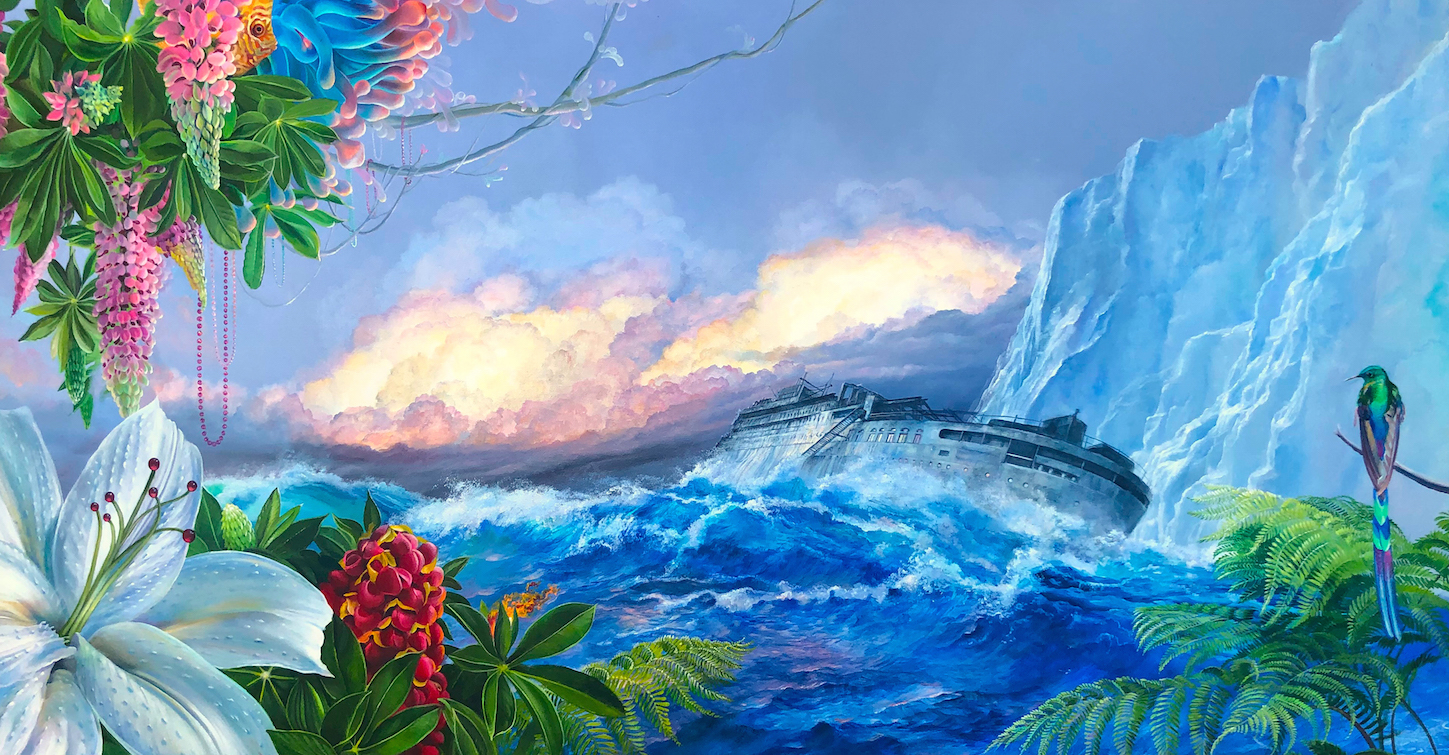
In the collection of Fort Wayne Museum of Art: Renee McGinnis, “USS Lilly,” 2020, oil on cradled birch panel, 18 x 36.5 in. The artist tells us, “Under turbulent skies are planes, trains and ships — these emblems of Western progress, fueled by the ancient compression of flora — lie frozen in the barren, inhospitable future they are impacting.”
“My work attempts to distill all I know of our formidable species and the natural systems that sustain us down to a sorrowful beauty, speaking visually about humanities’ triumphs and tragedies and how these conditions continually co-exist,” said McGinnis. “Distilling all I know of our species and the fragile systems that sustain us down to a gentle yet startling beauty, the mid 20th century luxury liner is a metaphor for the earth herself, breathtaking behemoths, benchmarks of technology, human arrogance and aesthetic attention.”
To learn more about Truthful Illusions: Realism in the Age of Abstraction, visit the museum’s website at fwmoa.org.
As part of our effort to continue to help artists and art galleries thrive, we’re proud to bring you this week’s “Virtual Gallery Walk.” Browse the artwork below and click the image itself to learn more about it, including how to contact the gallery.
Spring Rain, Jean Schwartz, oil on linen, 30 x 40 in; Jean Schwartz; Calloway Fine Art and Consulting, Wisconsin Ave. Washington DC
***
Penumbra, Marian Fortunati, oil on RayMar linen panel, 10 x 20; Marian Fortunati
***
Tranquility, Laurie Hendricks, oil on canvas, 22 x 20 in; Laurie Hendricks
Want to see your gallery featured in an upcoming Virtual Gallery Walk? Contact us at [email protected] to advertise today. Don’t delay, as spaces are first come, first served, and availability is limited.
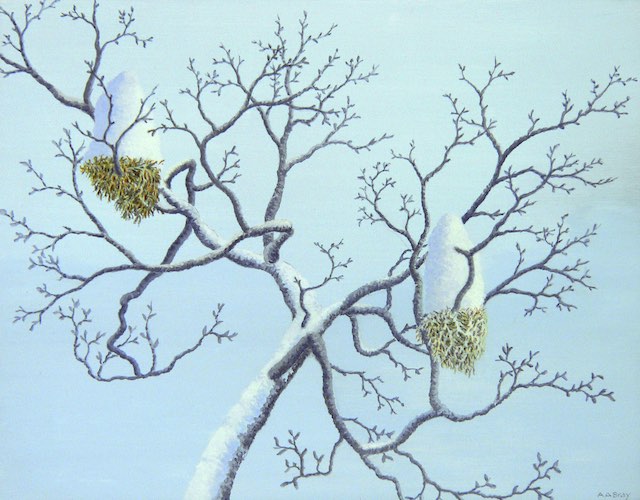
Alan Bray, "Neighbors," 2025, casein on panel, 11 x 14 in
Nature Paintings For Collectors > Alan Bray’s Maine is not the postcard vision of rugged coastlines and lighthouses. Decades of living in the state’s lesser-known interior—densely forested and isolated—have drawn the artist toward more intimate subjects.
In his most recent works, he favors the nests and dwellings of woodland creatures over sweeping vistas. While a singular mountain scene appears in this exhibition, his focus remains on the intricate architectures of natural phenomena, where small moments hold immense presence.
Rendered with exacting detail, Bray’s subjects—whether vacant burrows or hidden habitats—reflect both scientific observation and poetic sensitivity. Vividly toned and hyper-specific, they elevate the unnoticed into something fantastical and otherworldly.
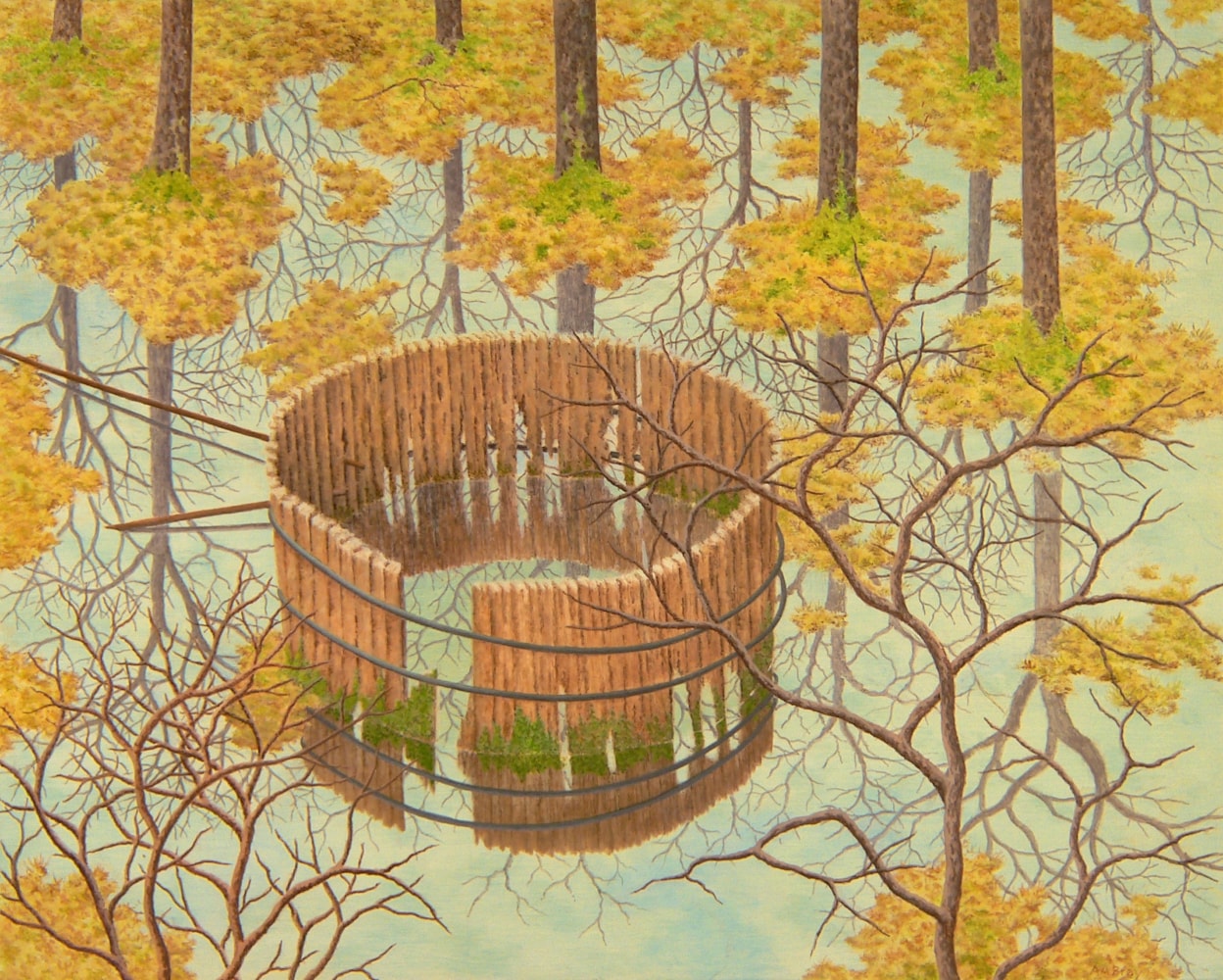
Alan Bray, “Relic,” 2023, Casein on panel, 16 x 20 in.
On View Through May 30, 2025:
“Alan Bray: Inhabited Landscape”
Garvey | Simon at DFN Projects, New York, New York garveysimon.com
More from the gallery:
Bray paints in casein, a milk-based tempera that dries quickly to a matte, velvety surface, requiring deliberate, precise application. Instead of sweeping brush strokes, he builds his images through small, controlled marks, layering pigment to achieve intricate detail. This unforgiving medium—nearly impossible to blend or correct—demands patience and meticulous layering, producing textures that verge on the tactile.
Alan Bray, “Fallow,” 2025, casein on panel, 15 x 24 in
This is particularly striking in his recent depictions of birds’ nests, where interwoven brushstrokes evoke the dry fragility of twigs and leaves. Though casein remains his primary medium, “Inhabited Landscape” includes a rare graphite drawing, in which Bray masterfully builds dimension through subtle shifts in shade and tone.
Alan Bray was born in Waterville, Maine, and grew up in Monson, a small slate-quarrying town set in the northern reaches of the Appalachians. Bray attended the Art Institute of Boston before graduating from the University of Southern Maine; he received his MFA in painting from the Villa Schifanoia in Florence, Italy. It was during this formative time in Florence that he was exposed to tempera on panel.
Bray’s work has been the subject of no less than 25 solo exhibitions and is included in the public collections at the Portland Museum of Art, ME; DeCordova Museum and Sculpture Park, MA; the Farnsworth Museum of Art, ME; Arnot Art Museum, Elmira, NY; Zillman Art Museum, ME; Leigh Yawkey Woodson Art Museum, WI; Lyman Allyn Museum of Arts, New London, CT; Maine Savings Bank Collection, Memphis Cancer Center, Kohlberg, Kravis, Roberts, Menlo Park, CA; amongst others. The artist lives and works in Sangerville, Maine.
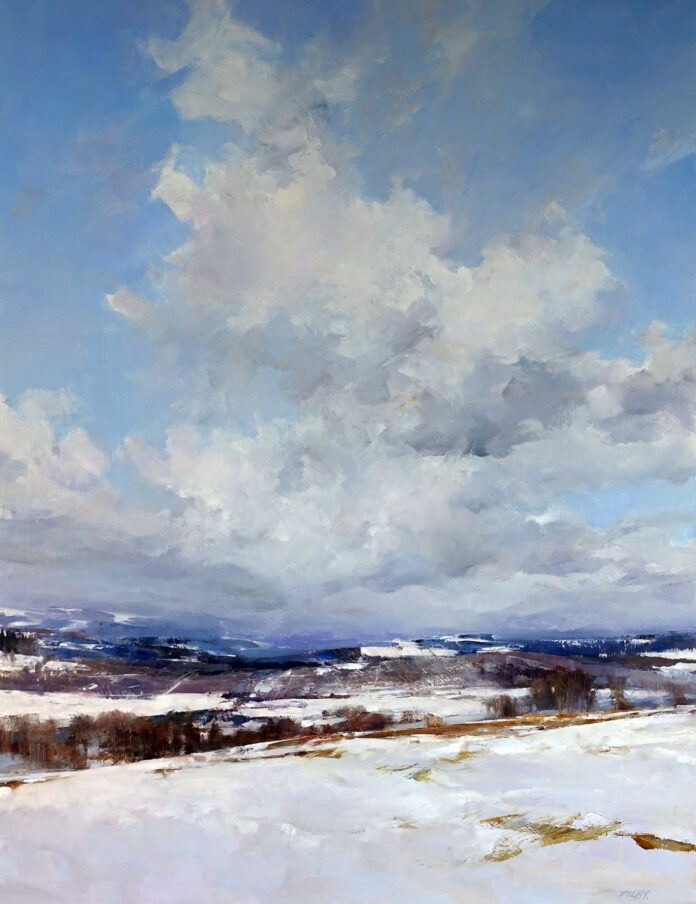
Deborah Tilby (Canada), “Into The Distance,” Oil, 30 x 23 in.
Please help us congratulate Deborah Tilby for winning Overall First Place in the March 2025 PleinAir Salon, judged by previous PleinAir Salon winner Lori Putnam.
“When I paint, it is my intention to be relatively faithful to the colour and light that I see all around me while experimenting and playing with the paint application,” Debroah says. “I would like my brush and knife handling to be as interesting as the subject; to have the mark making and the colour working together to be the life and energy of the work. At least, that is my goal! Accomplishing that goal is always difficult but also fascinating and really fulfilling. It keeps me painting almost daily.”
“One word: Energy!” said Lori about the painting. “There is an unexplainable stirring that happens when a painting has this kind of movement,” Lori said. “I compare this to the same sort of excitement I get when I watch an orchestra conductor with baton moving, hitting the downbeat, then moving again while the other hand is begging for more before gently pushing back. It is all but impossible to ignore … float, hit, release, attack, the crescendo, and dramatic finale.
“This artist takes us through a journey here. Compositionally, there is a strong ‘X’ design using diagonal lines. The masses are brilliantly organized by value and contrast. The piece is masterfully painted using a variety of mark-making and brushwork.”
In the spirit of the French Salon created by the Academie des Beaux-Arts in Paris, this annual online art competition, with 11 monthly cycles, leading to the annual Salon Grand Prize winners, is designed to stimulate artistic growth through competition. The PleinAir® Salon rewards artists with $50,000 in cash prizes and exposure of their work, with the winning painting featured on the cover of PleinAir® Magazine.
Winners in each monthly competition may receive recognition and exposure through PleinAir Magazine’s print magazine, e-newsletters, websites, and social media. Winners of each competition will also be entered into the annual competition. The Annual Awards will be presented live at the next Plein Air Convention & Expo.
The next round of the PleinAir Salon has begun so hurry, as this competition ends on the last day of the month. Enter your best art in the PleinAir Salon here.
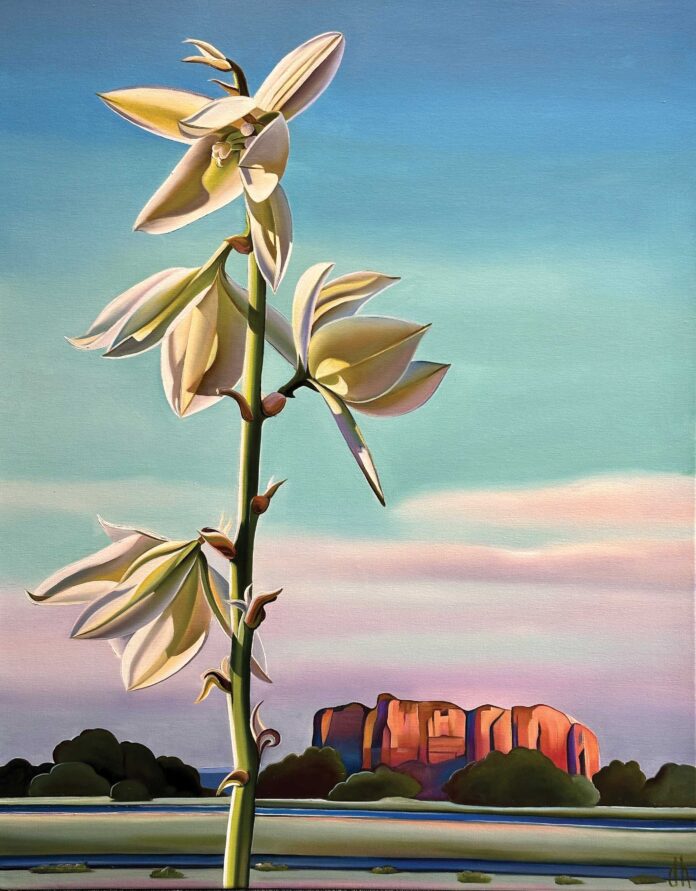
Dyana Hesson (b. 1966), "Sedona Windsock (Soap Tree Yucca, Sedona Airport)," 2024, oil on canvas, 28 x 22 in.
20th Annual Cowgirl Up! Western Art Show
The Desert Caballeros Western Museum
Wickenburg, Arizona westernmuseum.org
Through May 25, 2025
The Desert Caballeros Western Museum preserves and exhibits the art and history of the Southwest and desert frontier. Twenty years ago, it launched “Cowgirl Up! Art from the Other Half of the West,” an invitational exhibition and sale that — in the male-dominated field of Western art — has turned the spotlight squarely on women.
The 20th edition of CU! will feature more than 60 talents offering paintings, drawings, and sculptures in various techniques, styles, and mediums.
Among the new participants is oil painter Sara Bloodwolf, whose ancestor Sequah performed with Buffalo Bill Cody in his Wild West Shows.
As part of our effort to continue to help artists and art galleries thrive, we’re proud to bring you this week’s “Virtual Gallery Walk.” Browse the artwork below and click the image itself to learn more about it, including how to contact the gallery.
Want to see your gallery featured in an upcoming Virtual Gallery Walk? Contact us at [email protected] to advertise today. Don’t delay, as spaces are first come, first served, and availability is limited.
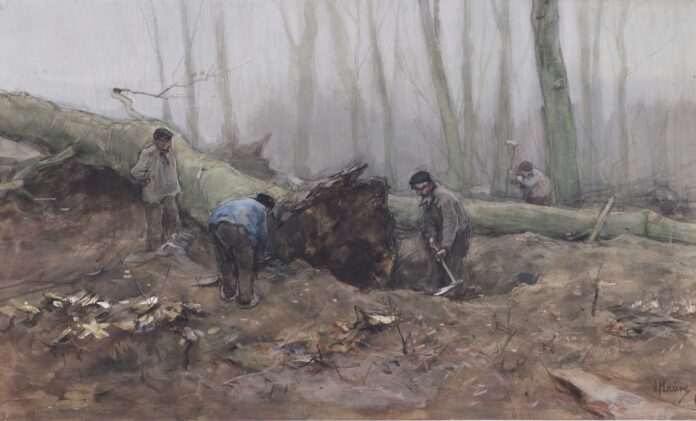
ANTON MAUVE (1838–1888), "Digging up a Tree," c. 1860s–80s, transparent and opaque watercolor on paper, 12 1/4 x 20 3/4 in., Museum of Fine Arts, Boston, bequest of Elizabeth A. Cotton
LANDSCAPE AND LABOR: DUTCH WORKS ON PAPER IN VAN GOGH’S TIME
Museum of Fine Arts, Boston mfa.org
through June 22, 2025
Although Vincent van Gogh (1853–1890) is among the most famous Dutch artists of all time, in his own era he was relatively little known, especially compared to artists of the Hague School. This group, named for the city where many of its members trained and worked, comprised those who had different styles but shared a devotion to depicting everyday life, looking to the Dutch countryside for subject matter.
Hague School members made a profound impact on artists of their time, and this is especially true of Anton Mauve, whom Van Gogh much admired. The artists went on to achieve international fame, and in the early 1900s U.S. collectors and museums — including the Museum of Fine Arts, Boston (MFA) — eagerly sought their works. Over time, however, the group’s fame faded.
Now the MFA is exhibiting important watercolors, prints, and drawings not only by Mauve and Van Gogh, but also by such forgotten artists as Jan Hendrik Weissenbruch (1824–1903) and Anton van Rappard (1858–1892). In this show, it becomes clear that Hague School artists favored farmers, fisherfolk, laborers, mills, canals, and dunes as their subjects, in part to convey a patriotic love of the countryside. In the densely populated and rapidly industrializing Netherlands, rural subjects recalled a simpler time and a simpler way of life — both of which were quickly disappearing.
MARK EDWARD ADAMS (b. 1974), "Soulmates," 2018, bronze (edition 10 of 18), 16 x 6 x 14 in.
Fine Art Collection Profile >
After several years of effort, Anne W. Brown and Rusty Munn completed the design and construction of their “forever home” in the scenic Four Corners region of southeastern Utah, where the state touches upon Colorado, New Mexico, and Arizona. It was writing and music that brought this couple together in their 60s, but especially art of the American West, which both have collected for decades.
As a small child on South Carolina’s coast, Rusty dreamed of heading west to see the snow-capped mountains depicted in a painting his grandfather owned. During his adolescence in Oklahoma, a field trip to the Woolaroc Museum introduced him to some of the great cowboy painters and sculptors, particularly Charles M. Russell and Joseph H. Sharp. From then on, Rusty became a voracious reader of art history.
As a toddler in her Michigan bedroom, Anne looked up at the walls and wondered at the framed prints made by E.I. Couse; though usually associated with the Taos Society of Artists, Couse was originally from Saginaw, Michigan. After her family moved to the Cleveland area, Anne encountered the broader world of art, ranging from high school classes at the Cleveland Institute of Art to exhibitions at the Philadelphia Museum of Art, where her aunt volunteered as a docent, to family trips to Taos and Santa Fe. Having taken graduate courses in art history, Anne attended an auction in Newport, Rhode Island, in 1973 and spent far too much of her income on her first artwork. Created by her favorite historical artist, Amedeo Modigliani, the signed and numbered lithograph marked the start of her collection of figurative art.
Also in 1973 — but 2,200 miles away, in Cody, Wyoming — Rusty purchased his first artwork from what is now the Buffalo Bill Center of the West. At first he kept the reproduction of Charlie Russell’s “Free Trappers” rolled up, but later he had it expertly framed and still cites it as the first of his many cowboy scenes depicting America’s 19th-century fur-trapping boom. Soon Rusty started visiting exhibitions at Utah State University, where he bought paintings from instructor Glen Edwards and (then) student James Morgan, both still among his favorite artists.
Today Anne and Rusty own a broad range of paintings in oils, acrylics, and watercolors, as well as sculpture, prints, drawings in pastels and charcoals, ceramics, photographs, and batik works. The artists represented in their collection include Mark Edward Adams, Vanya Allison, Terri Axness, Mark Bangerter, Arlene Braithwaite, Tim Cox, Vadim Dolgov, Mark Eberhard, Glen Edwards, Tammy Garcia, Frank Hagel, Dale Harding, Jennifer L. Hoffman, Brad Holt, Charlie Hunter, Lance Johnson, Donal Jolley, Jim Jones, Janet Lever-Wood, Lucy M. Lewis, Noel Logan, Robert Martinez, William Matthews, Curt Mattson, Fitz Maurice, James Morgan, Dan Namingha, Maggie Neal, Peter Nisbet, Michael Ome Untiedt, Dustin Payne, John Potter, Kevin Red Star, LaQuincey Reed, Stephanie Revennaugh, Dave Santillanes, Bill Sawczuk, Gil Scott, Hannah Barron Spencer, Kate Starling, Gregory Stocks, Kathleen Strukoff, Matt Suess, Ed Tewanema, Carolyn Thome, Kathryn Turner, Echo Ukrainetz, Ron Ukrainetz, Michele Usibelli, Michael Weinberg, and Jean Reece Wilkey.
Over the years, Anne has intersected with a wide array of individual artists, museum benefit auctions, and gallery exhibitions through service as a trustee or committee chair at various organizations including Cincinnati’s Contemporary Arts Center, the Laguna Art Museum, Scottsdale Artists’ School, Zion National Park Foundation, Salmagundi Club of New York, and National Sculpture Society, and also through her longtime role as associate publisher of Fine Art Connoisseur and PleinAir magazines.
Almost all of the living artists Anne and Rusty “own” have become acquaintances, and so the couple are always eager to visit studios around the country to reconnect, especially since their recent retirement allows them to travel more. Rusty has advised artists such as Michele Usibelli on the tack appearing in her horse paintings, and Anne offers tips to many artists on their career moves.
As they planned their new house in Utah, Rusty and Anne prioritized the artworks by including glassed built-ins and pale gray walls to accommodate not only paintings and sculpture, but also a large collection of Navajo rugs. Throughout the process, they consulted more experienced collector friends such as Mary Linda and Jay Strotkamp, Marlene Whitlock, and Tim and Cathi Newton, who showed them that creating a home gallery environment with occasional rotations means they’ll never have to stop acquiring.
Anne and Rusty note that, in the field of painting, representation “seems to have taken a back seat to abstraction, even at the Western auctions we enjoy attending.” That’s one reason they have started buying more sculpture, which looks great alongside their Hopi kachinas, Acoma ceramics, and Navajo rugs — and doesn’t require them to remove any paintings from their already crowded walls.
RON UKRAINETZ (b. 1949), “Sioux Single Tail,” 2020, polychromatic engraving, 36 x 16 in.
When asked to select just two artworks to illustrate this profile, Anne and Rusty struggled, admitting it was a bit like picking a favorite child. In the end, they chose “Soulmates” (at top), which Mark Edward Adams sculpted after volunteering at a therapeutic equestrian center. There he observed the strong bonds forged between horses and riders, a theme that resonated with both Anne and Rusty. It is now the focal point of their dining room table.
“Sioux Single Tail,” Ron Ukrainetz’s large polychromatic engraving of a Plains Native American headdress, was commissioned for the new house by Rusty, who had already picked out a spot where Utah’s abundant sunlight would not blanch the black clayboard surface. Like the artist, Anne and Rusty are intrigued by the idea that the feathers and furs a Native warrior wears signify key attributes of his soul — a nod to the unity of humankind and nature the collectors have attained with their beloved new home.
Returning this spring is the Scottsdale Art Auction, one of America’s leading sales of Western art. This is SAA’s largest edition ever, offering nearly 500 lots ranging from landscape and wildlife to figures and still life. One highlight is the group of more than 60 works by Maynard Dixon (1875–1946) from the collection of Abram Packer (“Abe”) Hays, Jr., who founded Scottsdale’s Arizona West Galleries in 1976. It includes oil paintings, drawings, watercolors, and studies, with a welcome emphasis on Arizona scenes.
Among other historic masters on offer are I.E. Couse, Thomas Moran, C.M. Russell, and J.H. Sharp, as well as recently deceased legends G. Harvey and Ed Mell. Among the living artists represented are William Acheff, Thomas Blackshear, John Coleman, Logan Hagege, and Mark Maggiori. The auction includes modern Indigenous art by such talents as Allan Houser, John Nieto, Kevin Redstar, and Fritz Scholder.
Attention Art Collectors! May 20-22, 2025: Visit the Plein Air Convention & Expo’s robust pop-up art gallery at the Nugget Casino Resort in Reno, Nevada, where hundreds of artists, including our master faculty, will have studio and plein air works on display and ready to purchase. Register for the full event at PleinAirConvention.com now.
Fill your mind with useful art stories, the latest trends, upcoming art shows, top artists, and more. Subscribe to Fine Art Today, from the publishers of Fine Art Connoisseur magazine.