As part of our effort to continue to help artists and art galleries thrive, we’re proud to bring you this week’s “Virtual Gallery Walk.” Browse the artwork below and click the image itself to learn more about it, including how to contact the gallery.
Coastal Overlook, Marian Fortunati, oil on RayMar Panel, 16 x 20 in.; Marian Fortunati
***
Carnival, Fred Danziger, oil on canvas, 32 x 48 in.; Fred Danziger
***
Dawn Discussion, Larry Cannon, 10 x 14 in., watercolor; Larry Cannon
Want to see your gallery featured in an upcoming Virtual Gallery Walk? Contact us at [email protected] to advertise today. Don’t delay, as spaces are first come, first served, and availability is limited.
Gavin Glakas, "Chinatown," oil on panel, 18 x 28 in.
Principle Gallery (Alexandria, Virginia), is presenting “Proximate,” a contemporary realism show featuring works by Gavin Glakas and Steven S. Walker, through March 23, 2026 (opening reception February 27).
Here, Gavin Glakas takes us behind the scenes of what it’s like to prepare for such a show with an ambitious goal of creating 12 new paintings on a time budget.
Scheduling Creativity in a Busy Life
By Gavin Glakas
I’ve never been so methodical about creativity, but I just had so little time. Principle Gallery’s Director asked me last March if I could have 12 paintings for a joint show with my friend Steven Walker this February, but I knew I couldn’t begin them until November.
If the stars aligned, I might have time to finish the 12th painting on the day of the opening, like I did for my last show.
However, I wouldn’t have time to be creative while painting. I wouldn’t have time to come up with ideas and follow my process if I was working day and night to finish 12 paintings.
Gavin Glakas, “The Last Outpost (Capitol Hill),” oil on linen, 18 x 24 in.
My process – in optimal working conditions – means generating ideas, letting them marinate and then doing any number of plein air studies if I’m planning to do the painting in the studio.
I’m a full-time artist with two kids, so I have very little time to myself when I’m not painting. And that alone time is when the ideas come and evolve.
This process has fallen by the wayside lately and I decided I had to do it right this time, which meant attempting the counterintuitive test of becoming methodical about creativity.
What to do?
I’m drawn to urban scenes and times of day other than broad daylight that bring other challenges: mornings and evenings (when I like to be with my boys) and locations that don’t offer parking, and I don’t work strictly from photographs.
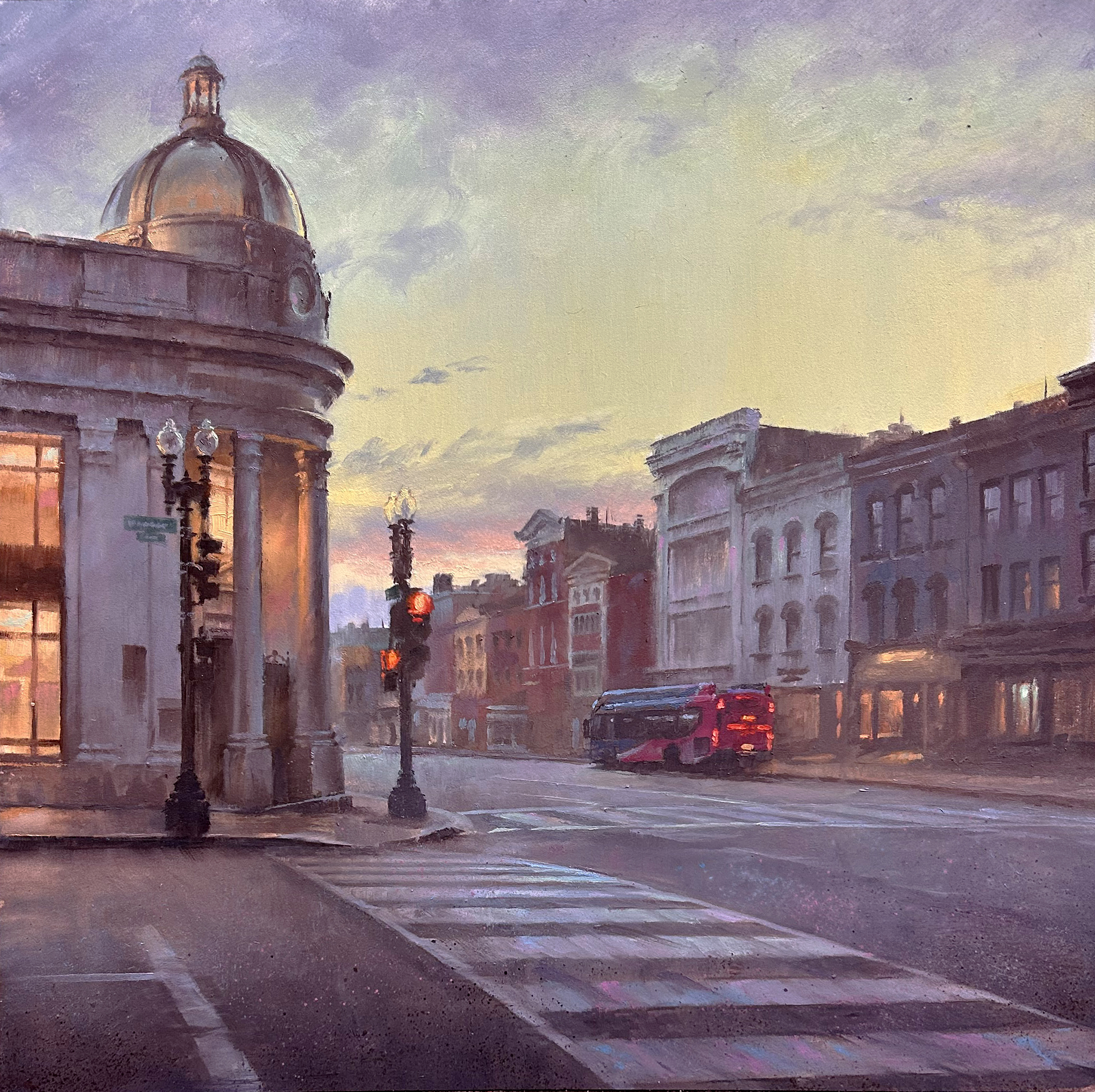
Gavin Glakas, “A Quiet Morning (M & Wisconsin),” oil on panel, 18 x 18 in.
To do my best work, I do plein air studies to understand the light, color, and depth, and I prefer this over the limited and distorted information we get from a photo. These studies are quick paintings and sketches that aren’t meant to look good. They’re basically just information-gathering exercises, but they’re very difficult to fit into a busy life.
So I spent six months plotting – making lists of all the places, lighting conditions, and vibes I wanted to paint. My sketchbook had passages like this scribbled in a hasty, borderline illegible hand:
Smithsonian castle golden hour
Twilight solitude
Electric explosion
Lincoln Memorial sunrise/sunset
Capitol Hill history row house rough
Eastern Shore peaceful stand by me
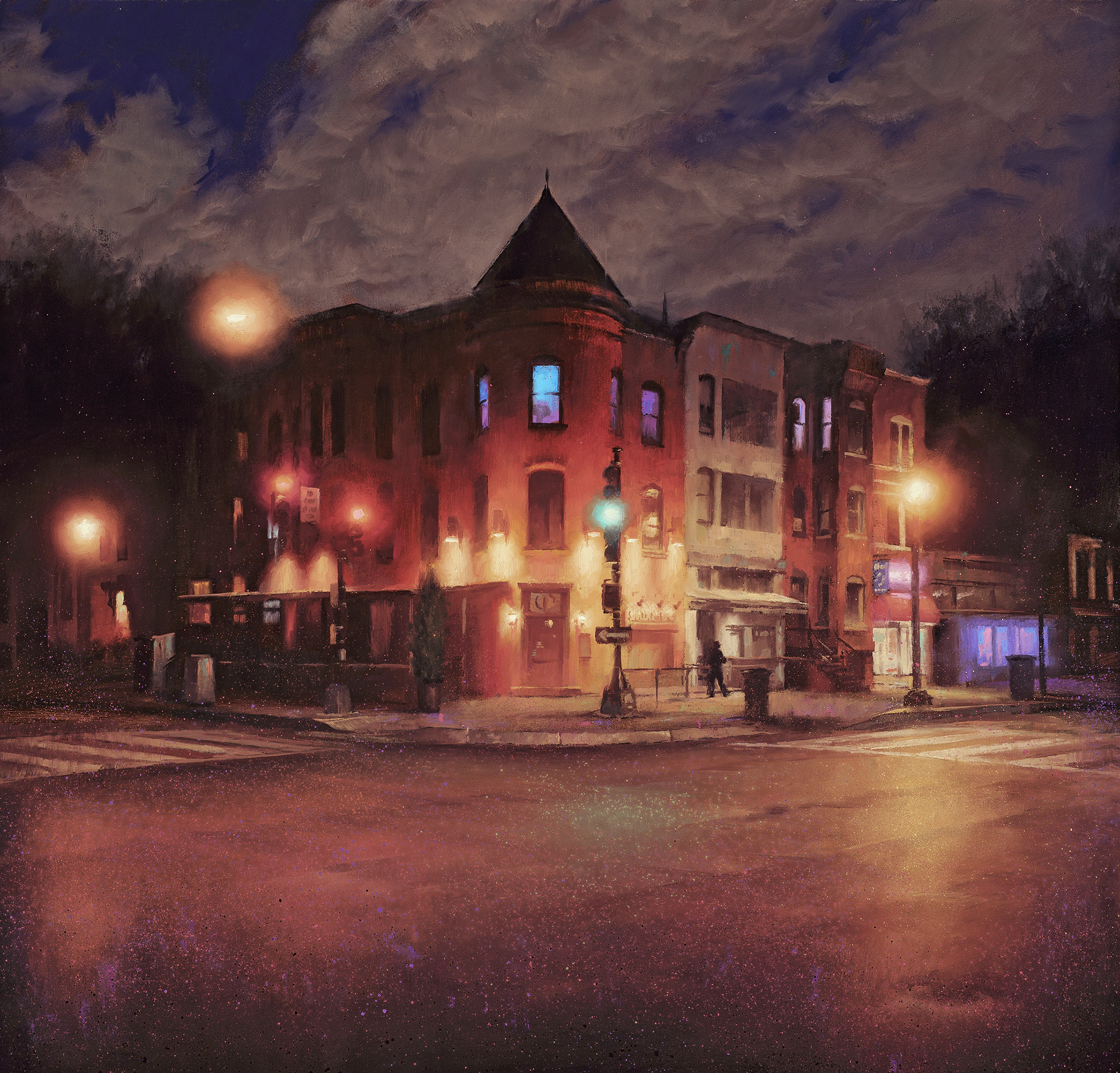
Gavin Glakas, “Electric 14th Street (Saint Ex),” oil on panel, 24 x 24 in.
Six months of brainstorming and then I struck! August. Wife and kids away for a week. Late nights and beer on the couch, you might ask?
No!
I woke up before dawn every day, dragged my easel downtown, did a color study or two as the sun was rising, worked on commissions in my studio all day, then headed out for another set of color studies that afternoon or evening.
After a week I had ideas, studies, and compositions for more than a dozen paintings I was on fire to paint.
The next two months were key because I didn’t work on them at all. I worked on my other paintings, led a plein air workshop on a Greek island, and let the ideas marinate.
What if I do this? What if I change that? I usually do it this way, but how else could I do it?
I could not have enjoyed this process more and, due to my scheduled creativity, when the time came to actually paint the paintings, I was ready.
Gavin Glakas, “The Eastern Shore (Denton, MD),” oil on panel, 16 x 32 in.
Works by Steven S. Walker in “Proximate”
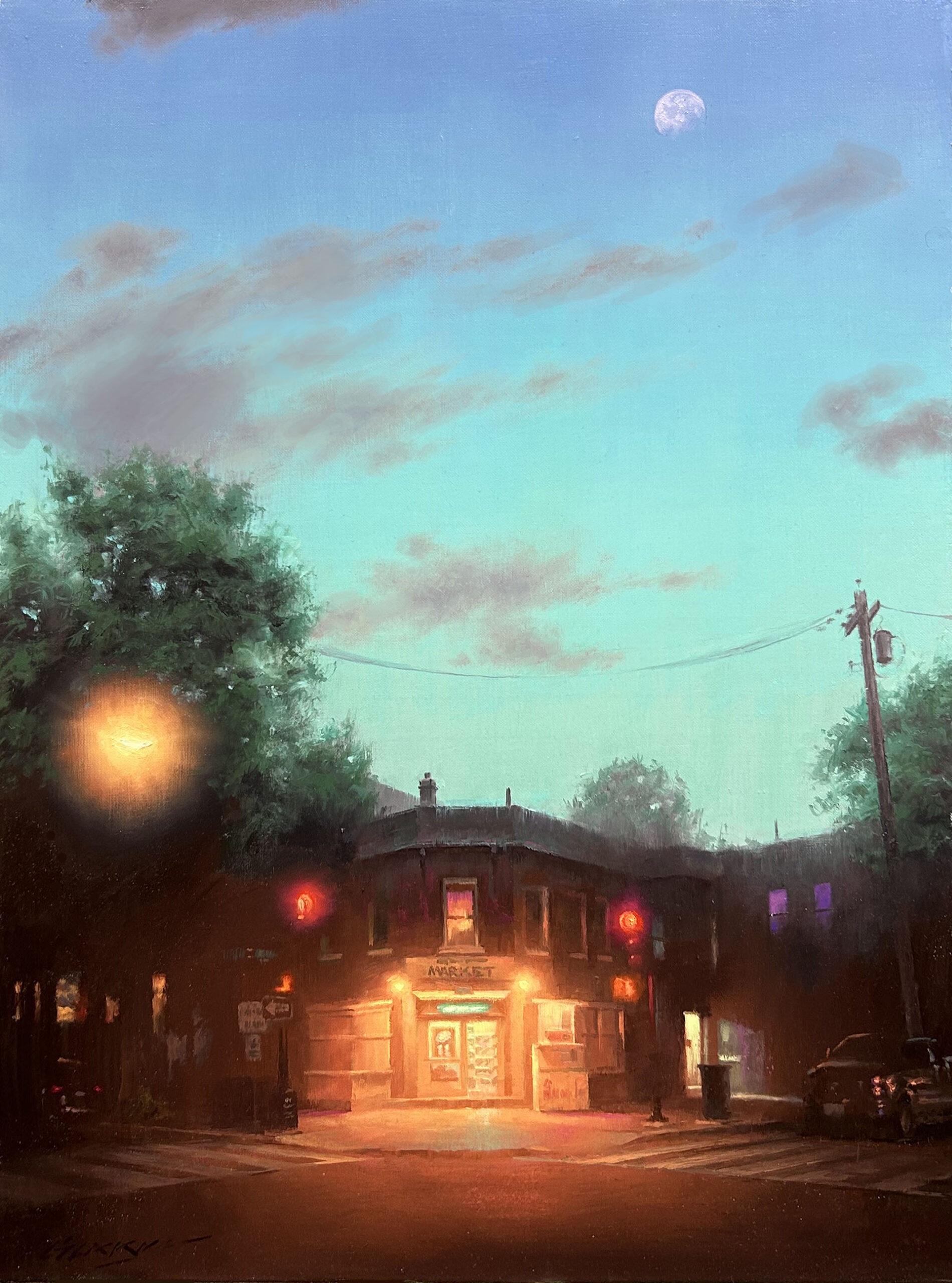
Steven S. Walker, “Wilson,” oil on panel, 24 x 36 in.Steven S. Walker, “Market Splash,” oil on panel, 24 x 12 in.Steven S. Walker, “In Memoriam,” oil on panel, 18 x 18 in.Steven S. Walker, “Key to the City,” oil on panel, 24 x 36 in.
From the gallery:
The two-person exhibition “Proximate” brings together local artist Gavin Glakas and Georgia-based painter Steven S. Walker, each presenting new work rooted in the landscapes and neighborhoods of the DMV. From quiet residential streets and overlooked corners to charged urban intersections, the exhibition offers a fresh, unsentimental look at a region most people think they already know. For more information about “Proximate” at Principle Gallery, please visit principlegallery.com.
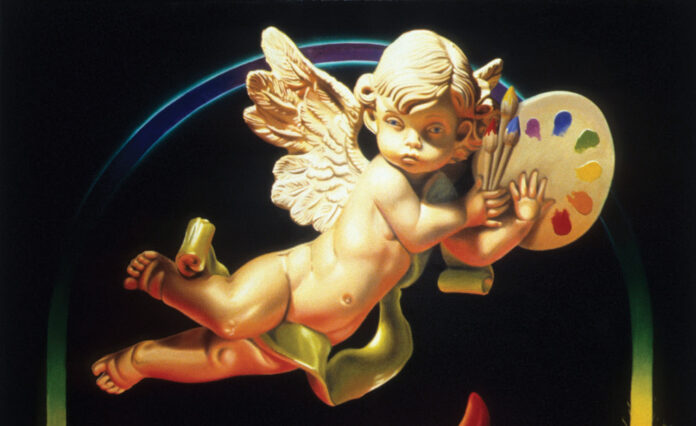
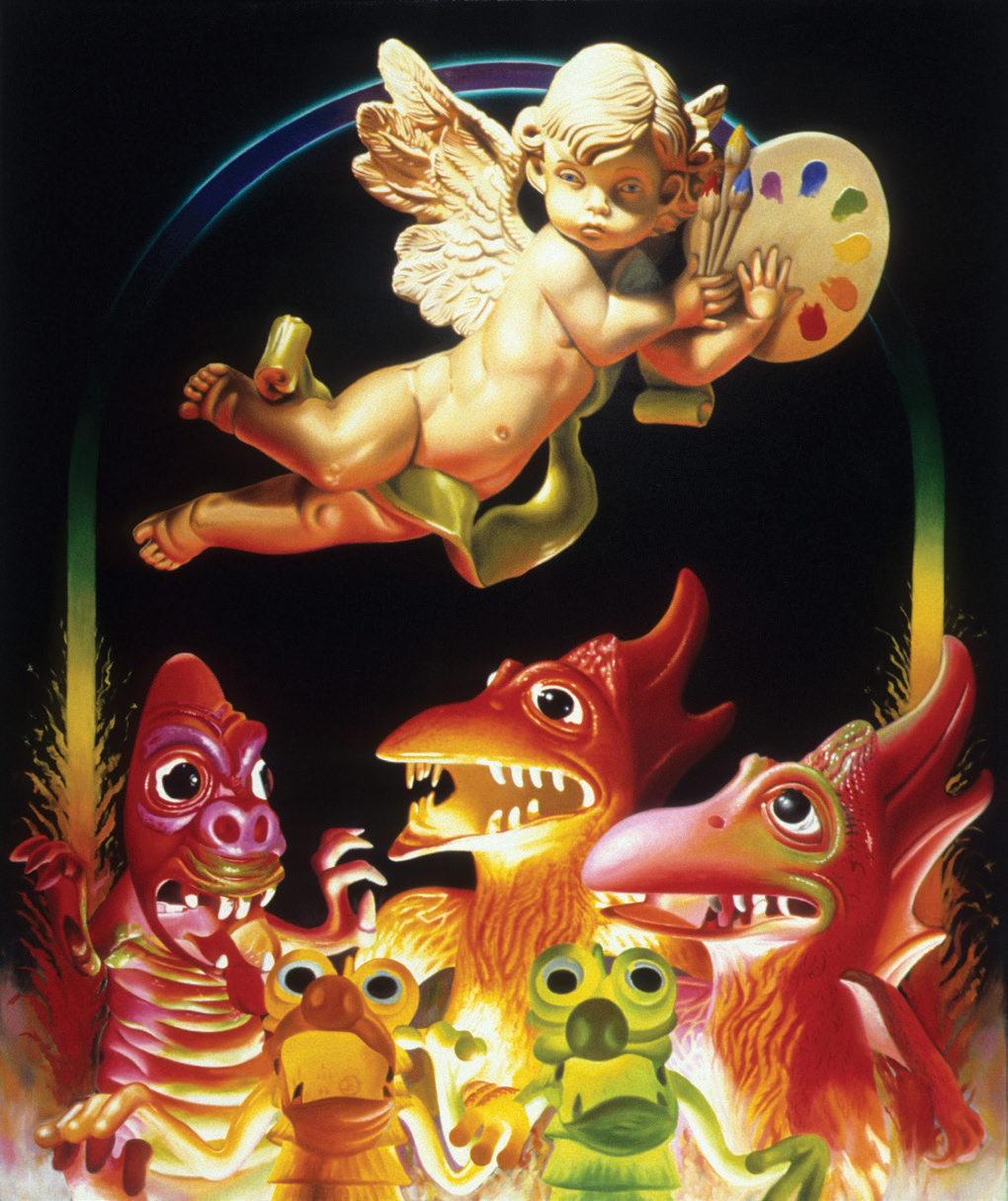
“Real, Surreal, and Photoreal” is the title of an exhibition at the Nassau County Museum of Art reflecting the fact that a range of American and European artists have, throughout the 20th century, created images that shift dramatically between fact and fantasy.
It encompasses paintings, works on paper, and even tapestries made by such talents as John Currin, Salvador Dalí, Carole Feuerman, William Glackens, Alex Katz, Fairfield Porter, Man Ray, and John Sloan.
Charles Bell (1935–1995), Art Angel, 1986, 72 x 60 in., Louis K. Meisel Gallery, New York City
“Real, Surreal, and Photoreal”
Nassau County Museum of Art
Roslyn Harbor, New York
Through March 8, 2026 nassaumuseum.org
As part of our effort to continue to help artists and art galleries thrive, we’re proud to bring you this week’s “Virtual Gallery Walk.” Browse the artwork below and click the image itself to learn more about it, including how to contact the gallery.
Want to see your gallery featured in an upcoming Virtual Gallery Walk? Contact us at [email protected] to advertise today. Don’t delay, as spaces are first come, first served, and availability is limited.
John Hull, "The Lowdown: Episode 25 Sergio Shoots Some Film," 2026, acrylic on canvas, 48 x 60 in.
Narrative art on view > In November 2024, John Hull ventured into a Catholic cemetery with photographer friend Steve Bliss to gain inspiration for new work—stories started to develop and the characters gathered for the story that he wanted to tell. The inspiration resulted in this show. Often characters find their way into paintings – either people he knows or from television, mainly other artists. One show that struck him was The Lowdown, a crime dramedy television series on FX.
Hull’s work invites viewers to take a closer look at the cast of characters he puts into his paintings. If you look carefully, you will find Ethan Hawk, star of The Lowdown, sharing a moment with Hull’s dog Forrest. Forrest, like many of his dogs, have made their way into several of Hull’s works over the years. Other cameos include friends and other artists that Hull admires – like Tony Anthony, Robert Rodriguez, Clint Eastwood, and Sergio Leone.
As Hull puts it, “I’m telling a story about artists. This is the artist, and the explorations of human beings in their role in the universe.” This main theme he explores, whether it is in a graveyard, a junkyard in Wyoming, a wrestling training center in Colorado, or baseball field, becomes evident.
Stories of life passages – “a series of psychological stories filled with boredom and wonder” are told by Hull. He wants to show human relationships and “the individual’s struggle to find equilibrium amidst passion and doubt. No matter how many different series or narrative ideas I explore as a painter, I think I end up telling the same story.”
“John Hull, The Lowdown: The Lost Episodes” is on view at Corrigan Gallery in Charleston, South Carolina, March 2-31, 2026.
Kathy Anderson, "Summer Yellow Roses," 2024, oil on board, 11 x 14 in.
Discover Kathy Anderson’s artful paintings of flowers in this feature article. By Daniel Grant
Based in Redding, Connecticut, Kathy Anderson (b. 1945) is a leading painter of floral still lifes and gardens, especially blooms gathered into groupings that provide contrasting colors and shapes. “I look for strong value patterns,” she says, “and for color combinations that excite me. A few weeks ago, I started a painting of white peonies, and now I have some pinks thrown in, even just spots of pink. That garden also had yellow lilies, which I wasn’t going to put in. But then I got home and thought, ‘You know what? I’m putting those in,’ and now they look so beautiful.”
A florist, Anderson notes, is usually focused on creating symmetry, balancing colors and flowers in equal measure, with everything at its peak. Her paintings, on the other hand, “look like a garden.” She says, “They have some dead flowers, pieces of flowers; occasionally you see a weed or grass or something like that. I have a more natural way of setting something up, as opposed to a formal bouquet, though sometimes I do that, too.” That peony painting, for instance, has some flowers in full bloom, but others are past their peak or just buds. It’s a still image that evokes the past, the present, and the future.
One might assume that someone growing up in the heyday of abstract expressionism and reaching maturity in the time of Pop, minimalism, and conceptualism would make art reflecting some of those influences. “My God, no,” Anderson laughs. “Experimenting in this, dabbling at that, trying one style after another. I’ve always gone to what I’m drawn to, which is nature and flowers.” She did study art, specifically illustration, at Farmingdale State College on Long Island. At the time it was the State University of New York’s largest college of applied science and technology, and its illustration program trained artists to work in the advertising industry. Anderson lasted a year and a half. The instruction was based on “very tight concepts,” and she hated it. “I just didn’t do the work and thought, ‘Oh, they’re not really going to flunk me,’” but they did.
Anderson spent 11 years working as a ticket agent for United Airlines at New York’s JFK airport, getting married in 1970 and eventually having children, all of which moved any aspirations to paint full-time to the back burner. But, as every parent knows, children do grow up and parents contemplate what they want to do next. Suddenly there was time to attend workshops and plein air paint-outs. “During my early career, I was pretty much self-taught,” Anderson explains, but if you work at something long enough, you generally will become more proficient.
She began with watercolors, painting birds, flowers, and wildlife, and showing in one or two local galleries. Anderson says she “transitioned to oils because I never painted as most watercolorists do, prioritizing the medium’s transparency. Instead I preferred to add gouache or even pastels. So I said to myself, ‘Why don’t I just work in oil?’”
In addition to selling through small galleries, Anderson bought a tent and began selling directly at outdoor shows for several years, which she now looks back on as “a nightmare.” She says, “It’s always weather-dependent. It’s too hot, it rains, it’s too cold.” Eventually, she put away the tent and began working with a few friends as a muralist, painting images on interior walls and ceilings in private homes.
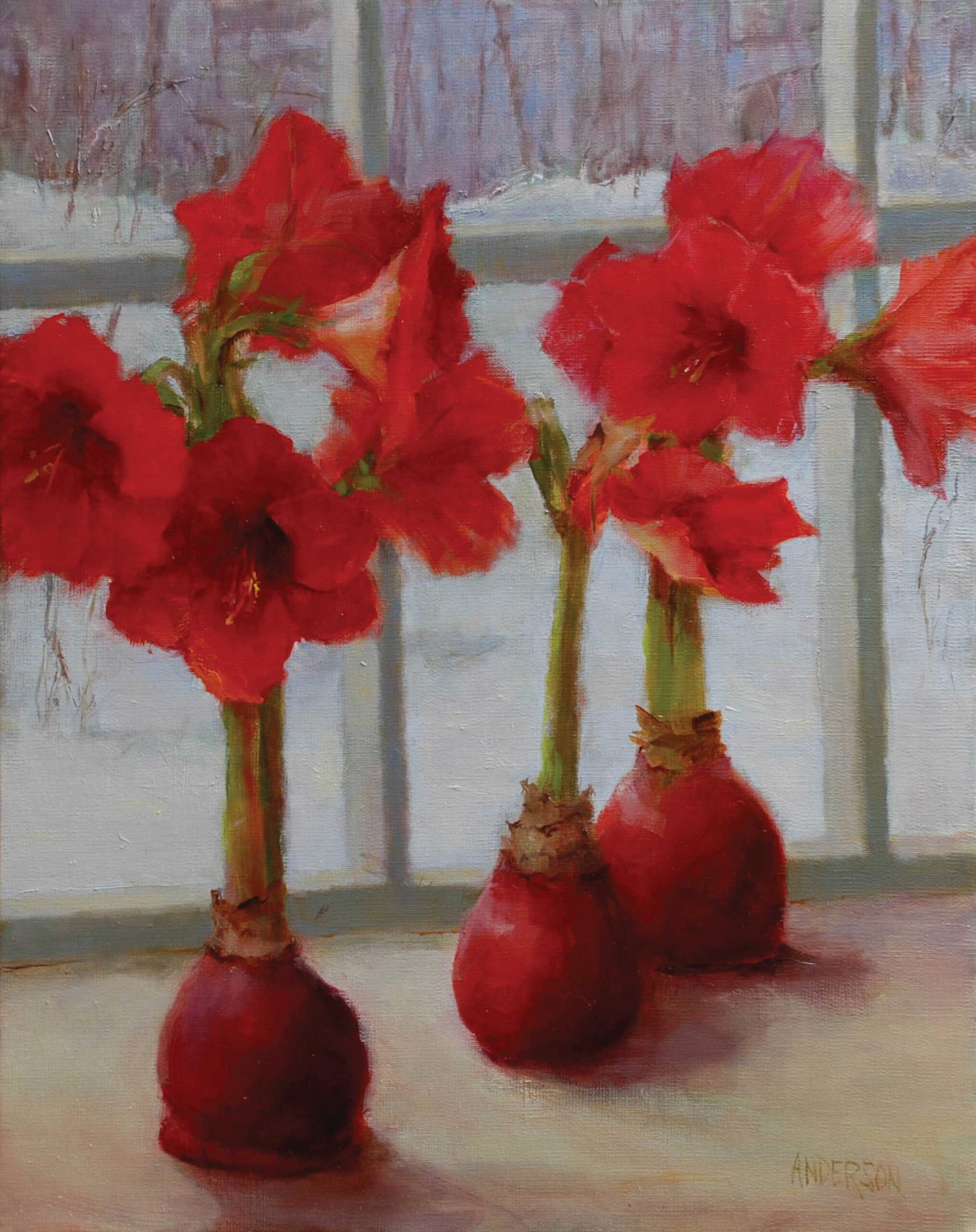
Kathy Anderson, “Amaryllis in Red Wax,” 2024, oil on stretched canvas, 20 x 16 in.
The Turning Point
It was at an arts and crafts festival in Sherman, Connecticut, that one of her paintings was purchased by the award-winning artist Richard Schmid (1934–2021), who had lived in the town before and returned annually to help promote the festival. The two artists did not actually meet at the time of the sale, but the next year Anderson participated in the same show “and introduced myself,” she says. “Richard then invited me to join the Putney Painters.” (Schmid, who died in 2021 at the age of 86, was the focal point of painting groups he formed in the various places he lived; this particular group met periodically in Putney, Vermont. Many of his valuable tips appear in the book Alla Prima: Everything I Know about Painting, which has been updated often by Stove Prairie Press since its first appearance in 1998.)
“What appealed to me about Richard mostly was his unbelievable joy in painting,” Anderson recalls. “And the standards of excellence I learned from him: don’t put out work that isn’t your best; don’t settle; always keep learning and sharing. That was the main thing: to share and pass it on.”
Schmid’s widow, the artist Nancy Guzik, says that his “influence on Kathy was profound. As members of the Putney Painters, they worked together regularly, providing Kathy with invaluable opportunities to observe Richard’s process up close. She learned how he approached and resolved artistic challenges and utilized his tools and materials. She observed his entire painting process from start to finish. Richard generously shared his knowledge, eagerly answering her questions and offering guidance. Over more than 19 years, their collaboration deepened into a close working relationship and a cherished friendship full of fun.”
Perhaps the most crucial lesson Schmid imparted to Anderson was to simplify her goals and paint what excites her. She recalls him saying: “Are you excited about that color? About the light on those particular flowers? Will what you see become a great composition?” Anderson also credits her long friendship with her Connecticut neighbor Everett Raymond Kinstler (1926–2019), whose influence and critiques added to her dedication to high standards in all aspects of an artistic career.
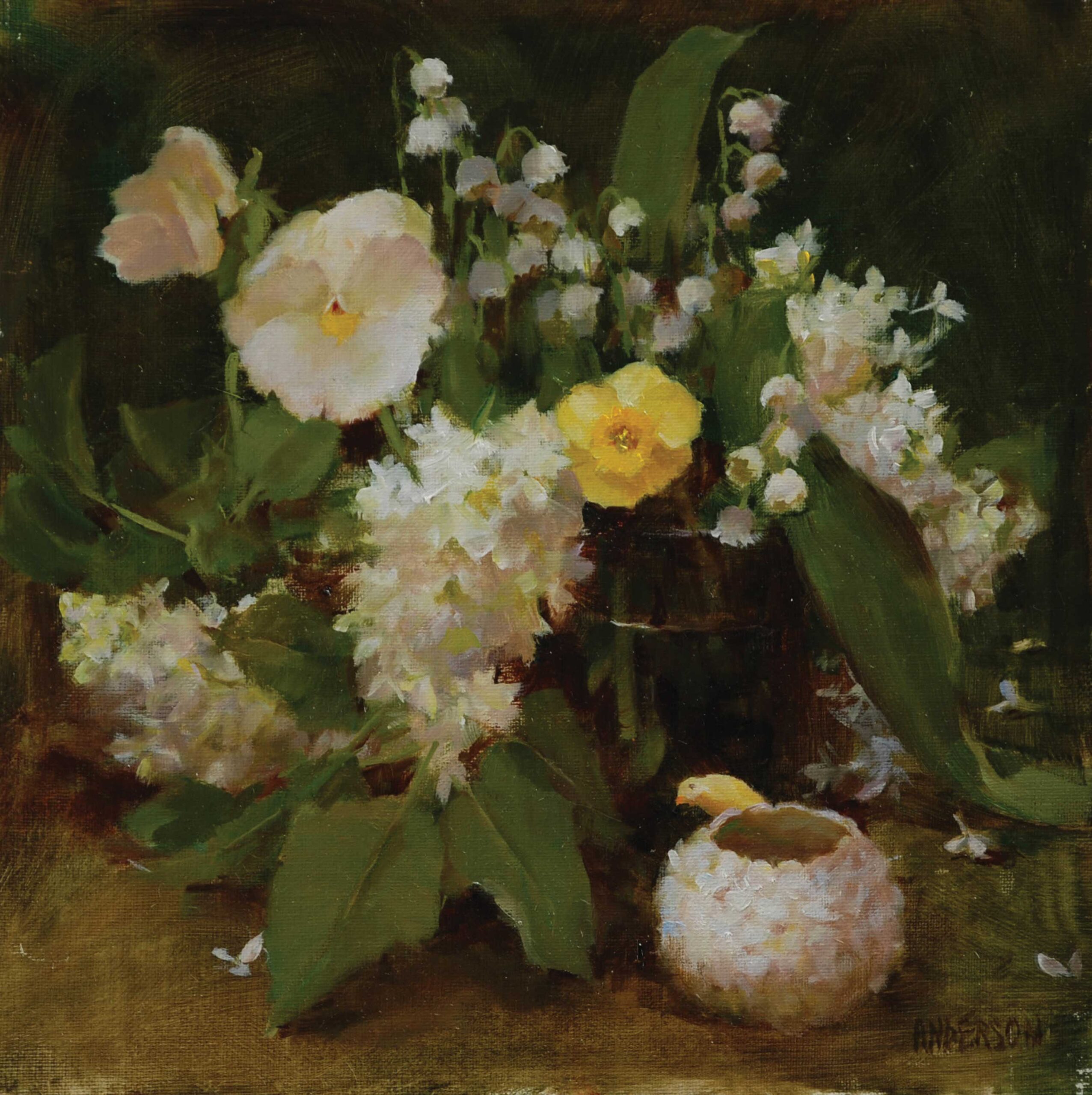
Kathy Anderson, “Harmony in White with Lilacs,” 2024, oil on board, 10 x 10 in.
Today Anderson keeps busy producing 30 to 40 paintings per year that range in size from 6 x 8 up to 34 x 50 inches. And she keeps her husband, John, equally busy as her expert in-house framer. That’s enough output to keep her seven galleries stocked with inventory that generally sells between $2,000 and $12,000 per piece. Anderson also teaches workshops around the country and abroad.
Anderson also enjoys painting landscapes and has participated in many plein air shows and paint-outs. On location, she looks not so much at “the big vista, the mountains, and clouds in the distance. I prefer intimate landscapes.” The world is her garden, and the garden is her world.
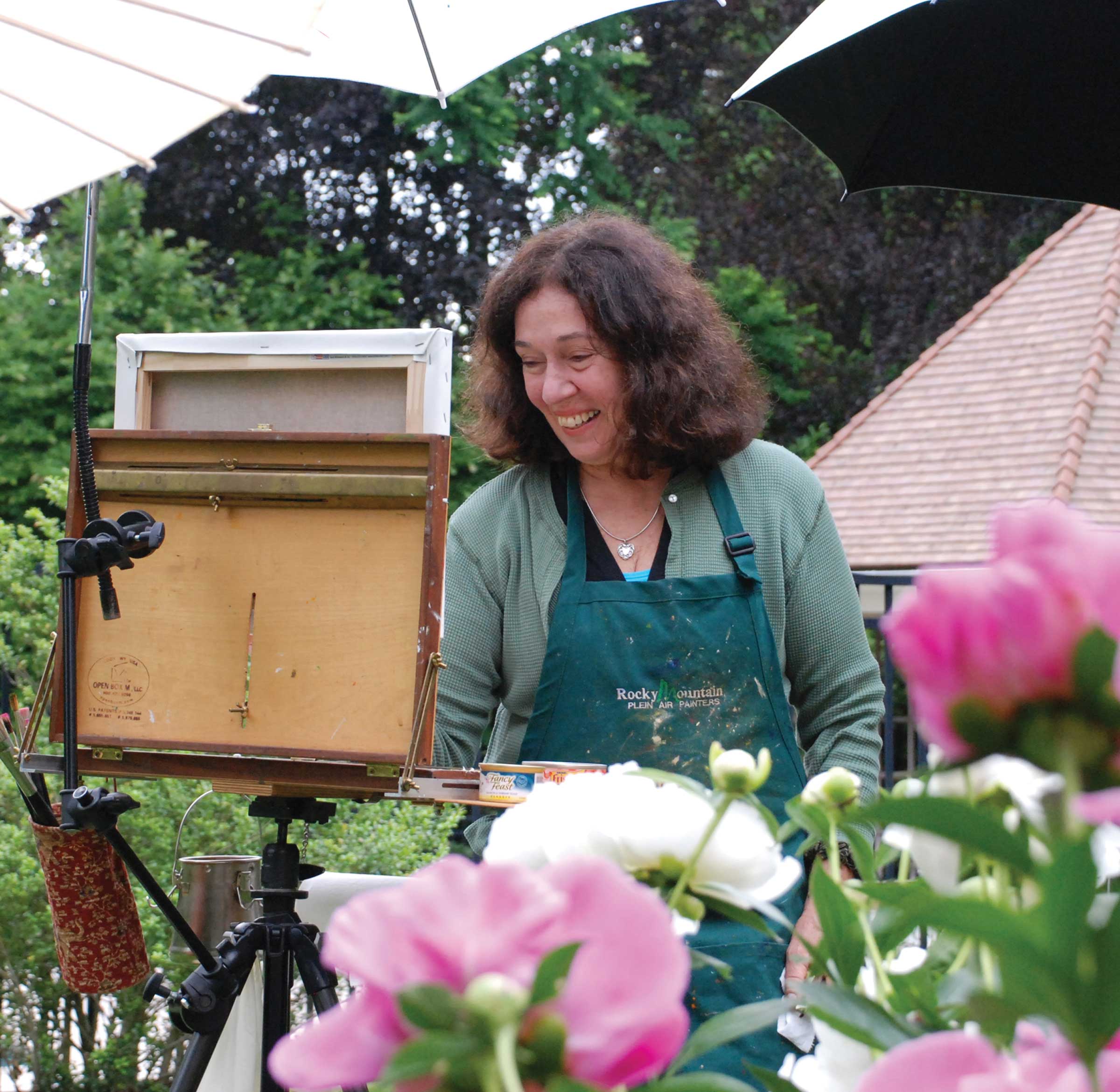
Kathy Anderson painting peonies in a garden
Paintings of Flowers & A Paradox
From time to time, I had occasion to speak with the late critic and author Dore Ashton. If I mentioned “the art world,” she would interrupt me to say, “There is no art world.” She meant that nothing holds together all of us artists, critics, curators, buyers, sellers, and viewers other than the word “art.” Instead, there are numerous niches where people maintain their own language in a certain fiefdom and look down on — or at least have little to do with — other fiefdoms. Just for example, artists highlighted in Fine Art Connoisseur almost never appear in ARTnews and Art in America, and vice versa.
Today I dare you to visit the “leading” galleries of New York City, Los Angeles, Chicago, or Miami and find plein air paintings of flowers. Yet all of us like flowers; many of us visit botanical gardens wherever we go, from Brooklyn to Giverny to Marrakesh, but somehow there is a disconnect between what we like to see in life and what we see in contemporary art.
Flowers in bloom (embodying life at its fullest) or in decay (signifying the shortness of life) were a long-standing artistic subject from the 17th century (e.g., Chardin, Bosschaert) right through the 19th century (Manet, Van Gogh). The modernists sustained this interest — just think of Klimt, Matisse, and O’Keeffe. But something changed in the mid-20th century: Warhol’s 1964 “Flowers” are just blocks of color with little to signify that they are hibiscus, while the floral backgrounds in Kehinde Wiley’s current portraits of Black rappers seem less to do with a love of flowers than with making a point about how Baroque artists depicted famous white men.
Kathy Anderson, “White Anemones with Nasturtiums,” 2023, oil on board, 10 x 14 in.
Not everything has to be ironic. One of Anderson’s dealers, Susan Powell of Susan Powell Fine Art in Madison, Connecticut, notes that “many of my clients like realism, and many respond to how lifelike Kathy’s floral and garden subjects are. Gardens will always be appreciated in the modern world because most people respond to the beauty of flowers and their surroundings.”
About the Author: Daniel Grant is the author of several books, including The Business of Being an Artist (Skyhorse Press). He also is a contributing writer to Fine Art Connoisseur.
Kathy Anderson’s easy-to-follow and detailed painting demeanor will have you painting fresh beautiful florals with new knowledge of floral structure. Her passion is easily conveyed so you’ll soon share her true love for the flowers, weeds, dirt and detritus of a natural, healthy garden. Learn more about how to paint flowers with Kathy’s three art video workshops.
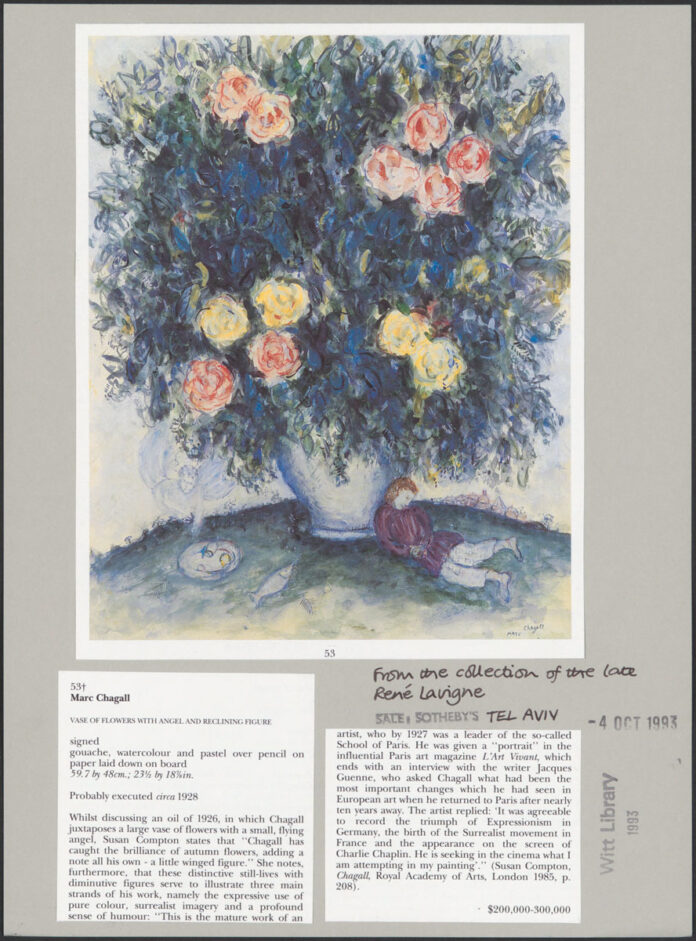
Marc Chagall’s painting "Vase of Flowers with Angels and Reclining Figure" (c. 1928)
Founded in 1932, the Courtauld Institute of Art is Britain’s leading center for the study of art history, holding not only an important collection of fine art but also unparalleled archival resources consulted by students, researchers, art trade professionals, and the public.
The Courtauld recently completed an 18-month project to digitize its Witt Photographic Collection (“The Witt Library”), which contains more than 2 million images of Western art spanning eight centuries. Anyone can visit the Courtauld website to explore this trove of photographs, reproductions, and clippings of artworks dating from the 13th century through today.
Founded in the 1890s by Robert Witt, one of the Courtauld’s co-founders, this holding began during his undergraduate years at Oxford, where he specialized in the Italian Renaissance. It expanded significantly in 1899 following his marriage to Mary, a fellow collector of photographs of Western art. Their brainchild was acquired by the Courtauld in 1944, and now is arranged into 26 different national “schools” categorized by artist and subject.
Since the 1890s, its sturdy cardboard sheets have been pasted up with clippings from auction cataogues, books, newspapers, and periodicals, even with original photographs and prints.
Previously stored in more than 19,000 boxes occupying almost a mile of shelf space, in 2023 the collection was shipped to the Dutch firm Picturae BV, where every item was photographed in high resolution. A useful example is illustrated above, showing Marc Chagall’s painting “Vase of Flowers with Angels and Reclining Figure” (c. 1928). Everything on this card was clipped from the catalogue of a Sotheby’s Tel Aviv auction held in 1993, the same year the card was created by a librarian, who annotated it by hand with the name of the seller. Even today, finding such obscure information online is difficult, so it’s no wonder the Witt Library features regularly as a filming location on the BBC’s hit television series Fake or Fortune.
Soon the Courtauld staff will begin transcribing all of the cards’ information and creating keywords so online users can search the entire collection by title, subject matter, and concept. In 2023, a team of 14,000 volunteers completed a similar five-year-long campaign for the Courtauld’s Conway Library of photographs of world architecture, architectural drawings, sculpture, decorative arts, and manuscripts. Also in 2023, the Courtauld Gallery launched its searchable website cataloguing its more than 33,000 original artworks.
Resources like these are expensive to create and maintain, but priceless for users who no longer must travel to London to study them by appointment. The Courtauld deserves much praise, and financial support, for sharing its riches with the public in these ways.
As part of our effort to continue to help artists and art galleries thrive, we’re proud to bring you this week’s “Virtual Gallery Walk.” Browse the artwork below and click the image itself to learn more about it, including how to contact the gallery.
Want to see your gallery featured in an upcoming Virtual Gallery Walk? Contact us at [email protected] to advertise today. Don’t delay, as spaces are first come, first served, and availability is limited.
On Collecting Art > Lynn and Dan Tarrence live in Milwaukee, where she works as an interior designer and he helps investors support environmentally sustainable companies.
Their collecting journey began with a shared love of vintage black-and-white photographs featuring such iconic figures as Frida Kahlo, Jacqueline Kennedy, and Paul McCartney. In 2016, when Dan was serving on a nonprofit board, he was invited by a fellow trustee to visit his newly opened Lily Pad West Gallery. Through the friendships the Tarrences formed with this Milwaukee gallery’s owners, Alan Perlstein and Terry Hamann, “we soon embarked on an inspiring journey into the art world.”
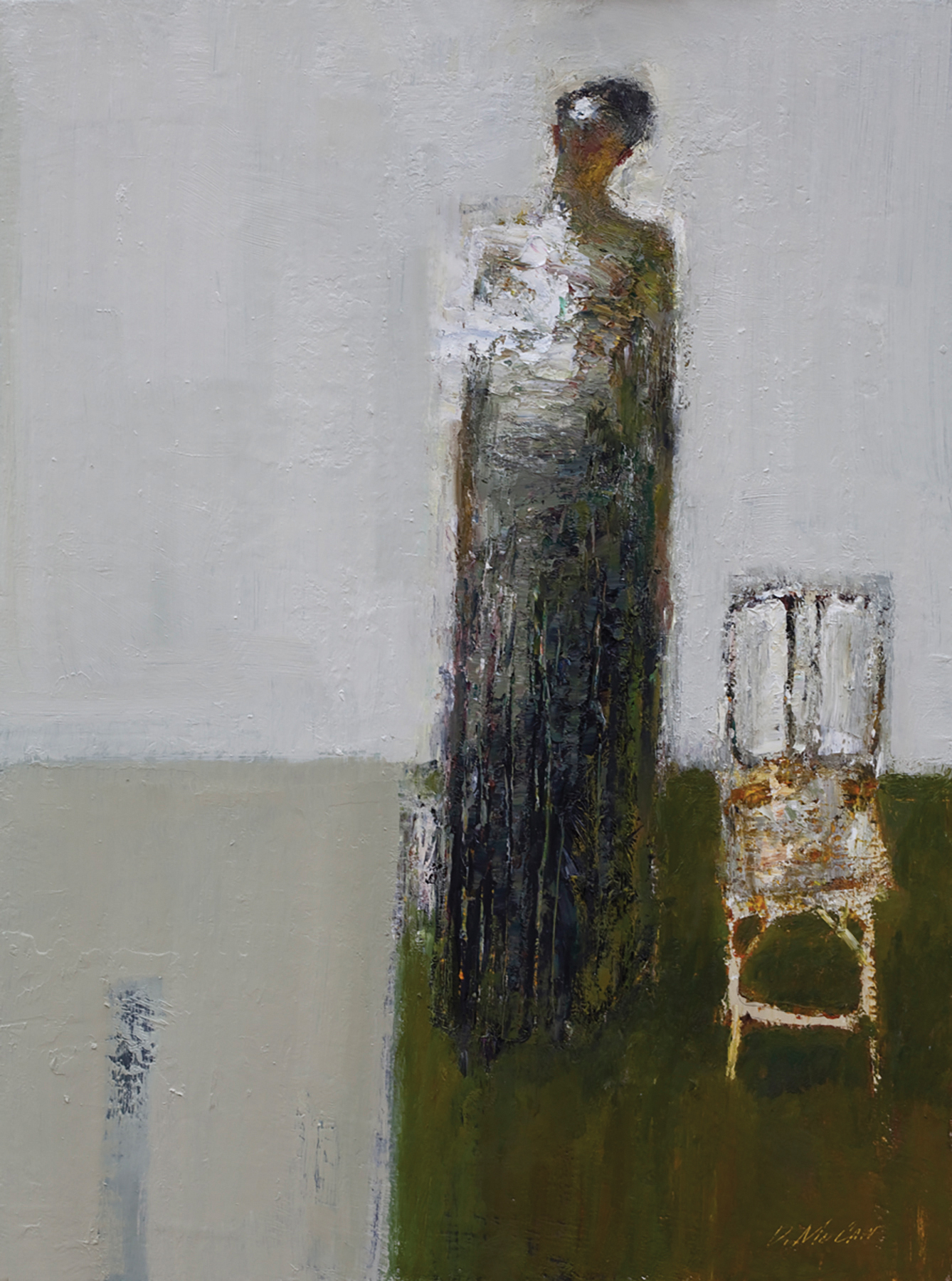
Dan McCaw (b. 1942), “Waiting,” 2016, oil on board, 24 x 18 in.
During their first visit to Lily Pad West, Lynn was immediately captivated by Dan McCaw’s painting “Waiting,” illustrated above. “In fact,” the Tarrences recall, “she couldn’t take her eyes off it, overwhelmed by the poignancy of its solitary figure. A week later, we returned, and ‘Waiting’ still held the same magic. On our third visit, Lynn made up her mind, pulled out her checkbook, and purchased the painting with her own money. It was a moment of pure connection and the start of our art collection.”
Since then, the Tarrences have acquired pieces by Peter Layne Arguimbau, Peter Batchelder, Jeff Faust, Guido Garaycochea, Susan Hall, France Jodoin, Dan McCaw, John Robert McDonald, Tim Meyerring, Andy Newman, David Patterson, and Christopher Pierce. They enjoy attending gallery shows featuring new work by these artists, and over the years they’ve had the pleasure of meeting Faust, Garaycochea, Jodoin, McDonald, and Patterson in person. “Hearing directly from artists about the inspiration and thought processes behind their creations is always inspiring,” Lynn notes.
The Tarrences enjoy participating in Milwaukee’s lively Gallery Night events, held four times per year, which “provide an engaging way to explore and celebrate the local art scene.” Other venues they visit include the Saint Kate Arts Hotel, student shows at the Milwaukee Institute of Art and Design, and various plein air shows, but they buy primarily through Lily Pad West.
Art has enriched their lives in other ways: “Now our travels take us to famous art destinations such as Amsterdam’s Rijksmuseum, and those visits often inspire us to purchase art there when we have the opportunity.” Visiting Tucson, for example, the Tarrences acquired two 1953 pieces by the French artist and writer Jean Cocteau, who was deeply influential on the surrealist and Dada movements.
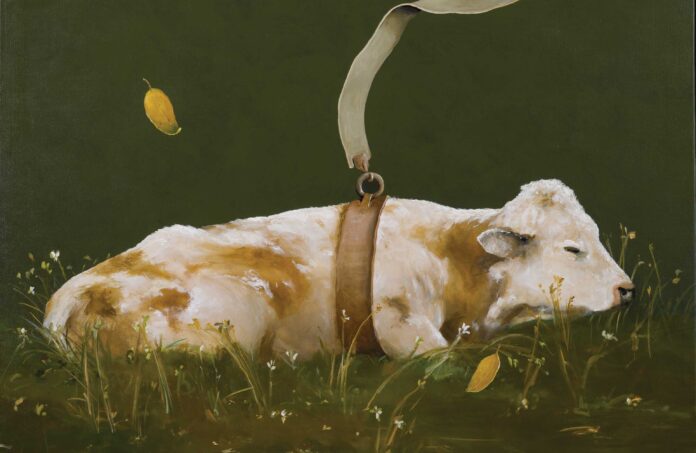
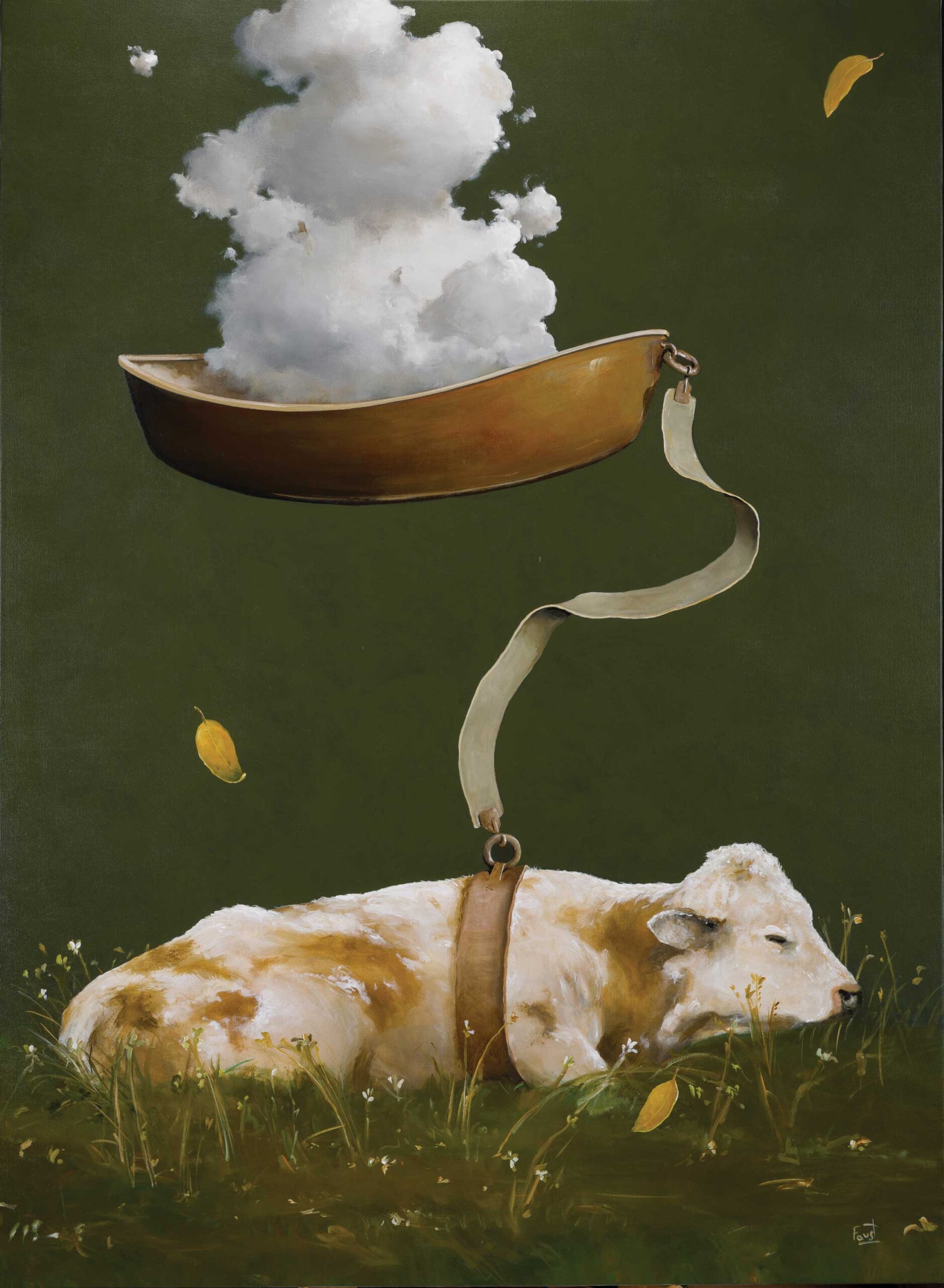
Speaking of surrealism, “When we bought our second painting by Jeff Faust,” Lynn observes, “it was the first time we had decided to collect a particular artist as a conscious choice. Previously, it had all been by heart.” One of their Faust works, “Clouds for the Poets,” is illustrated below; Dan says, “We loved it so much that Lynn designed our entire kitchen around it. Jeff even came to see the painting in its new home, and we hosted a small cocktail party to mark the occasion.” Of course, one is unlikely to see a cow resting with a cloud-filled rowboat floating above it, and that delightful streak of magic realism appeals to the Tarrences and can also be seen in two other Lily Pad West artists, Guido Garaycochea and H.M. Saffer II.
Jeff Faust (b. 1952), “Clouds for the Poets,” 2016, acrylic on canvas, 60 x 44 in.
As for displaying their treasures, the couple face the same logistical challenges other collectors do: “When Lynn likes a painting she sees at the gallery, Dan usually says all our wall space is taken. Yet somehow Lynn can always find space for a new one!”
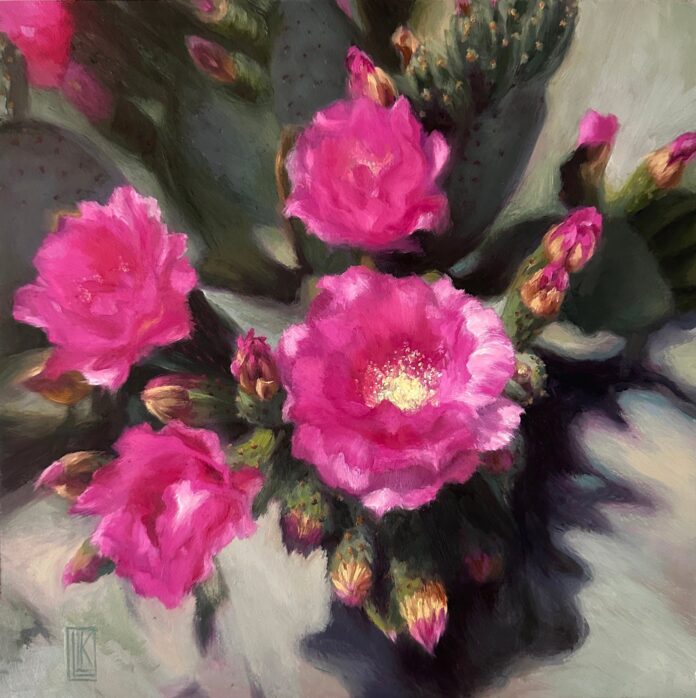
Laura Krusemark (b. 1977), "Desert Fireworks," 2025, oil on panel, 12 x 12 in.
Scottsdale Artists’ School: Best & Brightest
Scottsdale, Arizona scottsdaleartschool.org
Through March 12, 2026
Now in its 42nd year, the Scottsdale Artists’ School is set to present “Best & Brightest,” the annual juried art show and sale highlighting artworks created by its top students and alumni living around the world.
All artists who have taken a workshop, program, or online class through the school since 2019 were invited to submit their works for consideration.
The official opening reception and awards announcement ceremony is set for February 12. First and second place awards will be presented in each of six categories: drawing, oil painting, pastel, water media, sculpture, and small work.
The school’s executive director, Trudy Hays, is quick to praise the “professional quality of Scottsdale Artists’ School students” and laughs that she does “not envy the team assembled to jury the pieces because they have a difficult assignment.”
Among the works to be offered is the one illustrated above, “Desert Fireworks.” Its creator, Laura Krusemark, explains: “During my walks in the Scottsdale area, I was inspired by these bright fuchsia cacti blooms saying hello to me under the afternoon sun while their petals cast fanned-out shadows, like a dance across the sand. This piece captures the resilience and brilliance of the Southwest, where beauty thrives in light, movement, and unexpected places.”
For those who cannot attend in person, be sure to view and buy works directly from the school’s website.
Fill your mind with useful art stories, the latest trends, upcoming art shows, top artists, and more. Subscribe to Fine Art Today, from the publishers of Fine Art Connoisseur magazine.