
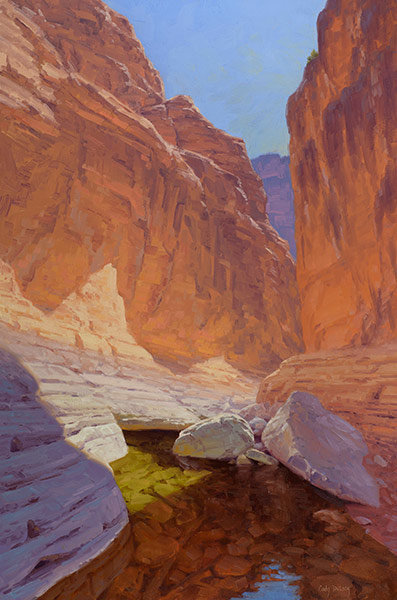
“Around the Corner”
oil on canvas
36 x 24 in.
About the Artist:
Cody DeLong from Cottonwood Arizona,, knows the Grand Canyon intimately,
having painted there for many years and from a variety of vantage points, including both the North and South Rims and the Colorado River. At the 2015 Grand Canyon Celebration of Art, he was honored by his fellow artists as the winner of the Artists’ Choice Award.
Speaking about “Around the Corner,” DeLong says: “This is a side canyon from one of my many rafting trips through the Grand Canyon. I love the little triangles of light in this scene. It just makes me want to hike farther and see what’s around the corner.”
As one of the 26 artists participating in the 8th annual Grand Canyon Celebration of Art, Delong will be painting the weekend of September 10th at the North Rim of the Grand Canyon. He and fellow artist Mitch Baird will be doing a dual demonstration on the porch of the North Rim Lodge on Saturday, September 10th, from noon until 2pm.
Both artists will join the rest of the artists at the South Rim for the plein air event taking place September 10-17, 2016, with the exhibit and sale of their work at Kolb Studio opening on September 18 and continuing through January 16, 2017. Proceeds from this event support the goal of funding a permanent art venue at the South Rim of the Grand Canyon.
For more information and a schedule of events please visit:
https://www.grandcanyon.org/arts-and-culture/2016-celebration-art
or contact Kathy Duley [email protected] 480.277.0458.
Featured Artwork: Grand Canyon Celebration of Art’s Cody DeLong
Featured Artwork: Kathryn Turner
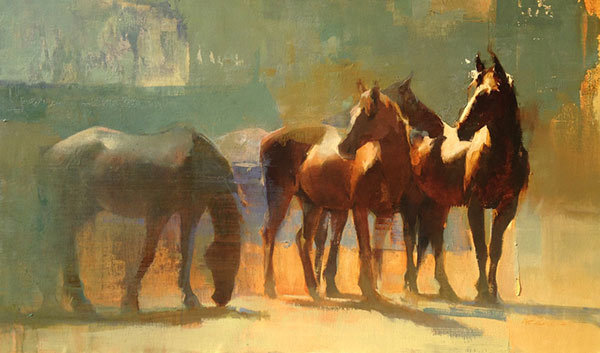
“Everything Shines as it Disappears”
Oil on linen
36 x 60 in.
www.turnerfineart.com
Light on the Land
Kathryn Turner’s latest collection of works is entitled “Light on the Land” which relates to three central concepts she explores in her artwork.
Firstly, visible light itself compels most artists by illuminating form and making color possible. In this body of work, Turner explores the many varieties of light from bright sunshine, to the diffused light of fog. One constant is that, in the landscape her native Jackson Hole, the light is ever changing, and this is directly reflected in her evolving artwork.
Among the highlights of this exhibition are many spectacular images of wildlife and animal subjects. These abstracted images capture a sense of movement and vitality in the forms.
Turner’s passion for animals stems from her upbringing on the Triangle X Ranch – a family guest ranch business located within Grand Teton National Park. Working with the animals on the ranch and encounters with the wildlife that surrounded it gave her an appreciation for the beauty of their physical forms as well as a reverence for the way they live in harmony with the environment. She is inspired by how animal species live so light on the land. With deep reverence, she believes we can learn from them about how to live sustainably on this earth. Her paintings reflect this admiration.
The centerpiece of the exhibition is a complex and bold painting of a herd of horses. This notable piece is complex in nature due to its abstracted composition and use of color. “Everything Shines as it Disappears” reflects Turner’s maturity as a artist. It tells a personal story of her family’s recent experience with Alzheimer’s disease. Objectively, the artist has retained the essential forms of the anatomy of the horses while expressing a heightened level of energy and mystery. The horse on the far left eventually fades to a gossamer veil. “I wanted to really push myself in this piece by creating a daring, expressive piece. I believe that, by its nature, art is meant to evolve. It was my hope that this painting could pave its own path to someplace all-together new.” Such a goal would be paralyzing had it not been that Turner found a Leonard Cohen quote which provided guidance “Forget your perfect offering. There is a crack in everything. This is how the light gets in.” In order to allow for the natural evolution of the painting as well as her own style, she had to have a lightness in her approach and be willing to explore new territory. The result is indeed a rare image with singular expression.
Featured Artwork: Zion Plein Air’s John Cogan
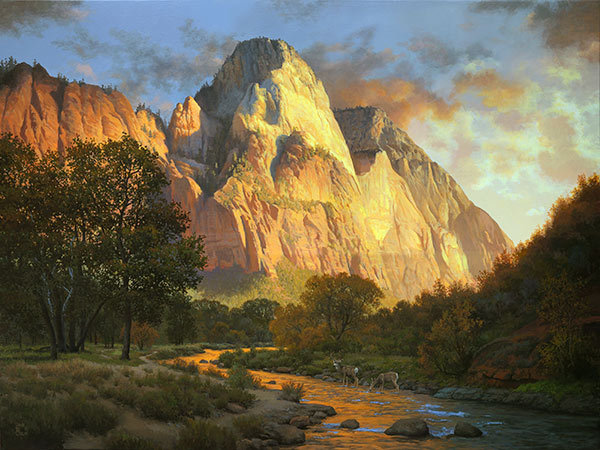
“Waters of Evening”
acrylic
30 x 40 in.
ZION PLEIN AIR ART EVENT 2016 CENTENNIAL EDITION
Twenty-four invited artists will paint in Zion Canyon during the week of November 7-13, 2016, celebrating the role art played in the creation of the park. This year’s eighth annual Zion National Park Plein Air Art Invitational is being billed as the “Centennial Edition,” celebrating the influence of original art in the founding of the National Park Service one hundred years ago.
Among this year’s selected artists are long-standing favorites, a few who have been away for a while, as well as six brand new artists to the event. There are 16 oil painters, three watercolor artists, two who work in acrylic, and three pastel artists. This year’s featured artist, selected as last year’s Foundation Award Winner, is John Cogan of Farmington, New Mexico. Cogan’s new painting, “Waters of Evening” is featured in this year’s advertising and promotional materials.
As part of this year’s “Centennial Edition” of Plein Air, each artist is invited to submit one studio painting of a national park other than Zion. Those paintings, along with one other studio painting by each artist, will hang in the Zion Human History Museum beginning September 14 through the end of the Plein Air Week in November. The studio paintings are on sale as soon as they are hung. The plein air paintings produced during Plein Air Week will go on sale Friday evening, November 11, at an invitation only preview event for art buyers. Then, beginning Saturday morning at 9 am, the show opens to the public and remains open, 9 am to 5 pm through November 28, 2016.
Keeping with tradition, each artist will give a free one-hour painting demonstration during the week, on the patio of the Zion Human History Museum. Visitors may also interact with artists throughout the week as they paint at various locations in the canyon.
Saturday of Plein Air Week has become one of the most fascinating days of the year in the park as all 24 artists participate in a “Paint Out” and sale which is held up-canyon on the lawn of the Zion Lodge. Between 11 am and 2 pm, visitors can watch each of the artists paint in fairly close proximity and if their heart settles on a particular painting, they can put their name on it and claim it for purchase, even before it is completed. In the meantime, a silent auction of the paintings produced for the demonstrations during the week will be ongoing in the Lodge Auditorium. When the bell rings, each painting goes to the highest bidder on the bid sheet.
This year’s Centennial Edition of Plein Air will also feature a special slate of free lectures on Tuesday, Wednesday and Thursday evenings, as well as a Friday morning presentation by Zion Canyon Field Institute Director Michael Plyler on the role of art in the creation of the National Parks.
If you can only spend a few days, or even one day, in Zion National Park this year, make plans for that visit in early November when the air is inspiringly crisp, the leaves are golden, and the artists are at work.
Featured Artwork: Chantel Barber
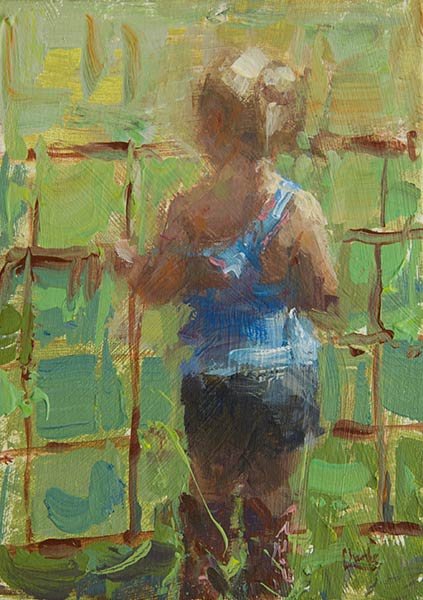
“Outside of the Fence”
acrylic
About the Artist:
Chantel’s passion for art began flourishing at age 12 when she was mentored under local San Diego artists. She continued to study art, largely self-taught, while living in Newport, Rhode Island and Keflavik, Iceland. While enrolled in a college art course, a fellow student introduced her to acrylic paints, and she soon found it to be a medium dominated by abstract art. But her first love was portraiture for which she found little advice. As she dreamed of perfecting her skills as an acrylic portrait artist, Chantel continued to learn from professional oil painters and translated their teachings into acrylic techniques. All the while, she remained active in local art communities.
In 2006, Chantel opened her own art business called Chantel’s Originals near Memphis, Tennessee. Chantel soon benefited from workshops and demonstrations with outstanding artists including Dawn Whitelaw and Michael Shane Neil. Chantel is currently the Tennessee State Ambassador for the Portrait Society of America, and is also a member of The Chestnut Group, and the American Impressionist Society. She is past President of Artists’ Link in Memphis, Tennessee.
Chantel has been featured in solo art shows and has participated in numerous group shows at premiere Memphis venues including the Dixon Gallery and Gardens. Her award winning paintings are in private and public collections throughout the United States and overseas. Her work is published in a feature length article in Acrylic Artists magazine. Chantel resides in Bartlett, Tennessee where she teaches online and in workshops throughout the United States.
Save the Date for Storm King
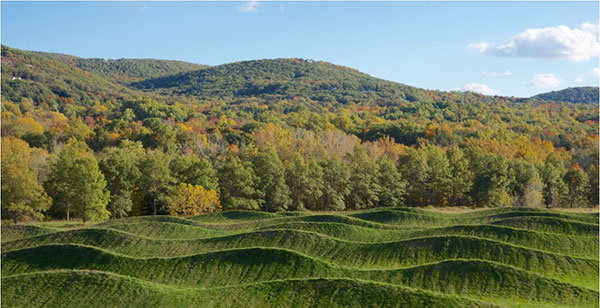
The Storm King Art Center, located in New York’s Hudson Valley, is one of the world’s most renowned sculptural parks, encompassing over 500 acres. This lush backdrop is home to more than 100 large-scale sculptures by many of the most acclaimed creators of our time. And its annual Gala is just about here.
The Storm King Art Center in New York will host its annual Gala and live auction on October 18 at the Rainbow Room in New York City. Hosted by the institution’s president, John P. Stern, the evening’s festivities will feature opportunities to purchase outstanding artworks and honor individuals with the Storm King Award. The honorees of this award are recognized for their meaningful contributions in the fields of visual arts, landscape, and nature conservation. Among the honorees this year aree Maya Lin, Cynthia Hazen Polsky, and Nicholas A. Polsky.
Tickets are still available and may be purchased here.
This article was featured in Fine Art Today, a weekly e-newsletter from Fine Art Connoisseur magazine. To start receiving Fine Art Today for free, click here.
Diptychs, Triptychs, andn Narratives
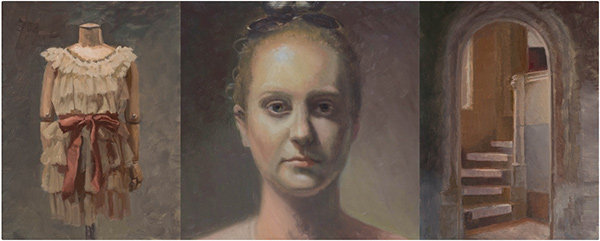
When art tells a story, audiences, intrigued, will look and contemplate. When art asks you to form the narrative yourself, artworks take on a life of their own. Where will your imagination take you during this solo exhibition?
Opening September 11 at Eau Claire, Wisconsin’s L.E. Phillips Memorial Public Library is an enthralling solo exhibition with narrative and history as its focus. Featuring recent diptych, triptych, and individual paintings by Kristie Bretzke, “Unspoken Narrative” invites the audience to participate fully in the revelation of each artwork’s story.
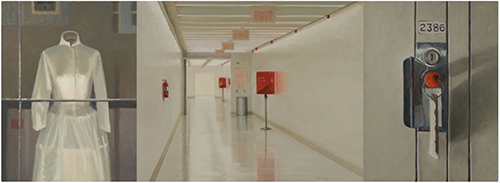
Kristie Bretzke, “Untitled, LAX Triptych,” (c) Kristie Bretzke 2016
Via the exhibition, “These images encourage a narrative on the part of the viewer. They are commonplace — an unmade bed, an elevator door opening or closing, an ordinary sink bathed in fluorescent light. Some depict real experiences. Some are inventions. Bretzke’s paintings provide the introduction to many ‘unspoken narratives.’”
Bretzke will be present for an opening reception at the library on Thursday September 15. To learn more, visit the L.E. Phillips Memorial Library.
This article was featured in Fine Art Today, a weekly e-newsletter from Fine Art Connoisseur magazine. To start receiving Fine Art Today for free, click here.
Are You Drawn to Greatness?
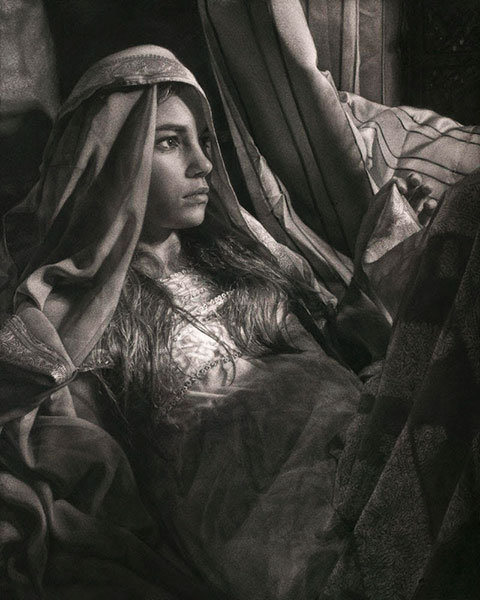
You will be during this landmark exhibition in California. Over 50 original drawings from many of the best realists working today will soon be on view. Details here!
Opening September 17 at Arcadia Contemporary’s new Culver City, California, location, “Drawn to Greatness” will arguably be the most spectacular display of realism in dry mediums in 2016. In a show featuring over 50 original works, visitors to the gallery’s exquisite new space will encounter names that will undoubtedly endure for generations to come, including Annie Murphy-Robinson, Casey Baugh, Julio Reyes, Daniel Coves, Kerry Brooks, Amaya Gurpide, Michael Chapman, Ryan Salge, George Morton, and many others.
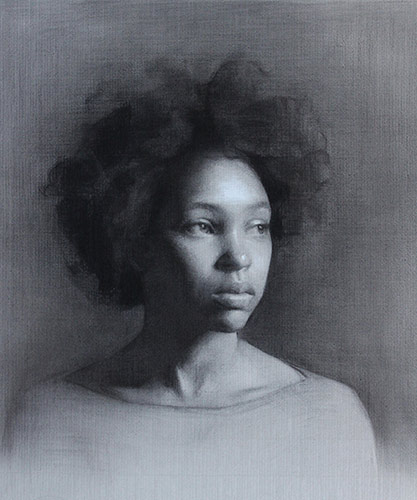
George A. Morton, “Mars,” charcoal and graphite on paper, 22 x 18 in. (c) Arcadia Contemporary 2016
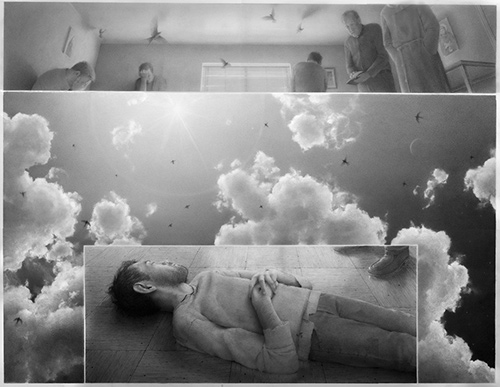
Ryan Salge, “Death of a Vagabond,” graphite on paper, 20 x 26 in. (c) Arcadia Contemporary 2016
Artists often swear by drawing, proclaiming its importance to any creator’s development in any medium. Moreover, Australian master Rick Amor once remarked that drawing is “the most direct and intimate expression of an artist’s sensibility.” Whatever you may believe, the finest examples have come together within a renowned gallery that merits a great deal of attention from connoisseurs and collectors.
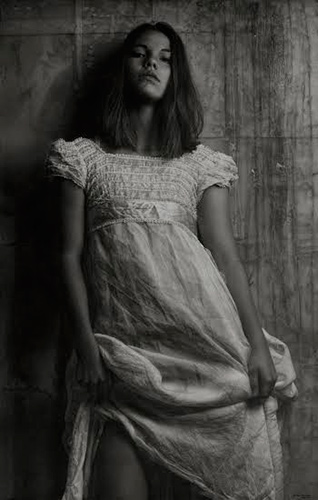
Annie Murphy-Robinson, “Casey Voodoo Child,” charcoal on paper, 60 x 42 in. (c) Arcadia Contemporary 2016
This extraordinary opportunity won’t last long. Opening September 17, “Drawn to Greatness” will dismount on September 29. To learn more, visit Arcadia Contemporary.
This article was featured in Fine Art Today, a weekly e-newsletter from Fine Art Connoisseur magazine. To start receiving Fine Art Today for free, click here.
Reader’s Choice: The Game is On!
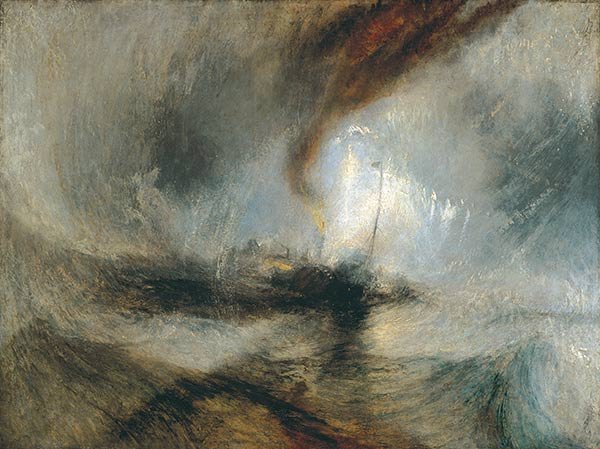
You’ve spoken! In this occasional series, we highlight one of most popular articles among Fine Art Today readers. This week we revisit the amazing art detective challenge and television show taking place now in the UK.
If you were in a museum staring at a masterpiece that had actually been replaced with a fake, would you be able to tell? A new treasure hunt and television show in the UK is asking just that.
It’s being called “Fake! The Great Masterpiece Challenge,” and it’s unlike anything you’ve seen before. In coordination with five national galleries in the United Kingdom — Cardiff, Edinburgh, Liverpool, London, and Manchester — seven masterpiece paintings (all by British painters) have been secretly removed from their galleries and replaced with fakes. Only the museum curators, production team, and hosts will know which paintings have been switched.
The show challenges the public of all ages and experience to locate the fakes in person at the museums or online. The prize for a correct identification? How about an appearance on the show’s finale and a chance to win a specially commissioned copy of one of the works to keep!
The challenge is an awesome way to generate interest in the arts as well as potentially boost patronage at the museums. Each episode of the show will delve into a particular period of British art, with special curatorial and art historian guests. Also included in the show are the contemporary artists who were asked to re-create the paintings from scratch.
The competition doesn’t appear to be limited to residents in the United Kingdom! To learn more, visit the competition webpage here.
This article was featured in Fine Art Today, a weekly e-newsletter from Fine Art Connoisseur magazine. To start receiving Fine Art Today for free, click here.
Win the Prize, Get the Cash
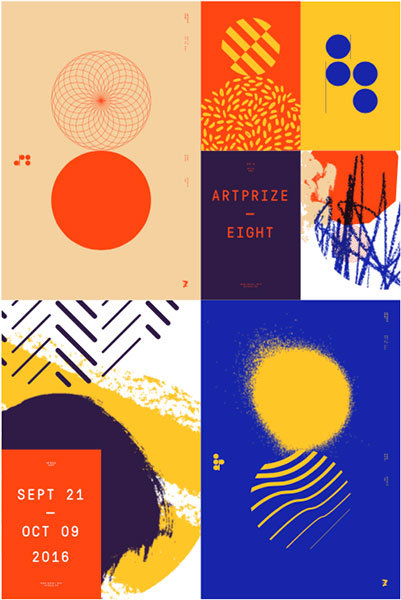
Some have argued it’s the largest public art event on earth, with nearly a half-million attendees and more than $500,000 in cash and other prizes. The eighth installment of this extraordinary festival kicks off September 21. Details here!
For seven — soon to be eight — years, Grand Rapids, Michigan, has played host to a gigantic art festival: ArtPrize. Beginning September 21 and continuing through October 9, ArtPrize is a full 19 days of pure artistic and entertainment joy. In arguably the largest public art event on earth, organizers have routinely expected over 400,000 attendees to descend upon the three square miles of downtown Grand Rapids.
Attendees of 2016’s edition of ArtPrize can expect to encounter over 160 participating venues hosting a complete variety of over-18 artists working in every conceivable style and medium. They may be found in a museum, gallery, bar, restaurant, theater, hotel, park, wall, bridge, laundromat, or auto parts store — ArtPrize is independently organized by artists and venues through the event website at artprize.org.
What makes ArtPrize particularly exciting? That would be the opportunity for artists to collect a number of cash prizes, including two Grand Prize awards of $200,000. All told, over a half-million in cash and other prizes are awarded to artists. Another interesting facet of the awards us how they’re determined. In a unique twist, winners of awards are chosen half by public vote and half by a jury of art experts. Categories of awards include two-dimensional, three-dimensional, time-based, and installation. Another award honors one of the outstanding venues.
To learn more about this year’s event and how to plan your trip, visit ArtPrize.
This article was featured in Fine Art Today, a weekly e-newsletter from Fine Art Connoisseur magazine. To start receiving Fine Art Today for free, click here.