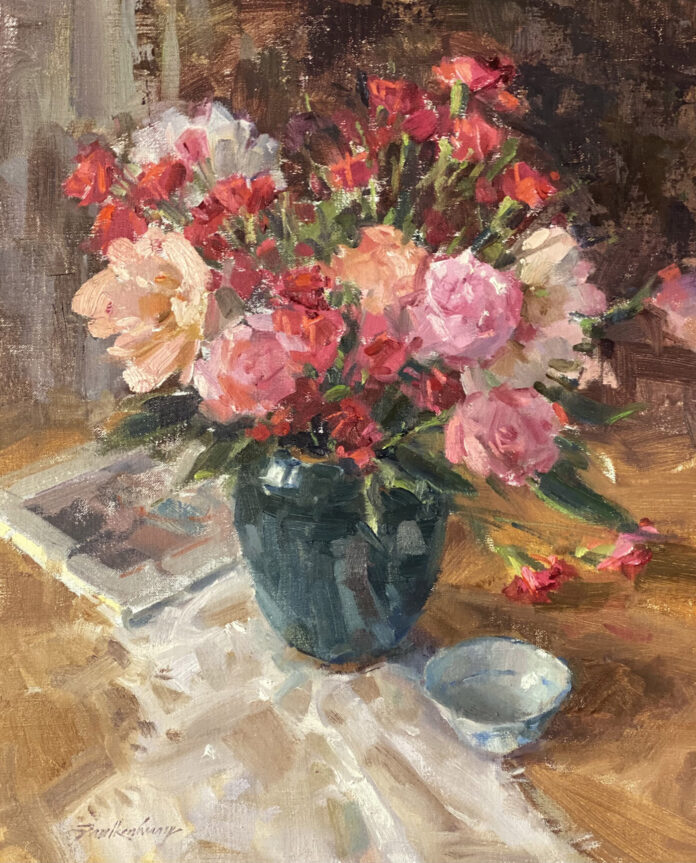
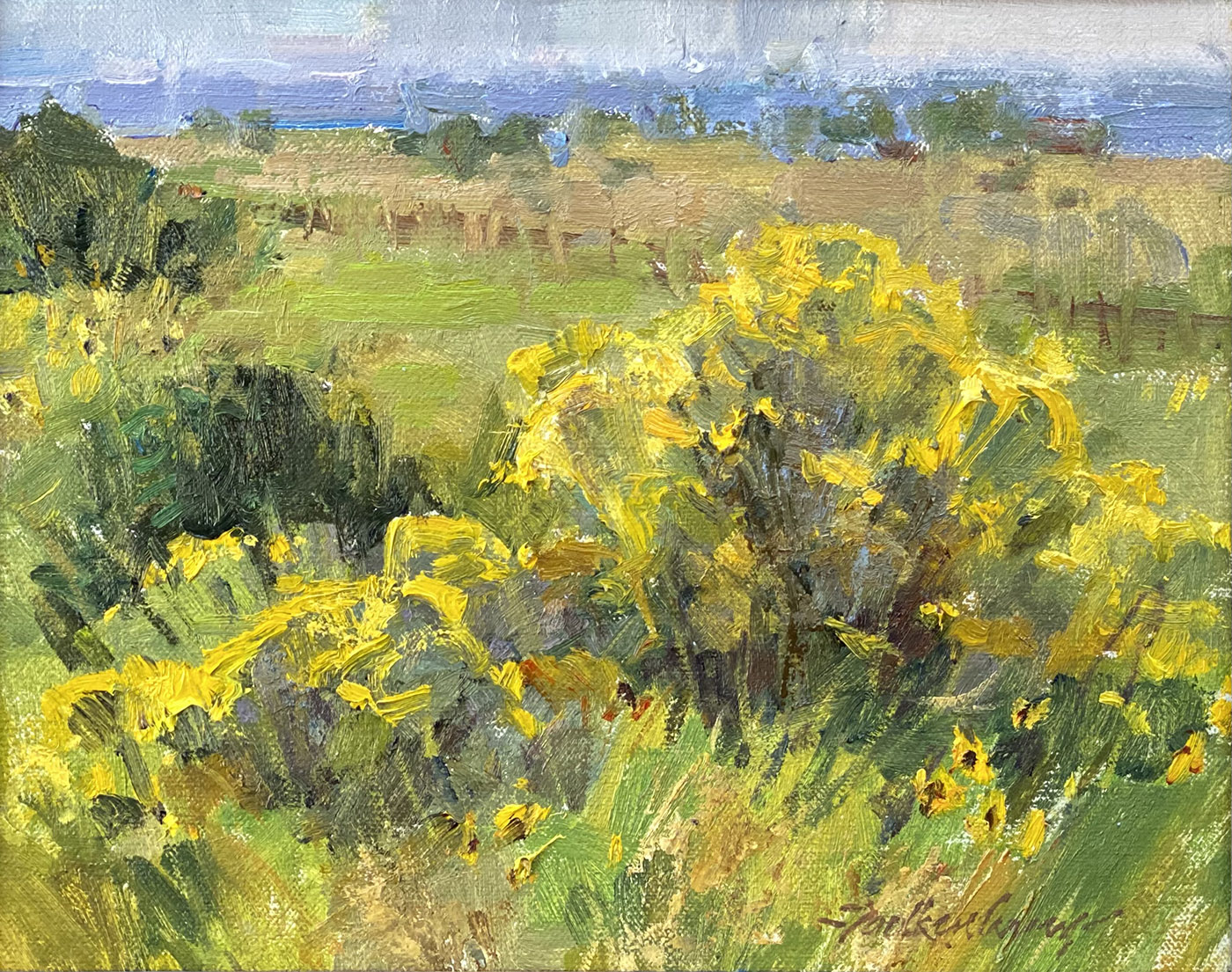
Gay Faulkenberry, “Shades of Spring”, Still Life, oil on canvas, 20 x 16 in., Private Collection
Gay Faulkenberry: My Still Life of “Spring Arrangement” was entered into the American Impressionist Society All Member Online Show in November of 2022. To my surprise it was awarded the “Award of Distinction”. Many thanks to Fine Art Connoisseur and judge Betty Carr. Peonies have always been one of my favorite flowers to paint and I had them in my garden. Hence a perfect arrangement for a still life set up in my studio.
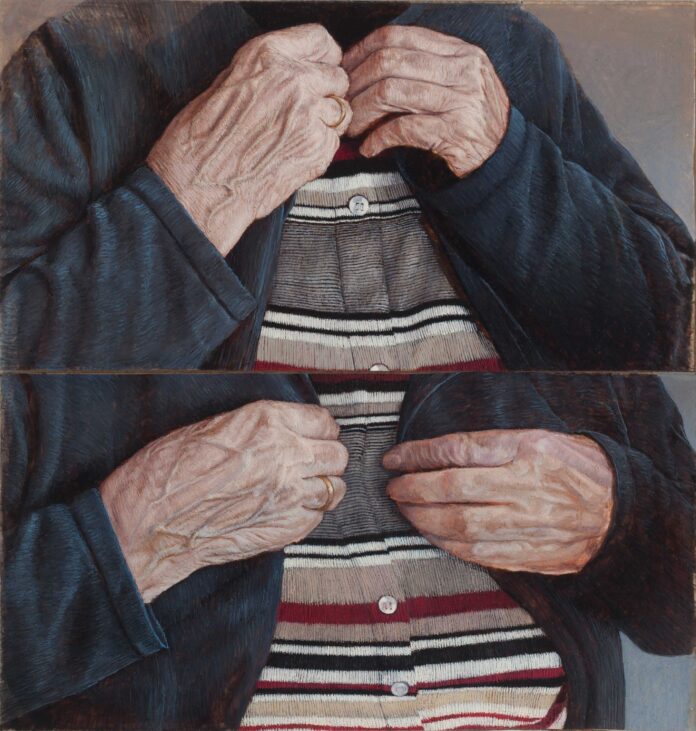
Maya Brodsky, “Open/Close,” 2019, Oil on mylar mounted on panel, 5 ⅝ x 5 ¼ inches (overall)
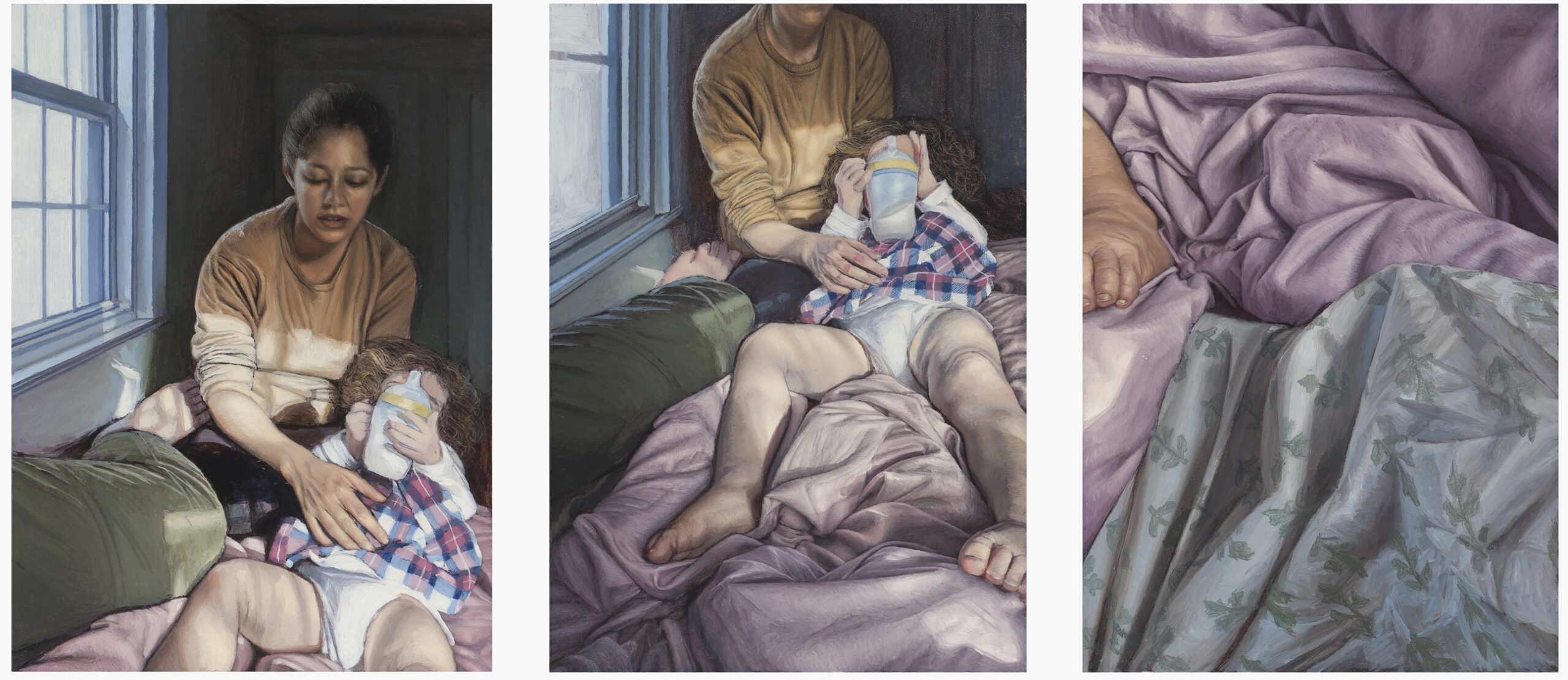
George Adams Gallery in NYC is opening “Moments of Being,” its first solo exhibition with Maya Brodsky. The exhibition brings together a series of portrait paintings – intimate in both scale and subject matter – that capture essential moments in Brodsky’s life.
The exhibition title derives from a Virginia Woolf essay in which she describes these consequential ‘moments of being’ as distinct from the ‘scaffolding in the background.’ Here, Brodsky calls out these singular moments that were transformative to her life through paintings created from photographs she took in the moment. The exhibition is on view through April 1, 2023.
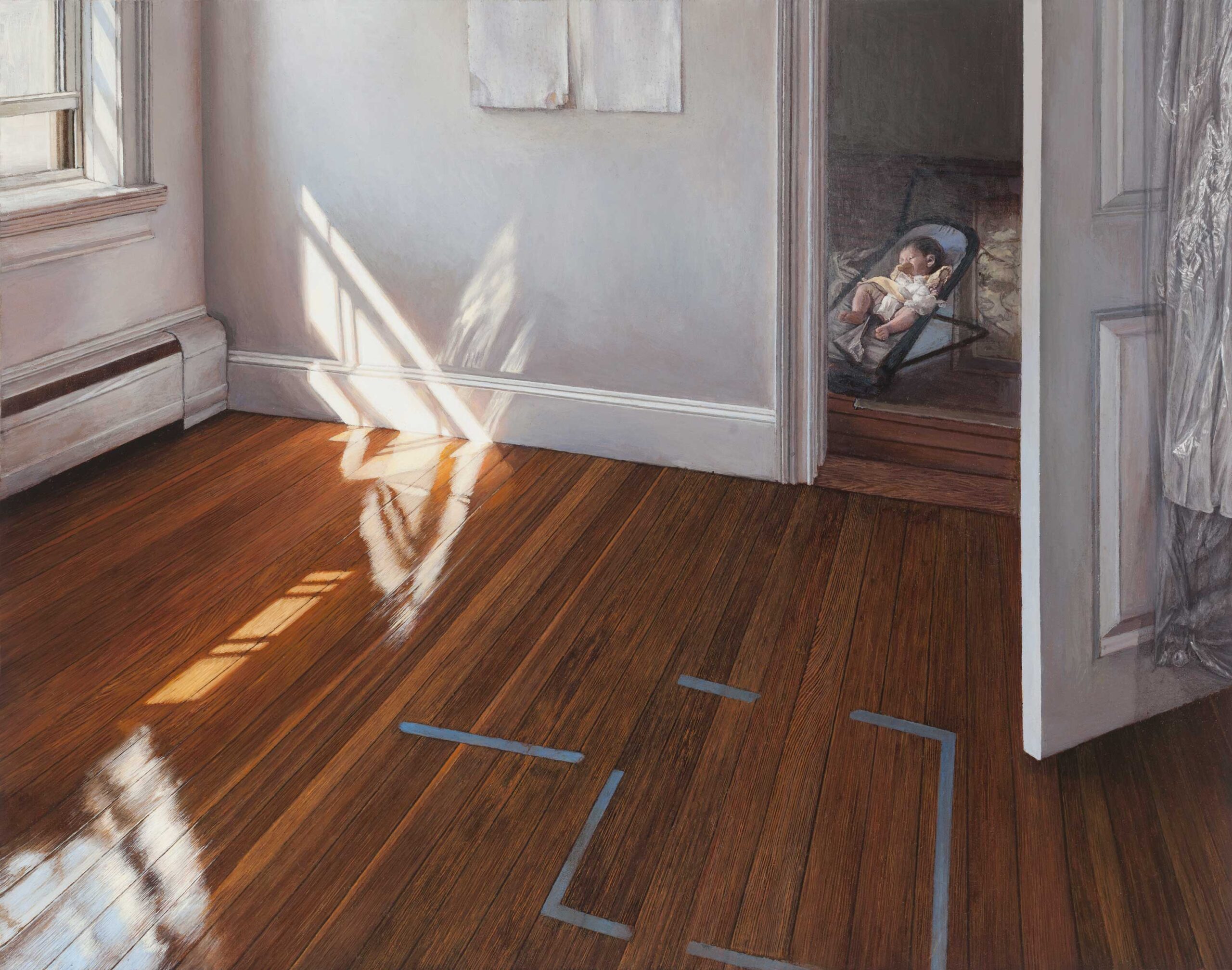
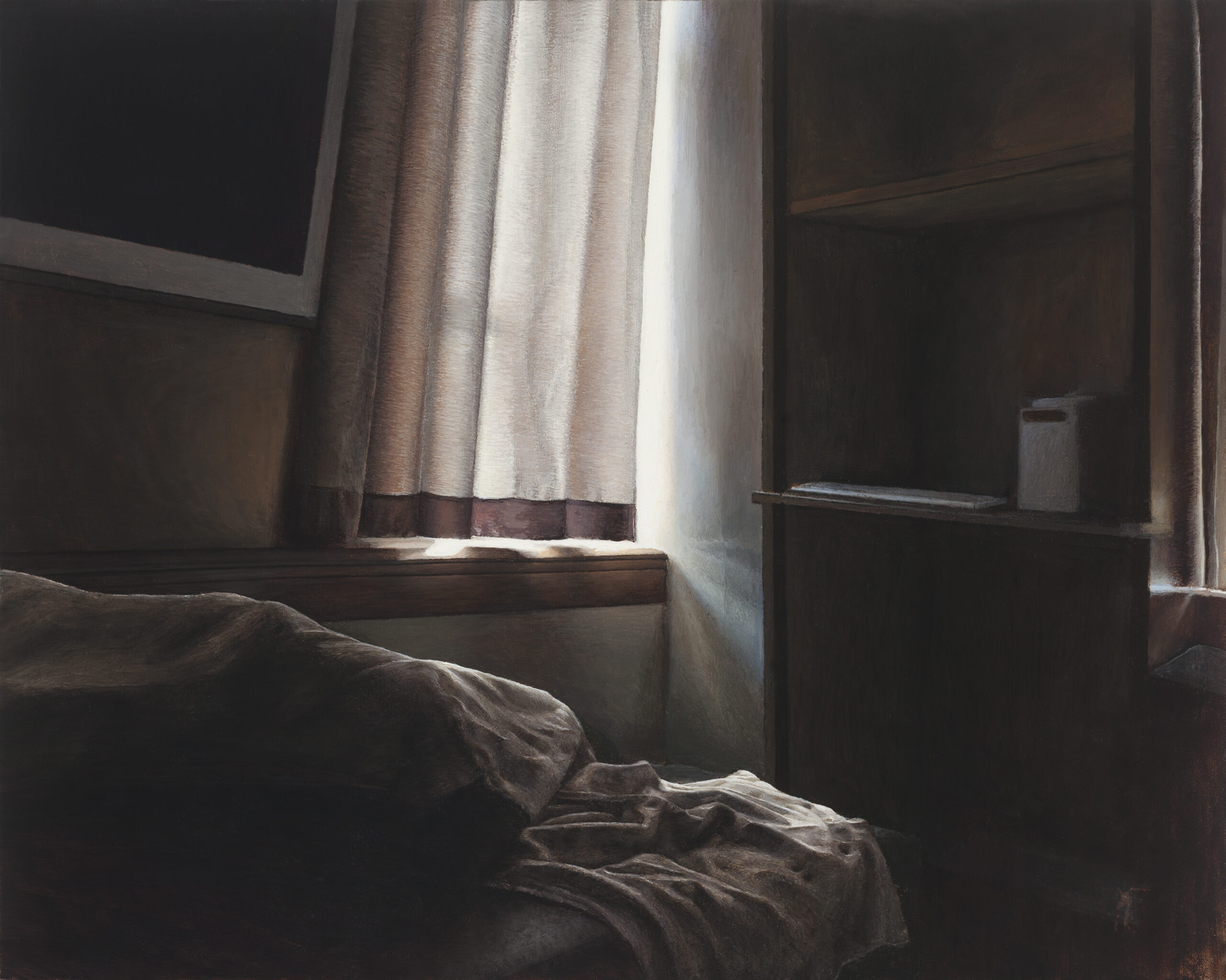
Maya Brodsky, “Sunbeam and Eda,” 2019, Oil on panel, 11 x 14 inches
The central piece of the exhibition is a series of paintings created around a hospital stay following the birth of her second daughter. The precisely rendered details of the works – wrinkled bed sheets, wilting flowers, coffee growing cold on a tray – contrast with Brodsky’s fractured memory of the moment, despite the significance of the event. Here the process of painting comes to life, a means to distill a single, essential moment and preserve it.
Maya Brodsky, “Dawn, Eda,” 2020, Oil on panel, 8 x 10 inches
Throughout the works, life, love, and death play a pivotal role, often tied together through paintings that emphasize the power of touch, particularly from one generation to another. Brodsky’s grandmother Dusya, and her daughter Eda, appear frequently throughout the works, often connected through small, intimate gestures.
Maya Brodsky, “Wave II,” 2019, Oil on panel, 5 x 7 inches (each)
Taken together, the ebb and flow of images and the inevitable connotations of film emphasize not only the passage of time, but also a transfer from one generation to the next.
Salmagundi Club of New York
New York City salmagundi.org
Through April 30, 2023
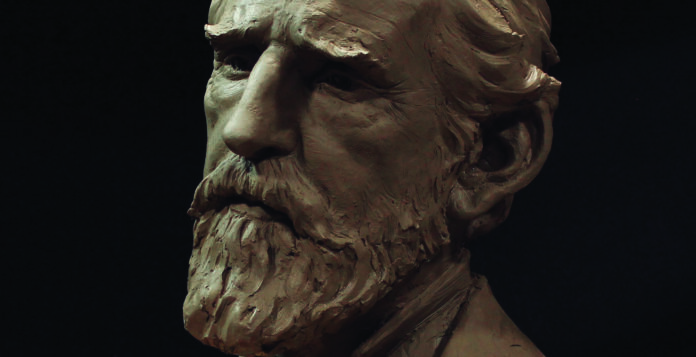
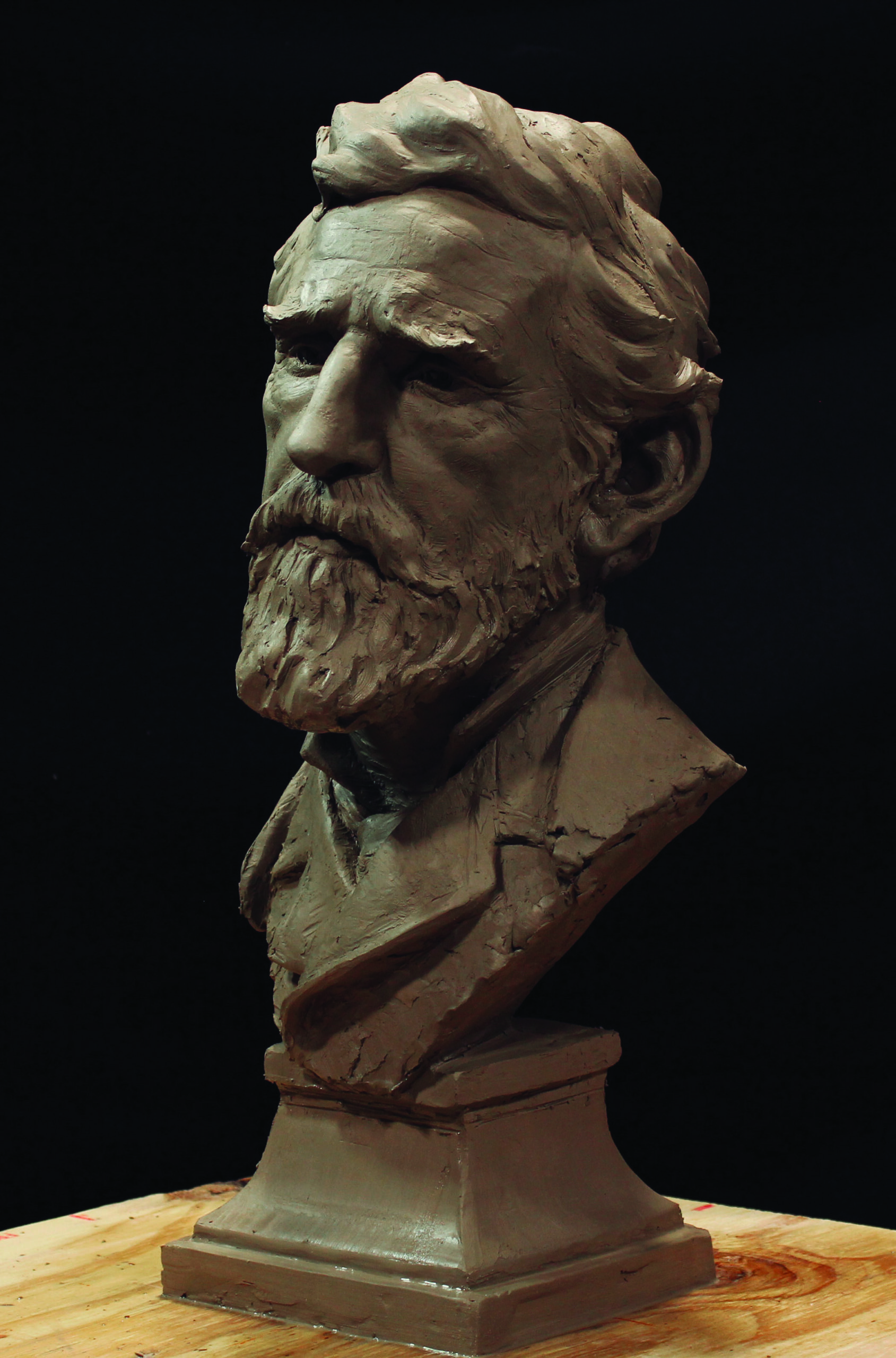
Heather Personett (b. 1988), “Bust of Augustus Saint-Gaudens,” 2022, clay, 19 x 8 x 7 in.
A professional and social organization for representational artists and their patrons, the Salmagundi Club of New York is housed in a historic brownstone mansion facing Fifth Avenue in Greenwich Village. It remains one of Manhattan’s best-kept secrets, and within it lies an even better-kept secret: a stunning library with an unparalleled collection of visual reference materials.
Beginning in the years around 1896, the philanthropist J. Sanford Saltus (1853–1922) and artist William Henry Shelton (1840–1932) were among the club members who regularly traveled to Europe to buy books containing illustrations of uniforms and other costumes that the club’s many illustrator members could use for reference.
“That was the golden age of magazine illustration,” says Alexander Katlan, chairman of the club’s library committee. “The illustrators would refer to these books to ensure their creations were accurate.” Today, the Salmagundi library contains some 5,000 volumes of rare material catalogued using a unique method that predates the Dewey Decimal System.
Beyond its archival resources, the library contains many artworks to admire, including two allegorical door panels painted in 2021 by Noah Buchanan (b. 1976) as a commission after he placed first in the club’s competition. Now another commission has been undertaken through the club’s first bust competition, which sustains the tradition of talented sculptors honoring their artistic forerunners.
The “Sculpting Our Heroes” competition was conducted last year, and this winter the public is invited to admire the winning work — Heather Personett’s bust of the great sculptor Augustus Saint-Gaudens (1848–1907) — plus nine other works recognized by the jury. (Interestingly, six of the 10 top artists chose to depict Saint-Gaudens, who joined the club in 1877. Their other subjects were William Merritt Chase, Alphonse Mucha, and N.C. Wyeth.)
Placing second in the competition was Jana Buettner; third place went to Andreja Vuckovic, and fourth to Maudie Brady. The remaining finalists were Kate Brockman, Zoe Dufour, Erik Ebeling, Matt Gemmell, Quitin McCann, and Susan Wakeen. Personett’s clay maquette (illustrated above) is being cast in bronze this season; both versions will be on view in the exhibition.
On February 16, Fine Art Connoisseur editor-in-chief Peter Trippi moderated a panel discussion on the bust competition and its significance.
On View: “Making American Artists: Stories from the Pennsylvania Academy of the Fine Arts, 1776–1976”
Pennsylvania Academy of the Fine Arts (PAFA) pafa.org
Through April 2, 2023
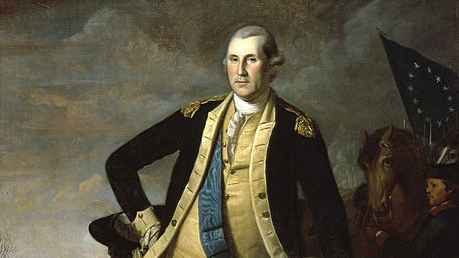
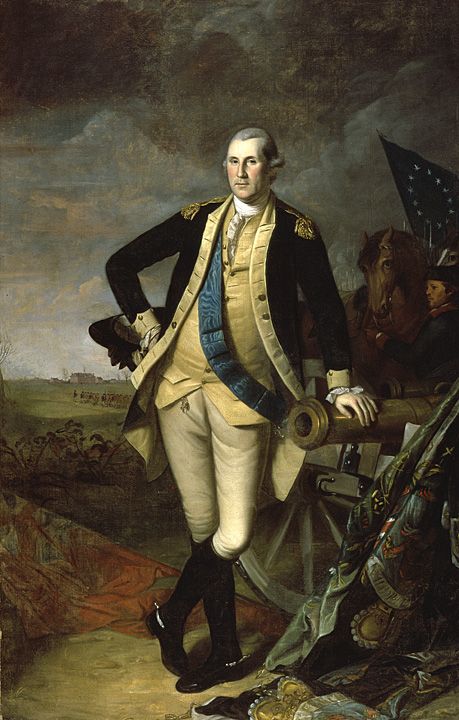
Charles Willson Peale (1741-1827), “George Washington at Princeton, 1779,” oil on canvas, 93 x 58 1/2 in., Gift of Maria McKean Allen and Phebe Warren Downes through the bequest of their mother, Elizabeth Wharton McKean, 1943.16.2
From the organizers:
Over 100 of the most iconic works in this famed collection spotlights both well-known names in American art and traditionally underrepresented artists, posing questions about what it has meant to be an American artist over two centuries.
“Making American Artists” explores the role that art has played in influencing our national history and identity over 200 years and embraces untold stories about women artists, LGBTQIA+ artists, and artists of color. Artworks will be displayed in five thematic sections—portraiture, history painting, still life, genre scenes, and landscape—rather than in chronological order. This design allows for objects from different time periods to be shown together, creating striking visual counterpoints and sparking new conversations.
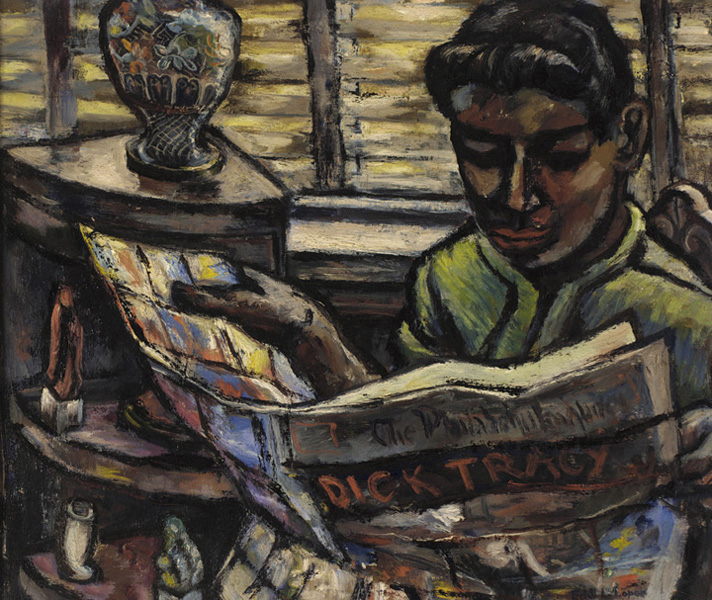
Edward L. Loper (1916-2011), “Sunday Afternoon,” 1948, Oil on canvas, 20 x 24 in., PAFA, 1970.34, gift of Dr. George J. Roth
Each of the featured artists’ careers were shaped by PAFA, whether through their education or the exhibition and display of their work, and the exhibition offers a critical re-examination of this legacy while shedding light on PAFA’s continuing role in shaping American art in the 21st century. Iconic American artists with one or more works in the exhibition include Mary Cassatt, Thomas Eakins, Barkley Hendricks, Winslow Homer, Edward Hopper, May Howard Jackson, Alice Neel, Georgia O’Keefe, Charles Willson Peale, Sonia Sekula, Henry O. Tanner, Dox Thrash, and Andrew Wyeth.
“‘Making American Artists’ is an epic collection of American art, featuring some of our nation’s most famous images and artists in new conversations with each other,” says Eric Pryor, President and CEO of PAFA. “When Charles Willson Peale founded PAFA with the sculptor William Rush in 1805, they created an institution that was devoted to groundbreaking initiatives in championing American art and artists—what that looks like has changed considerably throughout the last 217 years. This exhibition explores PAFA’s impressive collection with a critical eye and emphasizes its transformative contribution to the history of American Art.”
Chief of Curatorial Affairs and the Kenneth R. Woodcock Curator of Historical American Art Dr. Anna Marley led the curation of the 103 objects in the exhibition from PAFA’s collection of over 16,000 objects. Marley says, “‘Making American Artists’ asks integral questions about PAFA’s role in defining what American art was and is, and who gets to be considered an American artist. When you have a collection full of iconic art, that has been developed over more than 200 years, you have an opportunity and obligation to tell both familiar and surprising stories.”
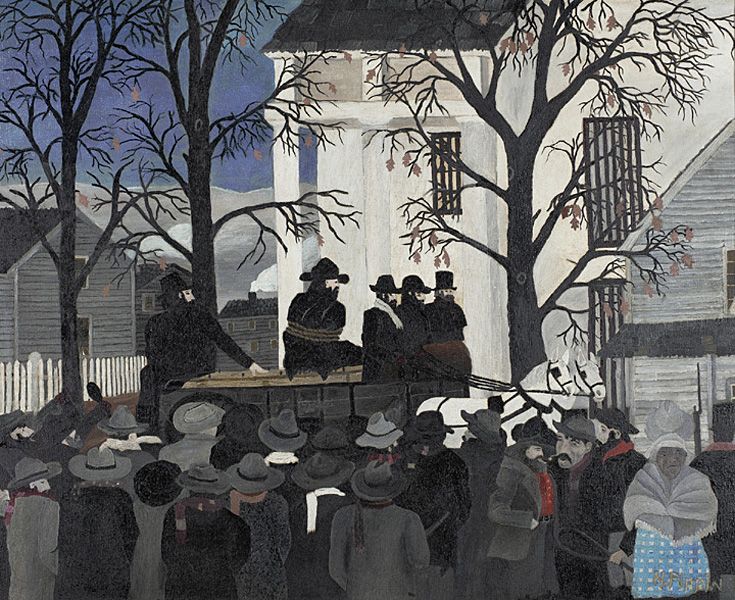
Horace Pippin (1888-1946), “John Brown Going to his Hanging,” 1942, oil on canvas, 24 1/8 x 30 1/4 in., John Lambart Fund, 1943.11
March 11: Carol Soltis, the premier scholar of the Peale Family of artists, will give a gallery talk about recent discoveries and outcomes of a multi-year investigation of the ”Washington at Princeton” painting by Charles Willson Peale.
April 5: “The Freedman” with Kelvin L. Parnell Jr. (Ph.D. candidate at University of Virginia and a 2020 Wyeth Foundation fellow at the Smithsonian American Art Museum)
As part of our effort to continue to help artists and art galleries thrive, we’re proud to bring you this week’s “Virtual Gallery Walk.” Browse the artwork below and click the image itself to learn more about it, including how to contact the gallery.
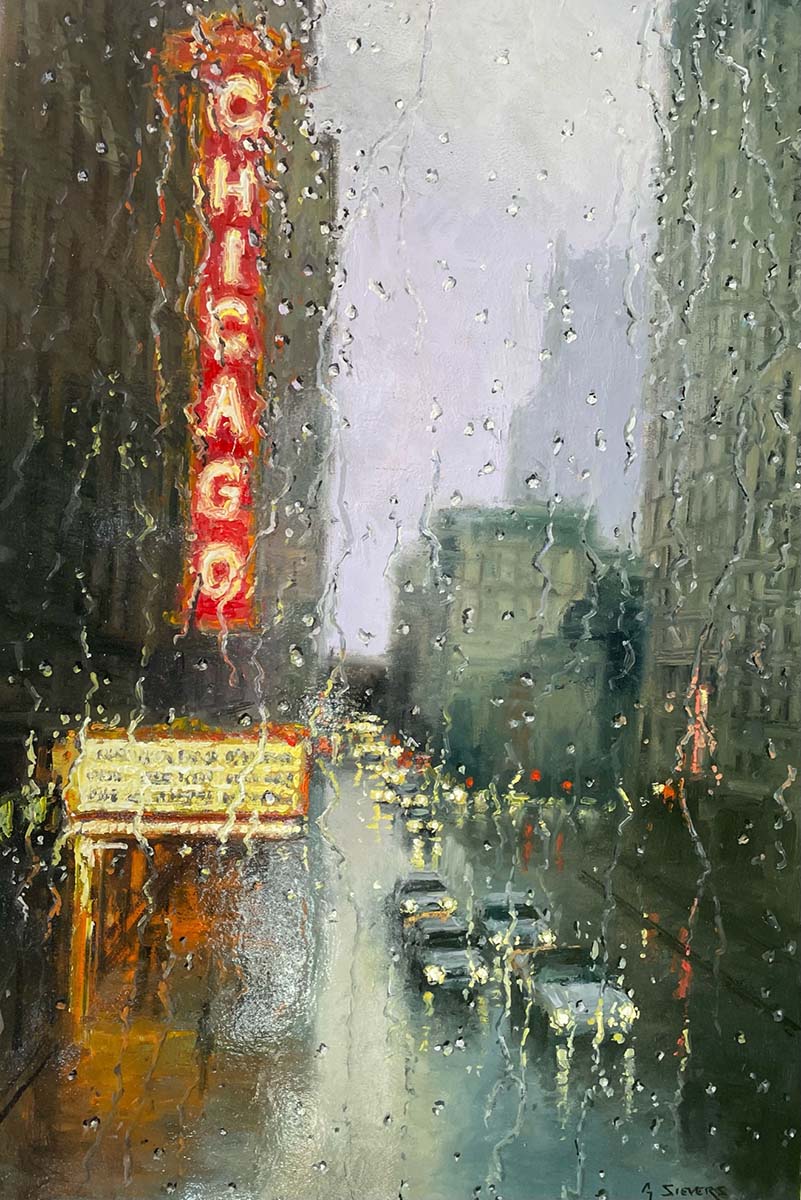
The Theater, Gregory Sievers, oil, 36 x 24; Celebration of Fine ArtAutumn Scarlet and Sparkle, Darcie Peet, oil, 24 x 30 in., Solo Show; ArtzLine
Want to see your gallery featured in an upcoming Virtual Gallery Walk? Contact us at [email protected] to advertise today. Don’t delay, as spaces are first come, first served, and availability is limited.
The Crocker Art Museum is set to open an intriguing exhibition titled “Art for the People: WPA-Era Paintings from the Dijkstra Collection.”
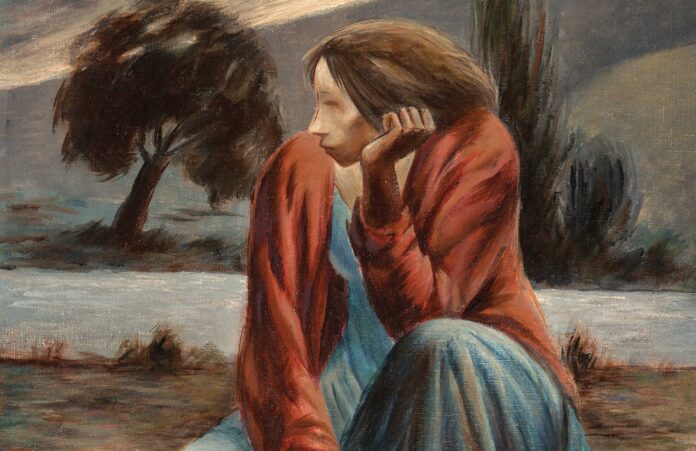
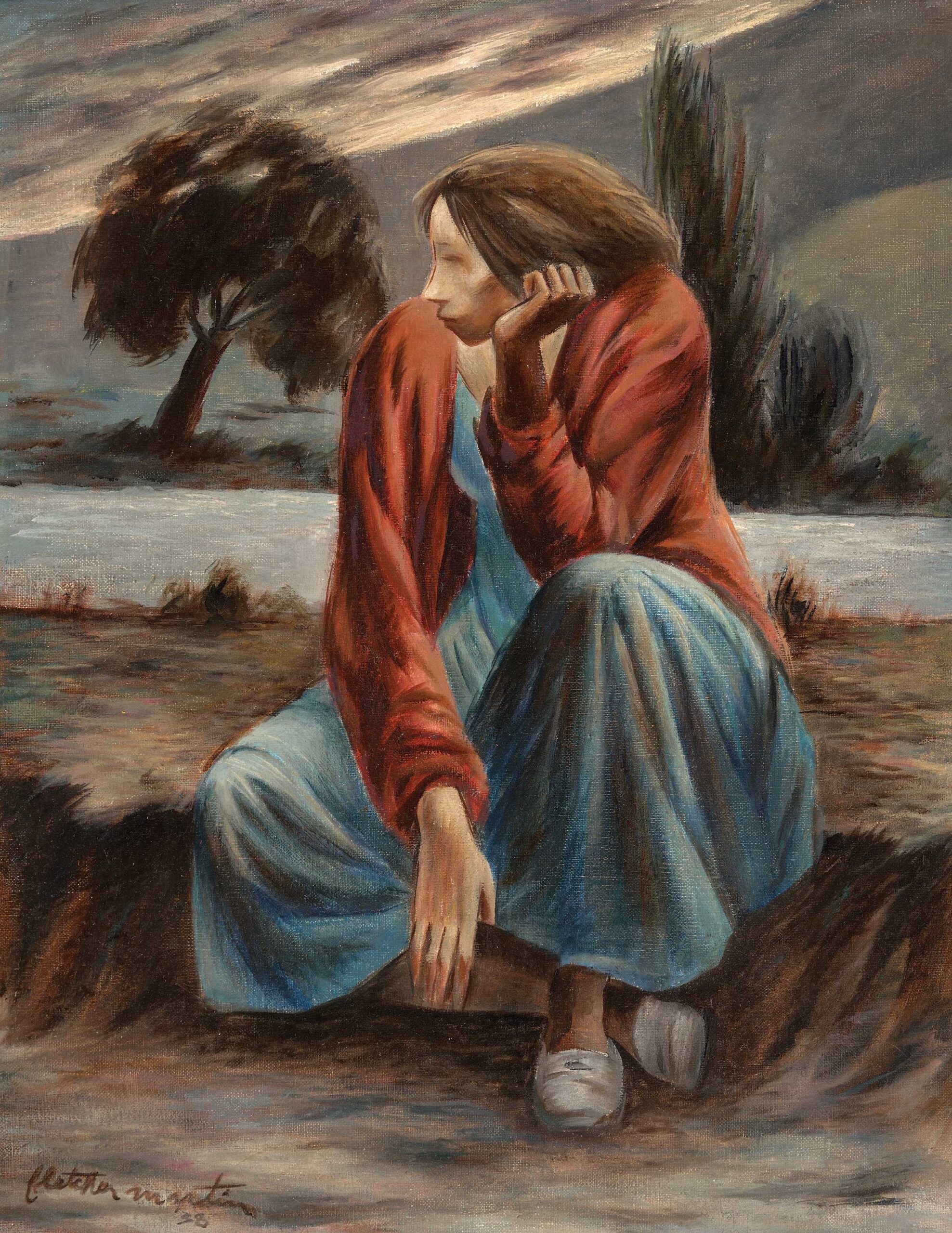
Fletcher Martin (1904–1979), “Migrant Woman,” 1938, oil on canvas, 20 x 16 in., collection of Sandra and Bram Dijkstra
Between the stock market crash of 1929 and the attack on Pearl Harbor, many American artists sought to make their work more accessible to everyday people, partly by depicting the people themselves, especially laborers, the poor, and the disenfranchised.
The artists’ goals were diverse, but included the desire to highlight a shared American experience during one of the country’s most challenging periods, to reject foreign artistic influences, to document rapidly passing ways of life, and to refine the visual language of protest and demands for social justice.
Some of these objectives were advanced by federally funded projects like the WPA (Works Progress Administration), which effectively transformed artists into “workers” themselves. As there was no prescribed aesthetic, the styles explored in this period ranged from regionalism and “American Scene Painting” to social realism and expressionism.
One of the finest private collections of art from this period is owned by California residents Sandra and Bram Dijkstra, who have been careful to acquire works from the East, Midwest, and West, and especially Californian artists overlooked by other patrons.
“Art for the People: WPA-Era Paintings from the Dijkstra Collection”
Crocker Art Museum, Sacramento crockerart.org
Through May 7, 2023
This year’s show of highlights from the Dijkstra Collection has been organized by the Crocker and two other California institutions, each of which will present it at different times and in different forms. The other partners are the Oceanside Museum of Art (exhibiting June 24–November 5) and the Huntington Library, Art Museum & Botanical Gardens (December 2, 2023–March 18, 2024).
The project is accompanied by a scholarly catalogue.
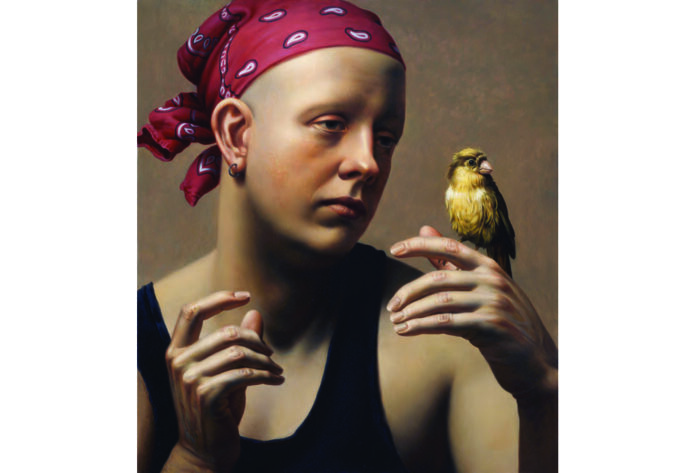
Will Wilson (b. 1957), "Canary Watching," 1994, oil on panel, 14 1/2 x 13 in., as seen in the art collectors profile on Ray and Lori Allen
From the Fine Art Connoisseur March/April 2023 Editor’s Note:
Collecting Art for the Right Reasons
On the cover: Mark Pugh (b. 1979), “An Unsatisfying Ending” (detail), 2021, oil and ink on linen mounted panel, 36 x 24 in.
My favorite issue of the year is the one that highlights real-world collectors of contemporary realist art. This is that issue, and we hope you will enjoy “meeting” the individuals and couples who have so generously opened their doors. These folks now join 87 others we have profiled since 2015, and we are honored and grateful to welcome them to this community.
Why do we do this? First, people need role models, in any walk of life. We play tennis better after watching Naomi Osaka, and we cook more effectively after Bobby Flay demonstrates the recipe. It’s harder with art collecting because there is no single way to do it, and unfortunately the best-known collectors are financiers and movie stars paying millions at auction for a Hirst or a Koons. Good for them, but that’s collecting warehoused-investment-assets with your ears, not art-to-live-with with your eyes. I’m far more intrigued by celebrities who collect items of comparatively low value: just for example, Tom Hanks buys antique typewriters, Angelina Jolie goes for medieval and Renaissance knives, and Claudia Schiffer seeks out mounted beetles, butterflies, and spiders.
Great, but this is a fine art magazine, and besides, buying anything when you’re a hundred-millionaire is not particularly difficult. The real trick is to buy wonderful “unbranded” art on a regular budget, away from the limelight and the art advisers who think about this stuff all day. The folks highlighted in this issue buy art with their eyes and hearts, living with and enjoying it, sometimes enhancing their lives further by getting to know the artists who made it.
The hardest step in this issue’s preparation is asking the collectors to choose just two artworks to illustrate in their profiles. That’s like choosing among your kids, but the collectors do it bravely, and they understand why we ask them to. It’s simple: we can dedicate only two pages to each collector, and if we were to fill them with seven or eight “favorite” images, there wouldn’t be room for the words. Besides, each artwork would look more like a postage stamp than a painting. And so we go smaller (in number) and bigger (in photo size), reminding everyone that these two images don’t represent the whole collection, only evoke it.
Our work on the collector profiles never stops, so it’s already time for us to plan next year’s edition. There are great collections — many still being formed — in every region of this country, and no one person could possibly know all of them. Though our research is well underway and we already have some terrific names in sight, I hereby invite you to send me suggestions or nominations of other collectors. Our criteria are simple: they must be U.S. residents (still living) who have collected, or are continuing to collect, superb contemporary realist art created any time after 1980.
Ideas are welcome from everyone: the collectors themselves, their friends, families, dealers, advisers, curators, etc. Please just send me an e-mail ([email protected]) and I will move it forward. Rest assured that our team is discreet; all communications with collectors will be virtual, and we will not turn up unannounced at their homes to take photos! The individuals selected will have an opportunity to fact-check everything, and in fact they themselves will provide the photos to be illustrated. That said, it’s our editorial team’s decision who goes in, and who doesn’t.
Thank you as always for your incoming suggestions, and please enjoy learning about this year’s fascinating collectors.
What are your thoughts? Share your letter to the Editor below in the comments.
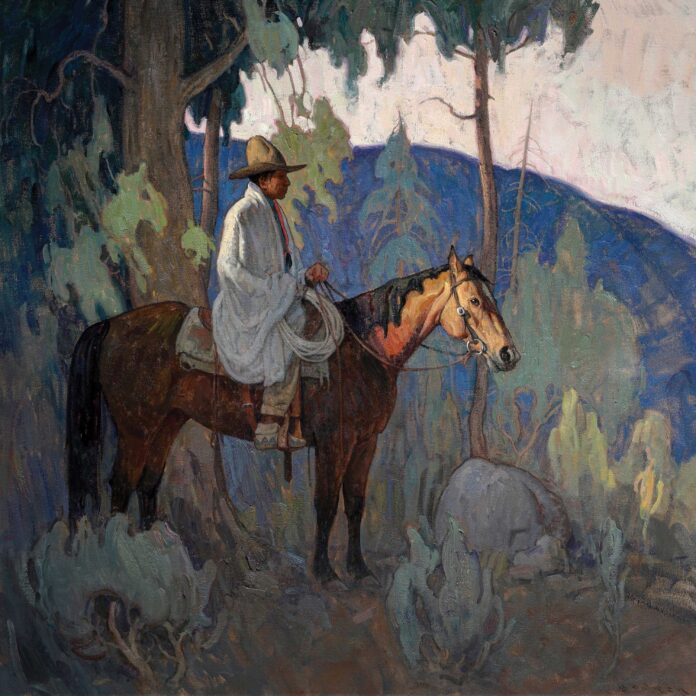
Eric Bowman (b. 1960), "Morning Broken," 2022, oil on canvas, 36 x 36 in.
Western Art On View: “Masters of the American West”
The Autry, Los Angelas masters.theautry.org
Through March 26, 2023
The Autry Museum of the American West is set to host its annual Masters of the American West Art Exhibition & Sale, featuring new pieces created by 64 leading painters and sculptors working in the Western genre. Their subject matter ranges from landscapes, seascapes, and wildlife to figures, portraits, and historical themes. Among the talents participating are Tony Abeyta, Peter Adams, Russell Case, Mick Doellinger, Logan Maxwell Hagege, Doug Hyde, Oreland Joe, Brett Allen Johnson, Jeremy Lipking, Eric Merrell, Dean L. Mitchell, Terri Kelly Moyers, Daniel W. Pinkham, Kyle Polzin, Grant Redden, Mater Romero, Billy Schenck, and Preston Singletary.
Since Masters of the American West launched in 1998, its proceeds have provided essential support for the Autry’s educational programs, exhibitions, and more than 100 public events annually. As its name suggests, the museum is dedicated to exploring the stories, experiences, and perceptions of the diverse peoples of the West. Its collection of more than 500,000 artworks and artifacts encompasses the Southwest Museum of the American Indian Collection, one of the finest holdings of Native American material in the U.S. Co-founded in 1988 by Jackie and Gene Autry and Joanne and Monte Hale, the Autry merged in 2002 with Women of the West, an organization highlighting the impact of women’s experiences.
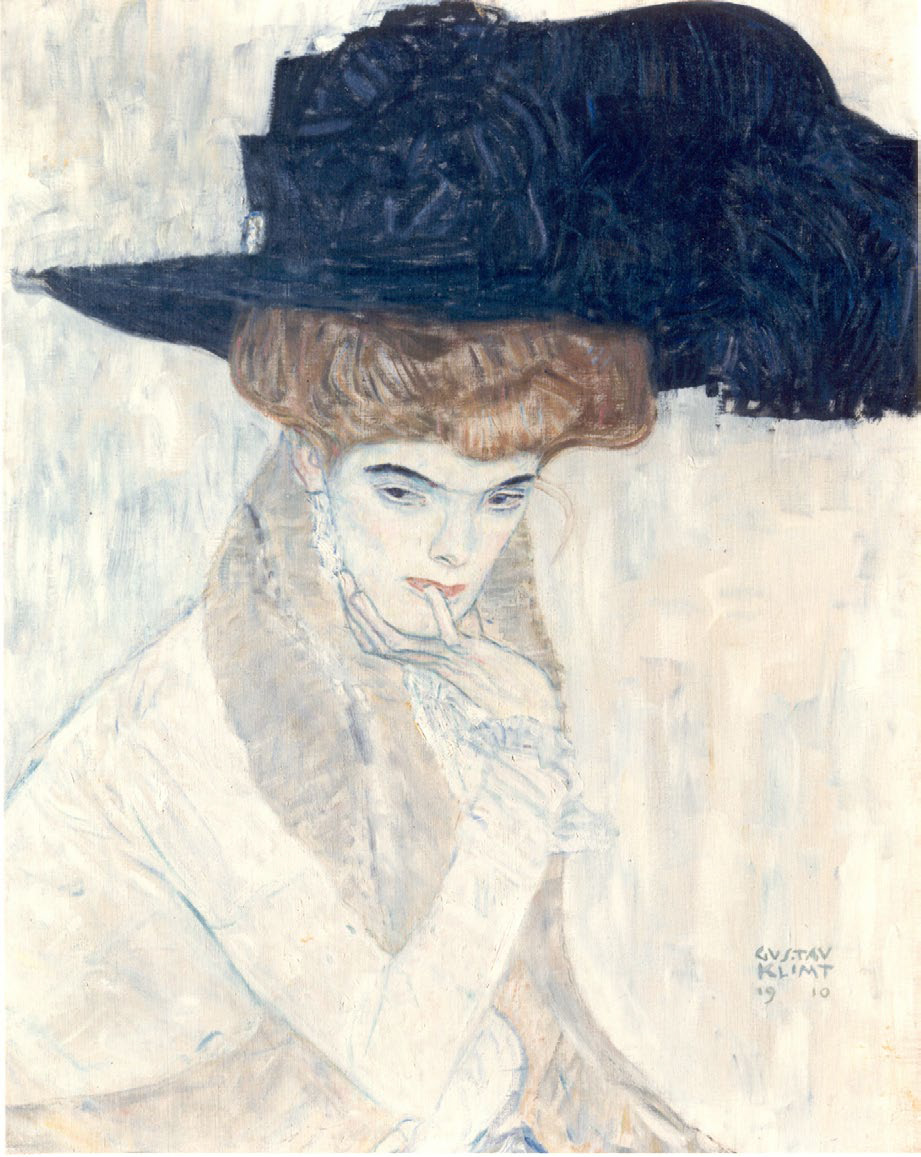
After years of collaborative provenance research, Ronald S. Lauder and the Beran family heirs have announced a restitution agreement for the portrait painting “The Black Feather Hat” by Gustav Klimt.
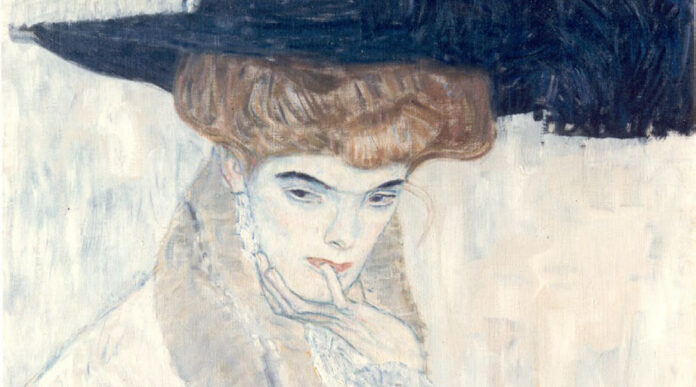
Gustav Klimt (1862-1918), “The Black Feather Hat,” 1910, oil on canvas; 31 1/8 inches x 24 13/16 inches
From the official statement on the restitution:
This agreement, which includes the restitution and reacquisition of the painting from the Beran heirs, is the result of several years of collaboration during which Mr. Lauder and the Beran heirs have worked with the assistance of expert researchers to advance a new understanding of the painting’s provenance.
Depicting a pensive female sitter adorned with a wide-brimmed hat, “The Black Feather Hat” is first documented as being owned by Irene Beran (1886-1979) in 1928, though it entered the family collection years earlier through her father-in-law Alois Beran. Recent research has confirmed that the painting remained in Irene’s possession in Brno, now part of the Czech Republic, through at least 1934. Its whereabouts from that time until the late 1950s, however, remain unclear.
In 1957, the painting reemerged as part of an exhibition in Stuttgart organized by Württemberg Art Association, Stuttgart, and Friedrich Welz, Salzburg. The work was exhibited extensively throughout the 1960s prior to its acquisition in 1973 in Austria. Since becoming part of Mr. Lauder’s collection, “The Black Feather Hat” has been featured in numerous exhibitions and publications. It was on view most recently from 2019 through 2020 at Neue Galerie New York* in a special exhibition of Austrian masterworks.
The Beran heirs, through their legal counsel Lansky, Ganzger, Goeth, Frankl & Partner, express their gratitude for Mr. Lauder’s generosity of spirit. In so doing, they recall how their grandmother Irene who, until the horrors of the Nazi period so utterly changed the course of her life, was herself an enthusiastic supporter of the arts in her hometown of Brno by exhibiting items from her collection of contemporary Austrian and German artists. The family is confident that Irene would be delighted to know that “The Black Feather Hat” found a home in New York, a city that had, at an important juncture in her refugee life, also been Irene’s home.
Added Mr. Lauder, “Together with the Beran family, we have worked arduously to uncover the full history of this artwork and trace its trajectory through time. While our joint research leaves gaps remaining, I have long championed the importance of restitution. In the spirit of the Washington Conference Principles, I felt it was of utmost importance to arrive at a just and fair solution that recognizes the family’s history with this painting.”
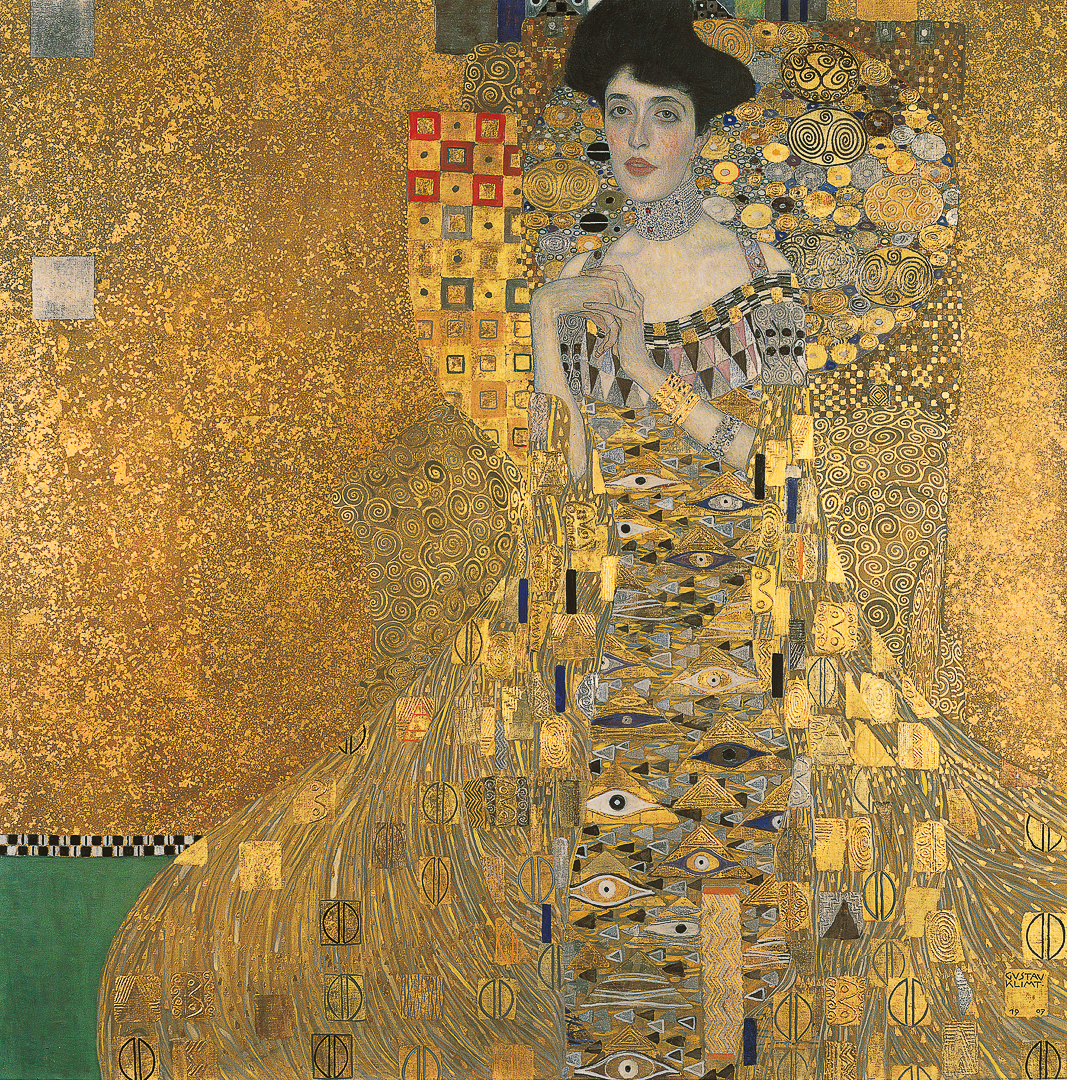
Gustav Klimt is considered one of the most innovative artists of the early 20th century. In 1897, he became one of the founding members of the Vienna Secession, which advocated for a break from the traditional artistic styles of the era. “The Black Feather Hat” marks a departure from Klimt’s now iconic gold leaf and highly decorative paintings, which he had been creating in the early 1900s, and demonstrates his growing interest in Expressionism, reinforced by his budding friendship with the young artist Egon Schiele.
The portrait of the unidentified female sitter is rendered in a monochromatic palette of pinks and light browns and offset by the fashionable black hat that sits atop her auburn hair. The work is central to the public’s understanding of Klimt’s oeuvre and his legacy.
*Related: “The Ronald S. Lauder Collection” On View through March 20, 2023
Ronald S. Lauder, 2022. Photo by Shahar Azran
From the gallery:
Neue Galerie New York culminates its twentieth anniversary season with the opening of “The Ronald S. Lauder Collection,” a major exhibition featuring approximately 500 works from the collection of the museum’s co-founder and President, many of which have never been on public display.
Gustav Klimt, “Portrait of Adele Bloch-Bauer I,” 1907, oil, gold, and silver on canvas, Neue Galerie New York. Acquired through the generosity of Ronald S. Lauder, the heirs of the Estates of Ferdinand and Adele Bloch-Bauer, and the Estée Lauder Fund
Developed over the course of 65 years, the Lauder Collection is defined by an absolute dedication to the art of beauty, quality, and rarity. Only on one other occasion has the public had the opportunity to explore the collection comprehensively, in a special exhibition organized in honor of the museum’s tenth anniversary.
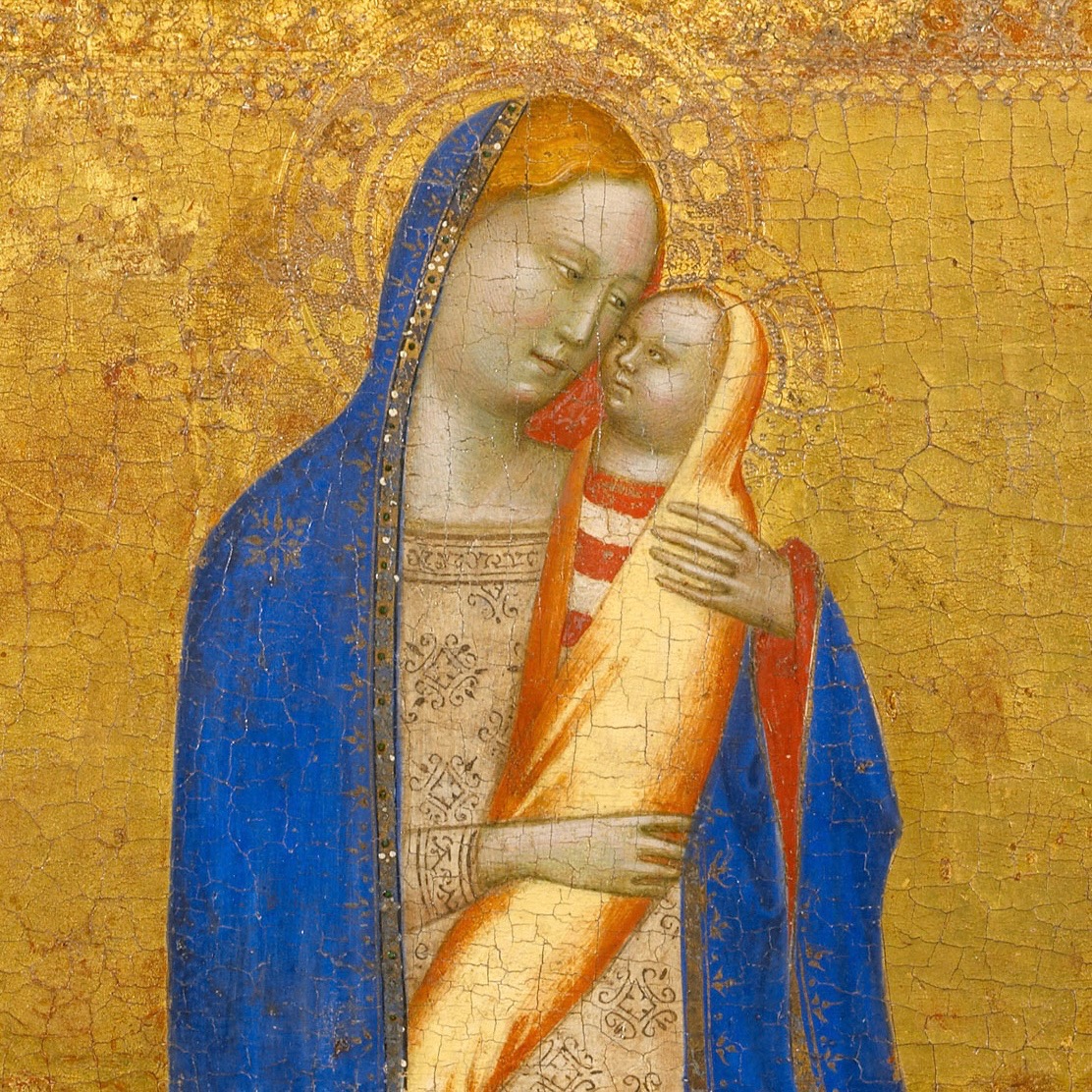
Bernardo Daddi, “Madonna and Child with Four Angels,” Central Predella panel from the San Giorgio a Ruballa Alterpiece, 1348, tempera and gold on panel, private collection
Now, for its twentieth anniversary year, the Neue Galerie reveals the continued evolution of the Lauder Collection, including masterworks of Greek and Roman sculpture, Italian thirteenth and fourteenth-century gold-ground paintings, objects for a Kunstkammer, and Austrian and German painting, sculpture, and decorative arts from the early twentieth century.
With a focus on important additions to the core collection, as well as new areas of inquiry, the exhibition conveys the collector’s commitment to excellence across a broad spectrum of art. Displayed throughout the museum’s two gallery floors, the exhibition situates these works in domestically scaled settings similar to how they appear in Lauder’s own home.
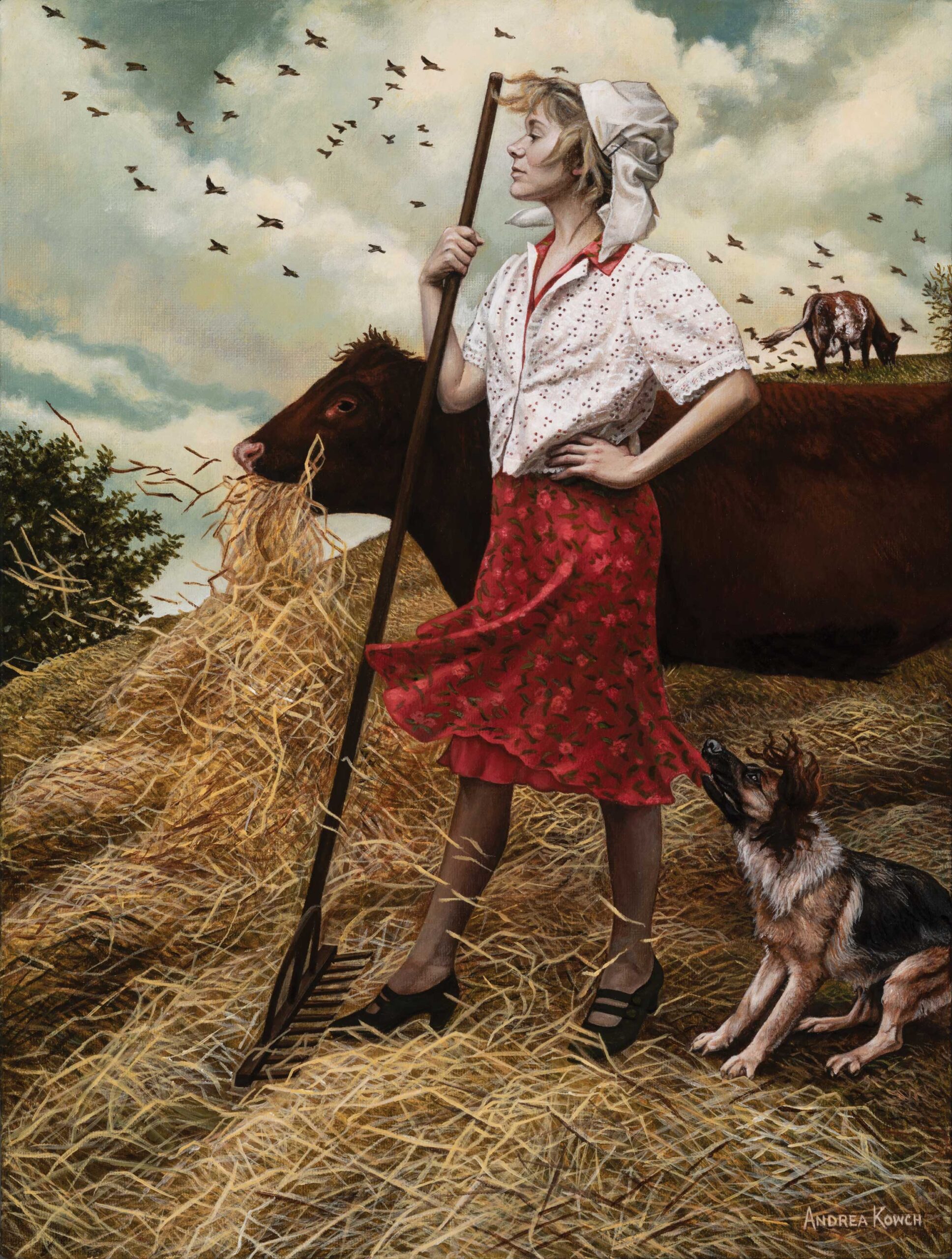
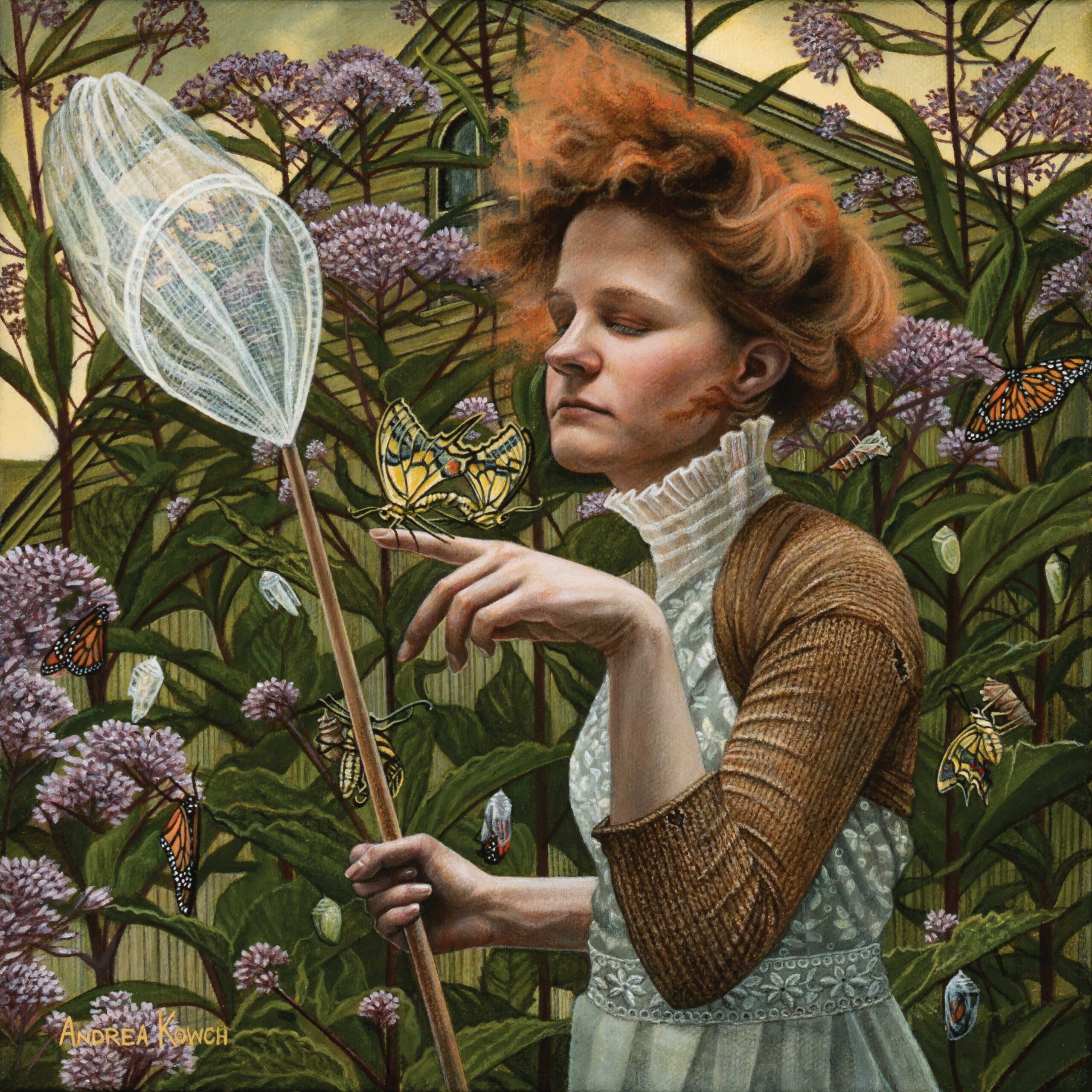
Realism Art on View > Andrea Kowch: Mysterious Realms
Museum of Art – DeLand DeLand, Florida moartdeland.org
Through April 9, 2023
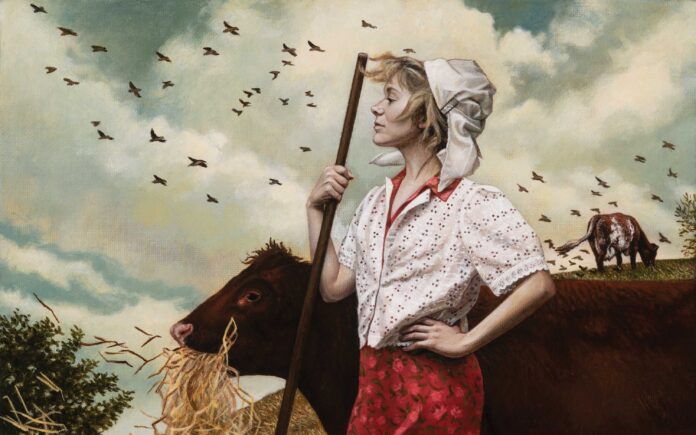
Andrea Kowch, (b. 1986), “Steadfast,” 2019, acrylic on canvas, 16 x 12 in., private collection
Florida’s Museum of Art – DeLand is now showing the solo exhibition “Andrea Kowch: Mysterious Realms,” which features more than 60 paintings and works on paper. This marks a rare opportunity to see Kowch’s art in depth because most of her works are sold even before she completes them. The show has been organized by curator Tariq Gibran and its catalogue’s lead essay penned by one of the artist’s most enthusiastic collectors, Steven Alan Bennett.
Born in Detroit, Kowch earned her B.F.A. summa cum laude at that city’s College for Creative Studies, where she has since taught as an adjunct professor. She has won renown for meticulously composed and painted scenes of figures — usually young women — in familiar yet dreamlike settings that suggest a story is unfolding, without telling us exactly what or how. This allegorical ambiguity allows viewers to make up their own narratives, or more likely just let Kowch’s uncanny, vaguely melancholy mood cast its spell.
Inspired by historical sources as diverse as Northern Renaissance painting and Midwestern regionalism, Kowch sets her puzzles in landscapes that suggest — without specifying — the countryside and vernacular architecture of her native Michigan. Some observers have associated her unique take on magical realism with “Prairie Gothic” (think Grant Wood), and indeed her scenes do reflect a mix of the banality and enchantment those two words evoke. There is more to her art than that, so seeing over 60 examples up close will surely intrigue the museum’s visitors this season.
In addition, several of Kowch’s works will be seen in Georgia this September as part of the group exhibition “Big Stories” at Columbus State University’s Bo Bartlett Center.
Andrea Kowch, “Expectation,” 2019, acrylic on canvas, 10 x 10 in., private collection
Fill your mind with useful art stories, the latest trends, upcoming art shows, top artists, and more. Subscribe to Fine Art Today, from the publishers of Fine Art Connoisseur magazine.